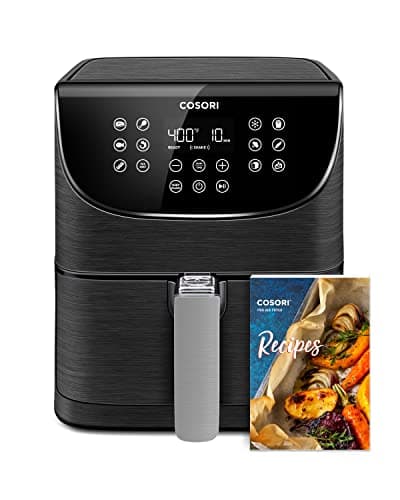
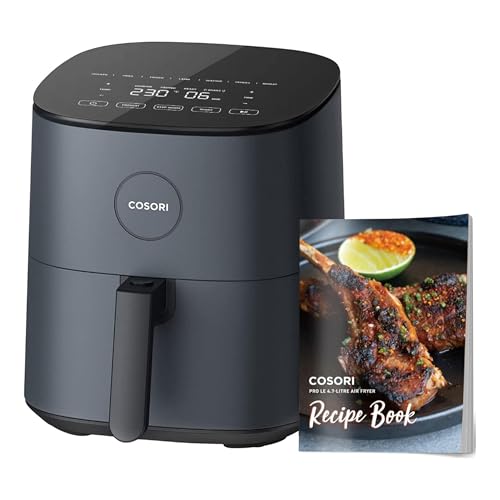
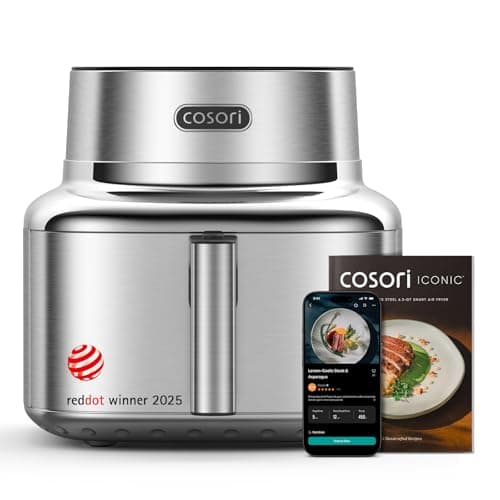
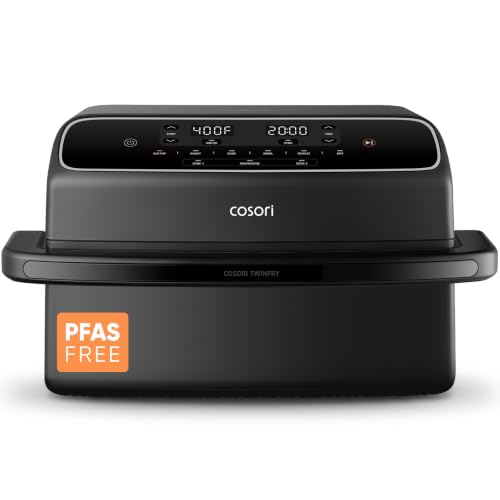
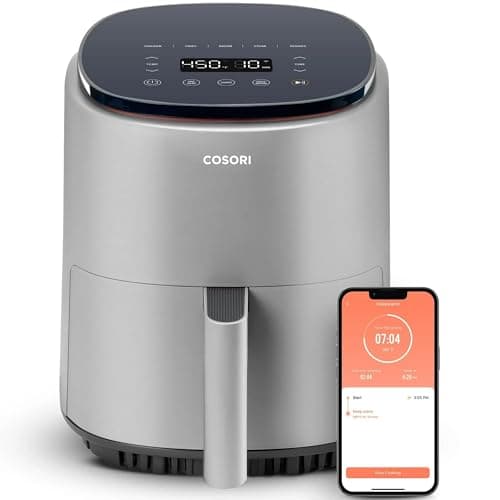
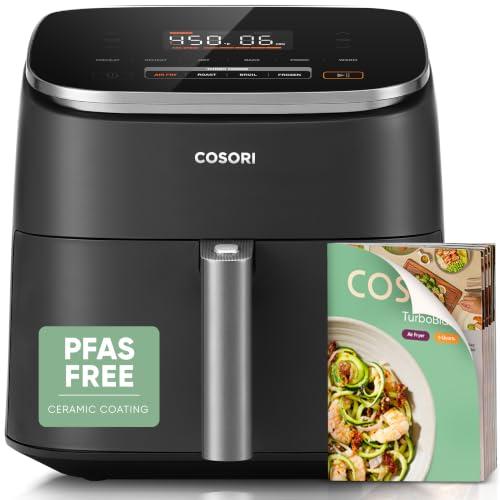
Buy the Cosori TurboBlaze 6 Qt. Six quarts, a PFAS-free ceramic basket rather than PTFE, a published 90°F to 450°F range and a fan that runs quieter than most of the category — which is why it also wins our quiet roundup. It suits two to four people who would rather not have a coating question. The budget pick is the Cosori Pro Gen 2 5.8 Qt: the cheapest Cosori that does the job properly, a square basket that fits more flat food than a round one of the same volume, with PTFE nonstick as the thing you give up. If you want to buy once and keep it, the Iconic 6.5 Qt at number four is the only machine here with a published five-year warranty.
The reason to rank Cosori separately from everyone else is that Cosori gives you more to rank on. Most makers in this category publish a ceiling and nothing else. Cosori publishes a floor as well on most models, names its coating material, and prints a wattage on several machines — which means the arithmetic on this page is arithmetic rather than estimation. Where a figure is missing we say so instead of filling it in.
The three figures we ranked on
- The coating, by name. Cosori ships PFAS-free ceramic on the TurboBlaze, the Iconic and the TWINFRY, plain ceramic on the Pro LE, and PTFE nonstick on the Pro Gen 2. That is a real, checkable split inside one brand, and it is the single biggest difference between models that otherwise look alike. The broader materials question is in are ceramic air fryers safe.
- Both ends of the temperature range. Everyone prints a ceiling; the floor is what decides whether a machine can prove dough or dehydrate at all. A published 90°F floor turns a one-job appliance into a three-job one, and three of the picks here have it.
- Usable capacity, not the number on the box. A 5.8-quart square basket holds more flat food than a 6-quart round one, because chips and wings are a plane and a round bucket wastes its corners. We rank the square baskets above their quart figure for that reason.
We have not lab-tested these — how we review says exactly what we did instead. If you are still choosing between brands, Ninja versus Cosori settles it at brand level and TurboBlaze versus the Ninja AF141 settles it at model level, with both wattages published so the running costs can actually be compared.
Weighing the brand against the rest of the field? Cosori air fryer alternatives matches each machine above to the one that answers it — the glass Ninja that removes the coating question outright, the Chefman that makes the same PFAS-free ceramic claim and publishes a wattage, and the cheaper options, with what each swap costs you.
The coating split inside one brand
This is the thing worth taking away from a Cosori lineup page, because no other maker gives you this much to work with. Three machines here ship a basket Cosori describes as PFAS-free ceramic — the TurboBlaze, the Iconic and the TWINFRY. One ships a basket Cosori describes simply as ceramic, the Pro LE, and we keep that distinction because the company itself does. One ships PTFE nonstick, the Pro Gen 2, and it is the cheapest. The Lite 4.0 sits at the budget end of the range on materials too.
If the coating is why you are looking at Cosori at all, that ordering is your shopping list and the TurboBlaze is the cheapest machine on it. If it is not, the Pro Gen 2 is the better buy and you should feel nothing about it. What we will not do is tell you ceramic lasts longer than PTFE, because the available evidence runs the other way: ceramic is easier to clean and no more scratch-resistant, and heavy users report it giving up sooner.
What a Cosori costs to run, where Cosori prints the number
Two picks here publish a wattage: the Pro LE at 1,500 W and the Iconic at 1,725 W. Divide by capacity and you get 300 and 265 watts per quart respectively — the 6.5-quart machine is the more efficient per quart, which is the opposite of the intuition most people bring to a bigger appliance. In cash, at the U.S. average residential rate, both land inside a cent or two of a dime for a twenty-minute cook. Across a year of cooking four times a week the gap between the thriftiest and thirstiest air fryer we rank anywhere on this site is about three dollars. Put your own rate into the calculator if you pay more than average, but do not let electricity pick your air fryer.
The TurboBlaze, the Pro Gen 2, the TWINFRY and the Lite do not publish a wattage we can cite, so we quote no running cost for them. The rating plate on the underside of each machine carries the real figure once it arrives.
How we picked
We did not lab-test this gear
Everyone in this category says they tested twenty air fryers. We have not lab-tested any of these, and we say so. What we did instead: compiled the published specifications — wattage, capacity, materials — worked out what each machine actually costs to run at the national electricity rate, read the manuals and owner reviews, and scored each one against a published rubric. The scores are judgments from documented research — not measurements we took, because we do not have a lab and we will not pretend we do. Where a number came from someone else's work, we name them in Sources.