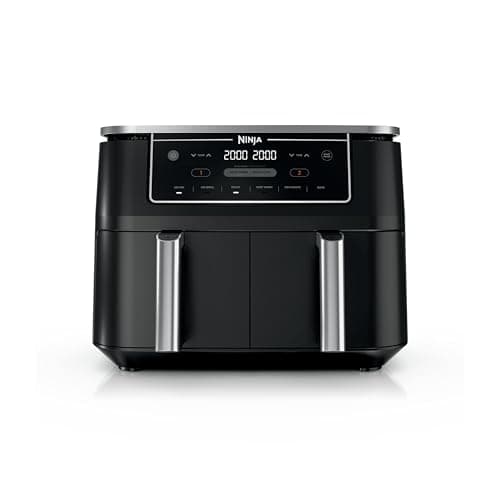
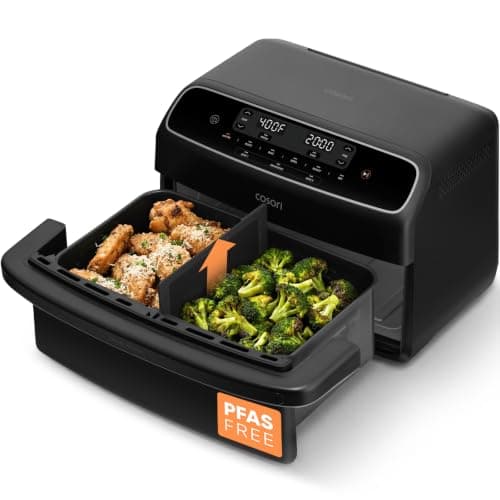
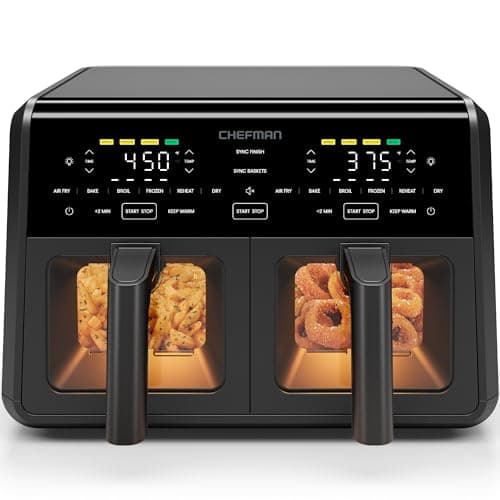
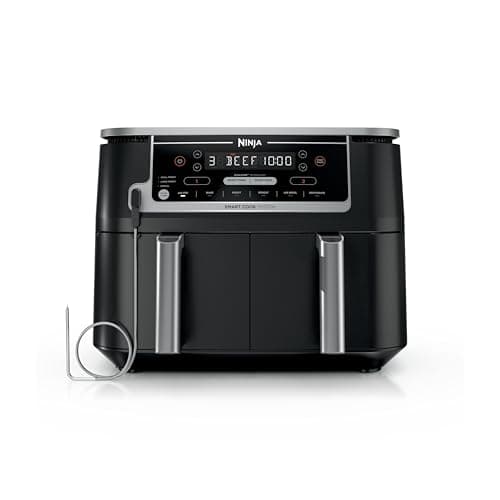
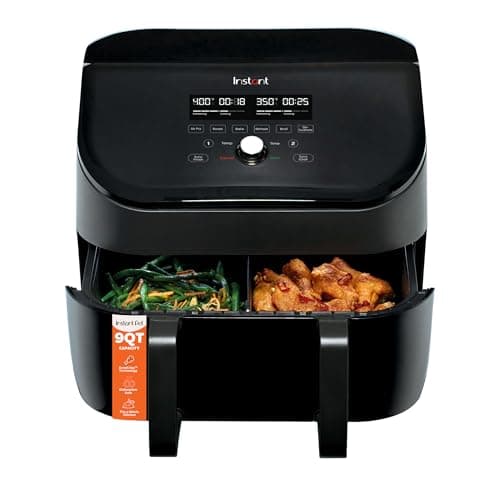
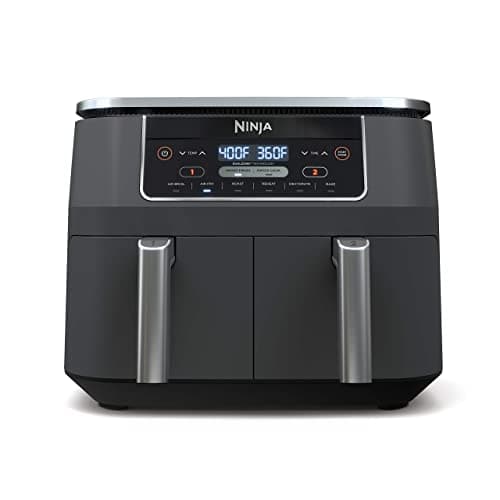
Dual-basket air fryers are the most genuinely useful development this category has had in years, and they are almost always sold on the wrong number. The headline is total capacity — 8 quarts, 9 quarts, 10 quarts — when the thing that actually determines whether the machine works for you is the size of each individual zone, and whether the machine can sync them.
So that is how these are ranked. A 10-quart machine with two 5-quart baskets is a substantially more capable object than an 8-quart one with two 4-quart baskets, even though the difference on the box looks like two quarts. Each zone in the first can do what an entire standard air fryer does; each zone in the second is a compact machine.
Before you commit to the format at all, be clear about the trade: two 5-quart compartments will not take a whole chicken, where a single 8-quart basket will. If large single items are your use case, you want the large single-basket picks instead. Our single vs dual basket comparison works the decision through properly.
Judge the zone, not the total
The number that matters is what one basket holds, because that is the largest thing the machine can cook. Divide the headline capacity by two and shop on that figure. Two 4-quart zones suit a household of three or four; two 5-quart zones suit four or five. Anything bigger than a single zone — a whole bird, a large joint — needs a single-basket machine or a machine with a removable divider.
Syncing is the actual feature
Without syncing, a dual-basket machine is just two air fryers sharing a plug, and you are back to doing timing arithmetic in your head. The sync functions — Ninja calls them Smart Finish and Match Cook, Cosori calls them Sync Finish and Sync Cook — are what convert the format from “more space” into “a finished meal.” Check any machine you are considering has both: one to end two different cooks together, one to copy settings across for a double batch of the same thing.
The removable divider changes the calculation
Two machines here — the Cosori TWINFRY and the Instant VersaZone — let you take the divider out and use the whole space as one. That directly answers the strongest argument against the format, which is that no compartment is big enough for a large single item. If you are torn between a dual machine and a big single basket, a convertible machine is the honest resolution, and it is worth paying a little more for.
Counter space, realistically
Every machine on this page is wide, because two baskets side by side has to be. Width is also the dimension most kitchens have least of. Measure the free run of counter before ordering, and remember these need clearance behind them for the exhaust as well. A dual-basket machine that has to live in a cupboard between uses will not get used — the format only pays off if it stays out.
Two baskets, twice the washing-up
This is the honest daily cost, and it is worth weighing before you buy. Two baskets and two crisper plates after every meal is a real increase over one, and it is the most common complaint from people who own these machines and use them less than they expected. Check whether the baskets are dishwasher-safe on the model you are considering — most are, but the manual is the authority. Our cleaning guide covers keeping coatings in good condition either way.
Do two zones double the running cost?
No. Both elements cycle to hold temperature rather than running continuously, so two zones cost more than one but nothing like twice as much — and cooking a whole meal in one dual-zone machine uses less energy than running two separate air fryers or heating a full-size oven. Put your machine's plate rating into the running-cost calculator for a real number.
One dual-basket machine is not on this list and is reviewed in full anyway, because it is the one people ask about most after the Ninjas: our Philips 3000 Series dual basket review.
How we picked
We did not lab-test this gear
Everyone in this category says they tested twenty air fryers. We have not lab-tested any of these, and we say so. What we did instead: compiled the published specifications — wattage, capacity, materials — worked out what each machine actually costs to run at the national electricity rate, read the manuals and owner reviews, and scored each one against a published rubric. The scores are judgments from documented research — not measurements we took, because we do not have a lab and we will not pretend we do. Where a number came from someone else's work, we name them in Sources.