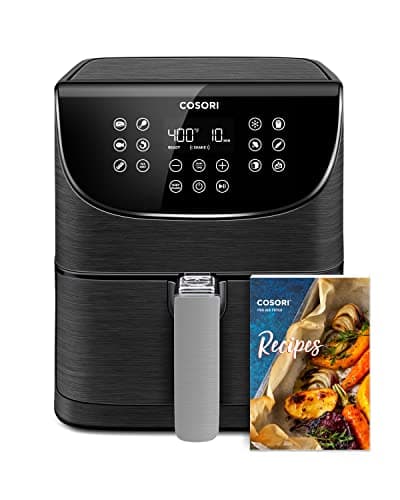
The Cosori Pro Gen 2 is the air fryer we recommend to people who want the job done and don't care what the machine looks like on the counter. It is not exciting. It has no window, no app worth using, and a design that could be any appliance from the last decade. It also does everything the more famous machines do, for less money, more often than not.
The one genuinely clever thing about it is the basket shape. Most air fryer baskets are round or heavily rounded; this one is square. Volume for volume, a square basket holds more flat food — more chips in one layer, more fish fillets, more chicken thighs without overlapping. Since overcrowding is the single biggest cause of soggy air-fryer food, that shape is worth more in practice than another two hundred watts.
It is the value pick in our best air fryers roundup and leads the budget roundup.
Why the square basket matters more than the spec sheet suggests
Air fryers cook by moving hot air around food. The moment pieces overlap, the air can't reach the covered surfaces and you get steaming instead of crisping. That is why “don't overcrowd the basket” is the first rule in every guide, including ours. A square basket gives you more usable flat area for the same stated quarts, which means more food in a single layer and fewer batches. It is an unglamorous design decision that does more for your dinner than most of the features manufacturers advertise.
Who it's for
Households of two to four who cook a lot of flat food — chips, wings, fillets, halloumi, roasted vegetables — and would rather put the money saved into groceries. It is also the machine we suggest to people buying their first air fryer on a budget, because nothing about it is confusing and there is very little to go wrong.
Who should skip it
If the nonstick coating is a dealbreaker, skip it: this is a standard PTFE basket, and your options are the glass Ninja Crispi or the ceramic Cosori TurboBlaze, both in our non-toxic roundup. If you want to watch food without opening the drawer, the Instant Vortex Plus ClearCook has the window. And if you cook for five or more, size up to the large picks.
Running cost
Cosori does not print a wattage on the Pro Gen 2's public specification sheet, so we won't state one. For context, machines of this size typically draw somewhere between 1,500 and 1,700 watts, which puts a 20-minute cook in the seven-to-nine-cent range at the national average rate — a few dollars a month for regular use, and far less than heating a full-size oven for the same food. The plate on the underside of your unit carries the real figure; drop it into the running-cost calculator for your own number.
Living with it
The shake reminder is the feature people end up appreciating most: a prompt part-way through the cook to toss the basket, which is exactly when most of us forget. The basket is dishwasher-safe, though a soak and a soft brush keeps the coating in better condition over years — the same advice as our cleaning guide. There is no window, so you will pull the drawer to check progress; the machine pauses when you do and resumes when it goes back in, which is the correct behavior and not a fault.
What the missing wattage means for running cost
One consistent frustration with Cosori across its range is that consumer specification sheets rarely print a wattage. Ninja does on several models, which is why we can state the AF141's running cost precisely and cannot state this one's. We are not going to fill that gap with an estimate dressed up as a fact.
What you can do instead takes ten seconds: the rating plate on the underside of the unit carries the real figure. Machines of this size generally land between 1,500 and 1,700 watts, which would put a twenty-minute cook somewhere around seven to nine cents at the national average residential rate — a few dollars a month for regular use. Once you have the plate reading, our running-cost calculator converts it into a number for your own tariff rather than a national average.
How it ages
The component that determines this machine's lifespan is the basket coating, as it is on every PTFE air fryer. Treated well — soaking rather than scrubbing, soft sponges, no aerosol cooking sprays — it will outlast the rest of the appliance comfortably. Treated badly it will be flaking inside a year, and a flaking basket is the end of the machine rather than a cosmetic problem. Our cleaning guide covers the specifics, including the aerosol-spray issue that quietly ruins more coatings than scouring does.
Worth checking before you buy, on this or anything else in the category: whether the maker sells replacement baskets. A machine whose basket can be renewed for a small sum is a very different long-term proposition from one that becomes scrap when the coating goes. It is one of the criteria in our brand guide, and it matters more than most of the features on the box.
Alternatives worth a look
The Ninja AF141 is the better-known machine at a similar size and frequently a similar price — pick it if you prefer Ninja's control layout, or if a printed wattage matters to you. The Chefman TurboFry 8 Qt gets you family capacity for not much more, at the cost of some refinement. If you want a window, the Instant Vortex Plus ClearCook is the one to look at. All of them sit alongside this one in the main roundup, and the Ninja vs Cosori comparison settles the brand question if that is where you are stuck.