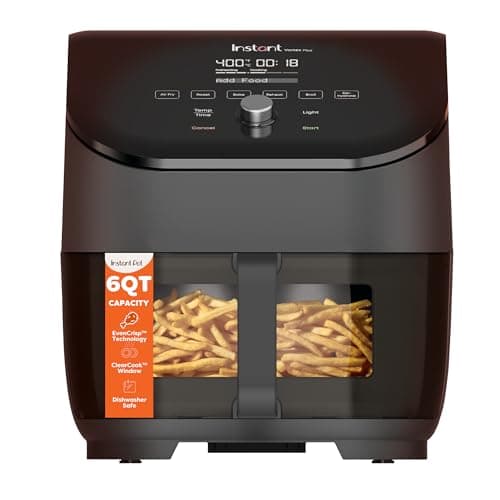
Every air fryer asks you to cook blind. You set a time based on a chart or a guess, and then you pull the drawer out every few minutes to see how it is going — which drops the temperature and slows the cook every time you do it. The ClearCook's answer is obvious in hindsight: put a window in it and a light behind the window.
It sounds like a feature invented by a marketing department. In practice it is the single most useful thing you can give somebody who is still learning how their machine behaves, because air-fryer timings vary enormously with the food's thickness, moisture and how full the basket is. Being able to look is worth more than another preset.
It sits in our best air fryers roundup and our beginner picks for exactly that reason.
Why the window is more than a novelty
Opening an air fryer mid-cook is not harmless. The basket is small and the air inside it is the entire cooking environment, so pulling the drawer dumps that heat and the machine spends the next minute or two getting back to temperature. Do it three or four times in a twenty-minute cook and you have meaningfully changed the result. A window lets you check as often as you like at zero cost, which matters most in the first few weeks when you have no instinct yet for how your machine handles a given food.
Who it's for
Beginners, and anyone who cooks a wide variety of foods rather than the same three things. If your air-fryer use is mostly “whatever is in the fridge,” you are constantly working without a reliable time, and the window converts that from guesswork into observation. It is also genuinely good for cooking with children in the kitchen — they can watch without anyone opening a hot drawer.
Who should skip it
People who cook the same handful of foods on repeat. Once you know that your fries take eighteen minutes and your wings take twenty-two, the window stops earning its keep, and the Cosori Pro Gen 2 does the same cooking for less. Skip it too if you want dual zones — look at the Ninja DZ201 — or if you are avoiding nonstick coatings, in which case see the non-toxic roundup.
The cleaning trade-off nobody mentions
A window is only useful while it is clear. Grease spatters onto the inside of it exactly as it does onto every other interior surface, and a hazy window is a worse version of no window at all because you will still try to use it. This is not a reason to avoid the machine — it is a reason to wipe the glass when you wipe the basket, which takes about ten extra seconds. Our cleaning guide covers the routine that keeps it usable.
Running cost
We do not have a manufacturer-published wattage for this exact model, so we do not quote one. Six-quart machines generally sit in the 1,500–1,700 watt band, which works out around seven to nine cents for a twenty-minute cook at the U.S. average residential rate. The rating plate on your unit is the authority; our running-cost calculator turns it into a real number for your tariff.
Six quarts, and who that actually suits
Six quarts puts this a step above the 5-quart machines that dominate the category, and the extra quart is more useful than it sounds — it is roughly the difference between a family side dish that fits in one layer and one that needs a shake halfway to stop the edges overlapping. For two to four people it is comfortable. For five it is not, and the honest recommendation there is a dual-zone machine or a large single basket from our large roundup.
What six quarts does not buy you is room for a large single item. Basket machines at this size are wide and shallow rather than tall, so a whole chicken is out regardless of the quart figure. If that is a job you need doing, you are looking at a countertop oven rather than a basket, and our sizing guide covers where that line falls.
Living with the presets
Instant leans on presets more than Ninja does, and they are well judged — but it is worth understanding what a preset actually is, because the marketing implies more than is there. A preset is a saved time and temperature, nothing more. It is a convenience, not a different cooking mode, and you can always override it. The practical value is that Instant's numbers are sensible starting points rather than the optimistic ones some brands ship, so following them tends to produce good results rather than pale food.
Combined with the window, this is what makes the machine forgiving: the preset gets you close, and then you look rather than guess. That combination is why it appears in our beginner roundup as well as the main one, and our cooking-times guide explains how to adjust from a starting point once you can see what is happening.
Alternatives worth a look
For the same money without the window, the Ninja AF141. For a quieter machine with a PFAS-free ceramic basket, the Cosori TurboBlaze. For the cheapest capable machine at a similar size, the Cosori Pro Gen 2, which trades the window for a lower price and a square basket. And for a machine you can see into and that replaces your toaster oven, look at the countertop ovens in our toaster-oven roundup — glass doors are standard there.