Skip to content
Preheat Club

Single reviews · Reviews

Cosori Pro LE 5 Qt review

The cheapest machine we know of with a published noise figure — and a useful case study in reading a manufacturer’s claims rather than a marketplace listing’s.

By Stephen V.Updated How we review
#ad

We earn a commission when you buy through our Amazon links, at no extra cost to you. It never changes a verdict, and we say so when the cheaper product is the better buy. How this works.

The Pro LE is Cosori’s volume machine: a 5-quart basket at a price that undercuts most of what we recommend, from a brand that generally publishes more about its appliances than its rivals do. It is a good air fryer. It is also a useful lesson in where product claims come from, which is the part of this review we would read first.

Cosori’s own product page publishes a rated power of 1,500 watts on AC 120 V, a 5-quart capacity for two to four people, a 90 to 450°F range, a shake reminder, and an AirWhisper noise claim of no louder than 55 decibels. It lists dimensions of 12 by 10.8 by 14.4 inches and a weight of 10 pounds, with a two-year limited warranty. That is a properly specified machine.

What Cosori’s product page does not carry, in the material we read, is a PFAS-free claim for this model — even though retail listings describe a ceramic coating and even though Cosori publishes exactly that claim for its TurboBlaze and Iconic. We think that distinction matters, and we would rather flag it than round it up.

01
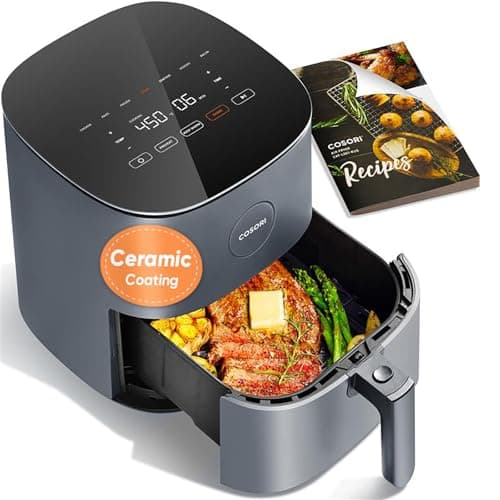
Cosori Cosori Pro LE 5 Qt (Ceramic)

Two to four people who want Cosori specification at a lower price

Cosori Pro LE 5 Qt (Ceramic)

5 qt1,500 W90°–450°FPublished ≤55 dB
7.8/10

A properly specified 5-quart machine at a price that undercuts most of what we recommend: 1,500 watts, a genuinely wide 90–450°F range, a shake reminder, and one of the few published noise figures in the category at no louder than 55 dB. Buy it as a value machine rather than as a non-toxic one — Cosori publishes the PFAS-free claim for its TurboBlaze and Iconic, not for this model.

Value
9
Crisping
8
Noise
8
Capacity
8
Materials
6

Pros

  • Published noise figure — almost nobody else in this category gives one
  • 90°F low end makes proofing and dehydrating genuinely usable
  • 1,500 W published, so running cost is arithmetic rather than a guess
  • Shake reminder, which sounds trivial and materially improves chips
  • 10 lb and 12 in wide — easy to move and to store

Cons

  • Cosori does not publish a PFAS-free claim for this model as it does for others
  • Two-year warranty against five on the Iconic
  • AC motor with a single fan speed, unlike the TurboBlaze
  • 5 quarts is right for two to four and tight for five

Don't buy this if…

the coating is the reason you are shopping — buy the TurboBlaze, where Cosori publishes the PFAS-free claim in writing.

$89.96View on Amazon

$99.9910% off

Price as of Aug 19, 2026. Prices change — Amazon's at checkout is the one that counts.

#ad · we may earn a commission from this link to Cosori Pro LE 5 Qt (Ceramic)

The coating question, handled properly

This model appears in our non-toxic air fryers roundup as a ceramic option, and this review is where we tighten that. Cosori’s own product page for the Pro LE publishes the wattage, the temperature range, the noise claim and the warranty — and no PFAS-free statement. The company does publish that claim, explicitly, for the TurboBlaze and the Iconic. Retail listings for the Pro LE do describe a ceramic coating.

Our position is the conservative one: buy on claims the manufacturer makes, not on claims a marketplace listing makes. If avoiding the PFAS family is your actual reason for shopping, buy the TurboBlaze or the Iconic, where the claim is Cosori’s own. If you simply want a good 5-quart machine at a keen price, none of this should stop you — and the wider brand-by-brand picture is in which air fryer brands are actually non-toxic.

A published noise number, which almost nobody gives you

Cosori states that AirWhisper keeps the Pro LE no louder than 55 decibels. We have said repeatedly in our quietest air fryers roundup that we will not rank machines on decibel figures, because manufacturers do not publish the measurement distance or the fan setting and the numbers are therefore not comparable. That caveat applies here too. What is worth something is that Cosori publishes a figure at all, and commits to a ceiling — that is more accountability than a page of adjectives.

Mechanically, this is an AC-motor machine with one fan speed, unlike the DC-motor TurboBlaze with five. If quiet is genuinely a priority — an open-plan kitchen, a sleeping baby — the TurboBlaze is the machine, and the reason is hardware rather than marketing.

1,500 watts, and what it costs

At 1,500 watts, a 20-minute cook is 1.5 × 0.333 = 0.5 kWh, roughly nine cents at the US average residential rate. That is the number the whole site is built around publishing, and you can put your own utility rate into the calculator on what an air fryer costs to run. It also draws about 12.5 amps at 120 volts, which is comfortably inside a 15-amp circuit but still deserves an outlet of its own rather than a shared power strip.

The 90°F low end is the sleeper feature

Most air fryers start around 170 or 200°F, which is fine for cooking and useless for anything else. A 90°F floor turns the machine into a proofing box for bread dough and a genuine dehydrator for fruit, herbs and jerky. If you will use either, this specification is worth more than a quart of extra capacity — and it is one of the few places where a mid-priced machine out-specs expensive ones.

Who should buy it

Two to four people who want a well-specified machine and would rather keep the difference. It is the machine we would recommend to someone buying their first air fryer on a budget who does not want the compromises of the genuinely cheap end — that field is in best budget air fryers, and the Pro LE sits a clear step above it. Skip it if quiet matters, if the coating claim is the point, or if you are cooking for five, where large air fryers is the right page.
How we picked

We did not lab-test this gear

Everyone in this category says they tested twenty air fryers. We have not lab-tested any of these, and we say so. What we did instead: compiled the published specifications — wattage, capacity, materials — worked out what each machine actually costs to run at the national electricity rate, read the manuals and owner reviews, and scored each one against a published rubric. The scores are judgments from documented research — not measurements we took, because we do not have a lab and we will not pretend we do. Where a number came from someone else's work, we name them in Sources.

Questions

Frequently asked

Is the Cosori Pro LE PFAS-free?
Cosori does not publish that claim for this model in the material we read, although it does for the TurboBlaze and the Iconic. Retail listings describe a ceramic coating. If avoiding the PFAS family is why you are shopping, buy a model where the manufacturer makes the claim itself — see which air fryer brands are actually non-toxic.
How many watts is the Cosori Pro LE?
Cosori publishes 1,500 W on AC 120 V. A 20-minute cook is about 0.5 kWh — roughly nine cents at the US average residential rate — and it draws around 12.5 amps. Your own figure comes out of our running-cost calculator.
Is the Pro LE quiet?
Cosori claims no louder than 55 dB, which is one of very few published figures in this category. We do not rank on decibels because nobody publishes the measurement conditions — see quietest air fryers — and mechanically this is a single-speed AC machine, so the DC-motor TurboBlaze is the genuinely quieter option.
Cosori Pro LE or TurboBlaze?
TurboBlaze if you want the published PFAS-free coating claim, the DC motor and five fan speeds. Pro LE if you want most of the machine for meaningfully less money. Both are Cosori, both are well specified — see the TurboBlaze review.
What does the 90°F setting do?
It makes proofing and dehydrating real. Most machines start at 170°F or higher, which is too hot to prove dough and too hot to dry fruit or herbs properly. A 90°F floor is a genuinely useful specification that expensive machines often do not match.

Keep reading

Receipts

Sources

We do not run a testing lab, and we do not pretend to. Where a measured number came from someone else's work, we name them and link them. Where we could not verify something, we say so on the page rather than quietly leaving it out. Read our full method.