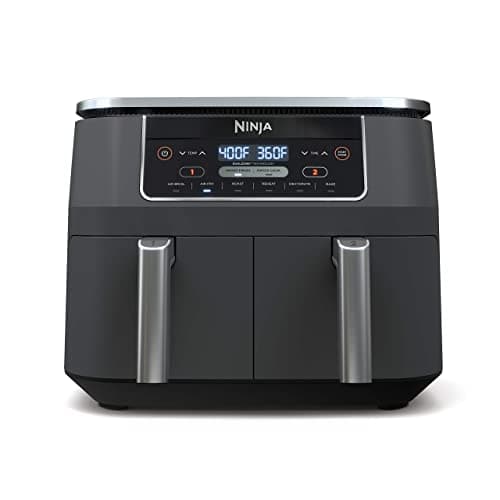
Almost every complaint about air fryers comes back to one thing: the basket is too small, so dinner happens in shifts. The DZ201 is Ninja's answer, and it is a genuinely good one. Two completely independent 4-quart baskets sit side by side, each with its own heating element and fan, so you can run fries at 400°F in one and chicken at 375°F in the other and have both land at the same moment.
That last part is the feature that matters. Plenty of large air fryers give you more space; very few give you two separate cooking environments. If you have ever stood in a kitchen keeping half a meal warm while the other half cooks, you already understand what you are paying for here.
It is our family pick in the best air fryers roundup, and it anchors the dual-basket roundup. Here is the honest case for and against it.
Who it's for
Households of three to five who regularly cook a protein and a side at the same time. That is the specific job this machine does better than anything near its price. A weeknight of chicken thighs and potatoes stops being a scheduling exercise and becomes one press of a button. It also suits anyone who cooks for people with different needs — one basket vegetarian, one not — without cross-contact or a second appliance.
Who should skip it
Two groups, clearly. If you cook for one or two, the second zone is dead weight: the Ninja AF141 gives you a 5-quart basket for less money and less counter. And if what you actually need is room for one large item — a whole chicken, a full tray of vegetables — this is the wrong shape of machine. Two 4-quart baskets are not the same as one 8-quart basket. A single-basket 8-quart like the Chefman TurboFry or a countertop oven is the better answer there. We work through that trade-off in single vs dual basket.
The counter-space problem, honestly
This is the part product pages skip. Two baskets side by side means a wide machine, and it needs clearance behind it for the exhaust as well. Before you buy, measure the run of counter you intend to give it and check it clears your upper cabinets. Plenty of returns on machines in this class are not performance problems — they are people discovering the thing does not fit where they imagined it. If your counter is tight, a taller single-basket machine with a smaller footprint is the more practical buy even if the total capacity is lower.
What Smart Finish and Match Cook actually do
Two buttons carry most of this machine's value, and their names do them no favors. Smart Finish lets you set each basket independently and then holds the shorter cook so both finish together — the machine works out the delay. Match Cook does the opposite: it copies one basket's settings to the other, so a double batch of the same food is one press instead of two. Neither is a gimmick, and together they are the reason to choose this over two cheap air fryers, which cannot coordinate at all.
Running cost
Ninja does not print a wattage for the DZ201 in its published specifications, so we don't quote one — inventing a number here would be exactly the thing this site exists not to do. What we can say is the shape of it: air fryers in this class draw roughly 1,400–1,800 watts, which puts a 20-minute cook in the region of seven to nine cents at the U.S. average residential rate. Running both zones does not double that in practice, because the two elements cycle rather than both running flat out. Put your own machine's plate rating and your own tariff into our running-cost calculator for a figure you can trust.
Alternatives worth a look
Want the same idea with more room? The 10-quart DZ302 and the smart-enabled DZ550 are the bigger siblings, both in the dual-basket roundup. Want dual zones without the nonstick coating? Cosori's TWINFRY uses a PFAS-free ceramic finish and appears in our non-toxic picks. Want to spend less and accept batch cooking? The Cosori Pro Gen 2 is the value single basket.
How we picked
We did not lab-test this gear
Everyone in this category says they tested twenty air fryers. We have not lab-tested any of these, and we say so. What we did instead: compiled the published specifications — wattage, capacity, materials — worked out what each machine actually costs to run at the national electricity rate, read the manuals and owner reviews, and scored each one against a published rubric. The scores are judgments from documented research — not measurements we took, because we do not have a lab and we will not pretend we do. Where a number came from someone else's work, we name them in Sources.