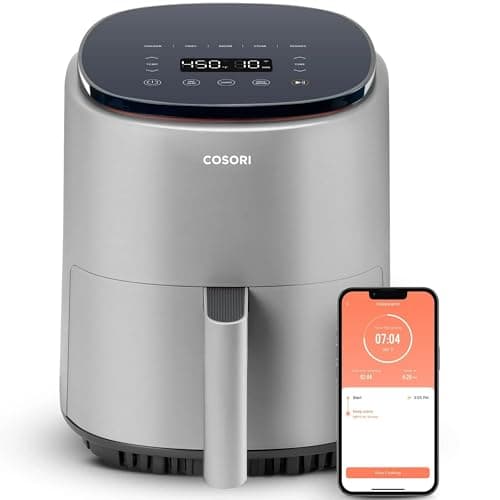
Cosori does something on this product listing that almost nobody in the category does: it states, plainly, that the machine is designed for one to three people. That single sentence is worth more to a buyer than the entire feature list, because oversold capacity is the most common cause of an air fryer being abandoned — and it is the reason we like this machine more than its specification sheet alone would justify.
The Lite 4.0 is a 4-quart, seven-function compact with Wi-Fi and an app carrying a large recipe library. It sits in an awkward part of the market: bigger than the tiny sub-$50 machines, smaller than the 6-quart mainstream, and connected in a category where connectivity is usually decoration. This review works out where it genuinely fits, and it is a narrower slot than the marketing implies — but a real one.
What the app actually does — and does not
Cosori's app gives you three things: remote start and monitoring, cook scheduling, and a library of over 150 recipes that can push a time and temperature to the machine. The first two are genuinely useful in a specific situation — a small kitchen you are not standing in, in a flat where the machine is in the corner of a living space. The third is the feature on the box and the one you will use twice, because the difficult parts of cooking are shopping, prepping, and judging doneness, none of which an app does. We make the same argument across the whole category in the smart air fryer roundup.
The important check, which we ran before recommending it: the machine has full physical controls and works normally with no network and no account. Connectivity here is additive, not a dependency. That is the bar any connected appliance should clear.
Four quarts for three people is optimistic
We rate Cosori highly for stating a people-count at all, but we would put the honest ceiling at two adults, or three if the air fryer is producing one component of the meal rather than the whole thing. Usable capacity in any air fryer is about two-thirds of the rated volume, because food needs to sit in a single layer for the air to reach every surface. Overcrowding a 4-quart basket to feed three is exactly the mistake that produces the complaint in air fryer not crisping. If you are near the line, size up.
Running cost, worked out
Compact air fryers are the cheapest thing in this category to run, and the reason is straightforward: less air to heat, less time to do it. Machines in this class draw around 1,200 to 1,500 watts, which puts a twenty-minute cook at roughly seven to eight cents at the U.S. average residential rate, and a quick reheat at two or three. Set against a full-size oven doing the same job, the gap is substantial — an oven has to heat a cavity ten times the size before it does any cooking. Our running-cost calculator takes your own utility rate if you want the exact figure rather than the national average.
Where it sits against its obvious rivals
Against the Ninja AF101: similar capacity and price, with the Ninja winning on temperature range and the Cosori winning on the square basket and the app. Against Cosori's own TurboBlaze: no contest on hardware — the TurboBlaze has the DC motor, the fan speed control, the PFAS-free ceramic and half again the capacity — but it costs meaningfully more and takes more counter. Against the sub-$50 tier: the Lite is worth the step up, because the cheapest machines have baskets small enough to be genuinely limiting and fans loud enough to be genuinely annoying. That comparison is laid out in the budget roundup.
Who should skip it
Anyone cooking for four. Anyone who wants nothing to do with an app or an account, since a chunk of what you are paying for is connectivity — the compact machines in our small air fryer roundup cover that case. And anyone for whom noise is a deciding factor: this tier of Cosori hardware does not have the DC motor and selectable fan speeds that make the TurboBlaze the pick in our quiet air fryers roundup.
How we picked
We did not lab-test this gear
Everyone in this category says they tested twenty air fryers. We have not lab-tested any of these, and we say so. What we did instead: compiled the published specifications — wattage, capacity, materials — worked out what each machine actually costs to run at the national electricity rate, read the manuals and owner reviews, and scored each one against a published rubric. The scores are judgments from documented research — not measurements we took, because we do not have a lab and we will not pretend we do. Where a number came from someone else's work, we name them in Sources.