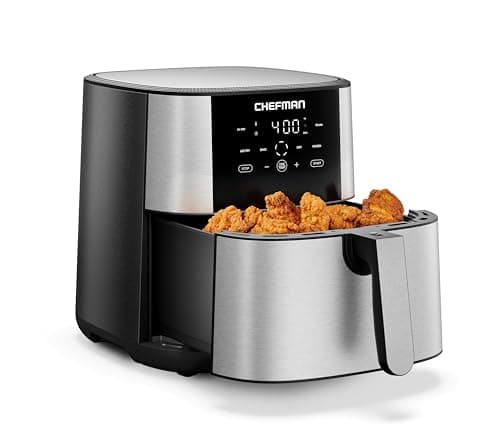
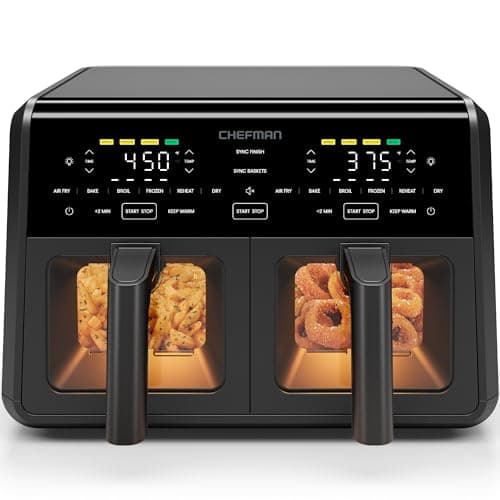
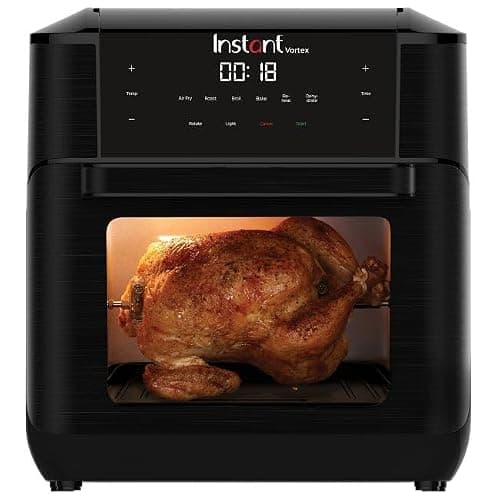
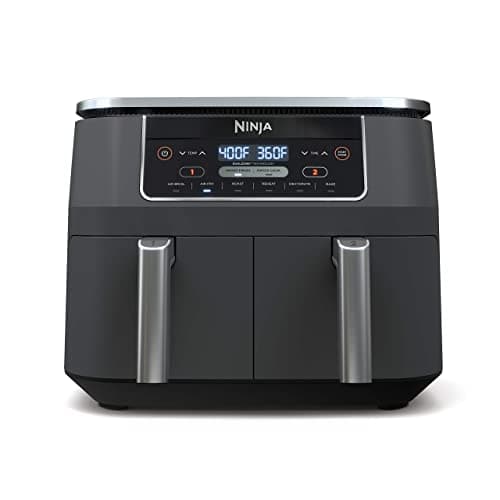
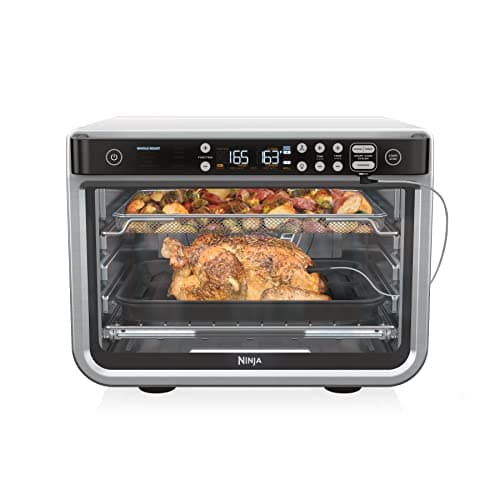
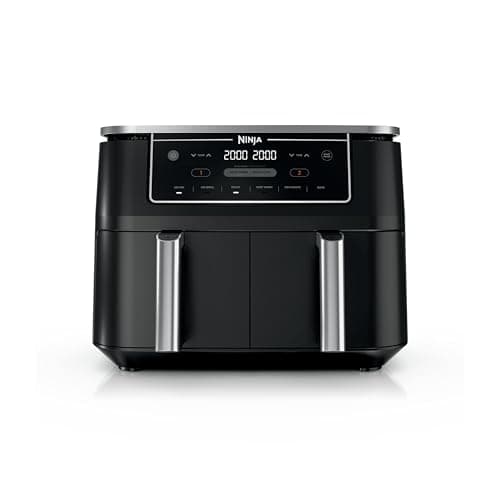
“Large air fryer” covers three genuinely different machines, and the number on the box will not tell you which one you are looking at. A 10-quart dual-basket gives you two 5-quart compartments. A 10-quart single basket gives you one big space. A countertop oven gives you racks. All three are sold as ten quarts; none of them can do the others' job.
So the first question is not how many quarts but what shape. If you cook complete meals — a protein and a side that want different temperatures — you want two zones. If you cook large single items, a whole chicken or a full tray, you want one big basket or an oven. Get that backwards and the capacity number will be right while the machine is wrong, which is the most common expensive mistake in this category. We work through it in single vs dual basket.
Everything below is ranked with that in mind, and each entry says which of the three problems it solves. If you are not sure you need this much machine, check the sizing guide first — large air fryers take real counter space and there is no prize for over-buying.
Read the capacity number carefully
This is the single most useful thing on the page, so it is worth repeating plainly. A dual-basket machine's headline capacity is the sum of two separate compartments. A 10-quart dual machine has two 5-quart spaces and cannot fit anything larger than 5 quarts. A 10-quart single basket has one 10-quart space. Same number on the box, entirely different capability. Decide which shape you need before you compare prices, or you will end up optimizing the wrong variable.
Three formats, three jobs
One big basket — best for large single items and the lowest price per quart. Simplest to load and clean. One temperature at a time.
Two independent zones — best for complete meals on weeknights and for households eating different things. Nothing else finishes two dishes at two temperatures simultaneously. Costs more per quart and doubles the washing-up.
A countertop oven — best for trays, roasts, baking and replacing another appliance entirely. The most versatile and the most demanding of counter space. Our air fryer vs toaster oven comparison covers where the line falls.
Measure twice
Large air fryers fail more often on geometry than on performance. Dual-basket machines are wide; large single baskets are tall; countertop ovens are both. All of them need clearance behind for the exhaust, and the tall ones frequently foul the underside of wall cabinets. Take three measurements before ordering — width of the free counter run, depth including clearance, and height to the cabinet above. It takes two minutes and prevents the most annoying possible return.
Big machines and running cost
Larger air fryers generally draw more power and take longer to preheat, so they sit at the upper end of the category's running cost. That still means cents per cook rather than dollars, and it is still far cheaper than heating a full-size oven for the same food — which is the comparison that actually matters, since a large air fryer is usually replacing oven use rather than small-appliance use. Our running-cost calculator will give you a real number from your machine's plate rating and your own tariff.
Don't over-buy
A large air fryer that mostly cooks small portions is a bad trade: you gave up permanent counter space and you preheat a big cavity for two servings of chips. If your household is two people who occasionally host, the honest recommendation is a 5–6 quart machine from the main roundup plus your existing oven for the rare big job. Buy large because you cook large, not because the discount was good — a point we make on the deals page too.
Three related pages sit next to this one. The machine that made dual-zone the default for families is reviewed in our Ninja DZ401 review, which also explains why it is no longer the one to buy. If the capacity is for feeding a household on weeknights, the same picks are re-sorted for gifters in gifts for busy families. And if what you want from a big machine is a whole chicken rather than a big batch, that is a spit rather than a basket — see the best air fryers with a rotisserie.
How we picked
We did not lab-test this gear
Everyone in this category says they tested twenty air fryers. We have not lab-tested any of these, and we say so. What we did instead: compiled the published specifications — wattage, capacity, materials — worked out what each machine actually costs to run at the national electricity rate, read the manuals and owner reviews, and scored each one against a published rubric. The scores are judgments from documented research — not measurements we took, because we do not have a lab and we will not pretend we do. Where a number came from someone else's work, we name them in Sources.