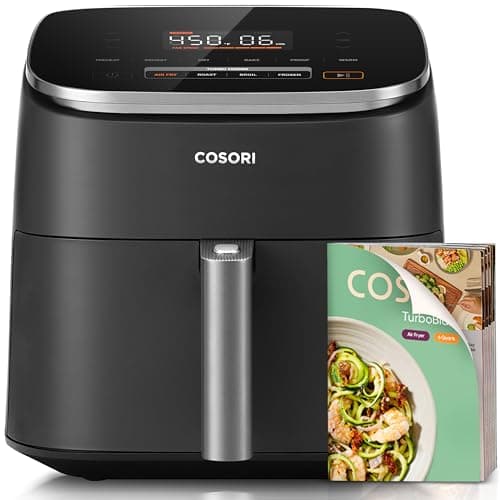
The Cosori TurboBlaze is what you buy when the standard nonstick coating bothers you but you don't want to compromise on capacity or cooking. It pairs a full 6-quart basket with a PFAS-free ceramic coating, a wider 90°–450°F range than most, and a fan that's genuinely quieter than the competition. It earns a place on both our best and non-toxic roundups.
The question this review answers is whether the step up from a workhorse like the Ninja AF141 is worth it. For most people the honest answer is “only if the coating or the noise matters to you” — but for those it does, this is the machine.
Who it's for
Three kinds of buyer should look hard at the TurboBlaze. First, anyone who wants to avoid the PTFE/PFAS family but needs a full-size basket that glass models can't match. Second, people in open-plan kitchens or apartments where a screaming air-fryer fan is a real annoyance — this one is measurably quieter. Third, anyone who dehydrates or cooks low-and-slow, since the range starts at 90°F. If you're one of those, the premium is justified.
Who should skip it
If the coating question genuinely doesn't bother you and you just want great fries for the least money, the Ninja AF141 does the everyday job just as well for less. And if you want the absolute purest coating-free surface rather than PFAS-free ceramic (which is still a coating), the glass Ninja Crispi is the more literal answer — at the cost of capacity.
Running cost
The TurboBlaze sits in the typical air-fryer band — figure a 20-minute cook at around 8–9 cents at the U.S. average electricity rate, the same ballpark as any 1,500–1,700-watt machine. The ceramic coating doesn't change the energy math; it changes what touches your food. Use the calculator with your machine's exact wattage and your rate.
Alternatives worth a look
Want the same PFAS-free ceramic for less? The Cosori Pro LE. Want it in premium stainless? The Cosori Iconic. Want zero coating at all? The glass Ninja Crispi. All three sit alongside the TurboBlaze on the non-toxic roundup, ranked by how honest and complete the material claim is.
Two follow-up questions have pages of their own. Against the machine most people cross-shop it with, see Cosori TurboBlaze vs Ninja AF141. And if this is more machine than you need, the smaller, smart sibling is reviewed in our Cosori Lite 4.0 Qt review.
How we picked
We did not lab-test this gear
Everyone in this category says they tested twenty air fryers. We have not lab-tested any of these, and we say so. What we did instead: compiled the published specifications — wattage, capacity, materials — worked out what each machine actually costs to run at the national electricity rate, read the manuals and owner reviews, and scored each one against a published rubric. The scores are judgments from documented research — not measurements we took, because we do not have a lab and we will not pretend we do. Where a number came from someone else's work, we name them in Sources.