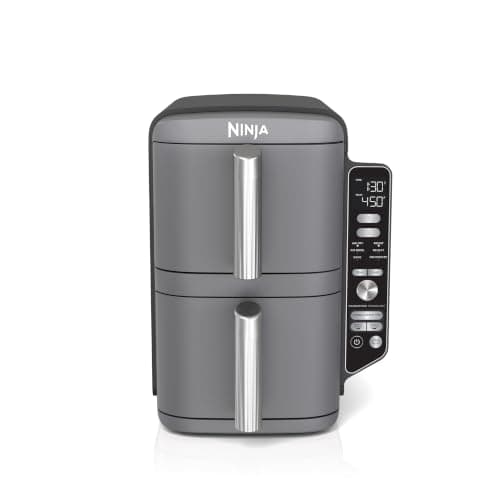
The single biggest objection to a dual-basket air fryer is not the price, it is the width. The Ninja DZ201 and everything like it put two baskets side by side, which means a machine roughly the width of a microwave sitting on your counter permanently. The DoubleStack XL is Ninja's answer: stack the two zones vertically instead, and get 10 quarts into a footprint close to a normal single-basket machine.
It works. That is the headline, and it is not a small achievement — this is the first dual-zone design that a normal galley kitchen can actually accommodate. The question this review answers is what the vertical arrangement costs you, because it is not free, and whether a 10-quart machine is what you needed in the first place. For many households the honest answer is that a 6-quart single basket from the best air fryers roundup does the job for a third of the money.
What stacking actually buys you
A conventional 8-quart dual-basket sits roughly seventeen inches wide. The DoubleStack XL takes those same two zones and puts one above the other, so the machine claims counter width closer to a normal 6-quart while offering more total capacity than the side-by-side design. If your kitchen is a galley, or your counter run is broken up by a sink and a hob, that is the difference between owning a dual-zone air fryer and not. It is the most genuinely useful piece of industrial design in this category in years, and Ninja deserves credit for solving a problem everyone else was ignoring.
What it costs you: height, and zone symmetry
Two honest trade-offs, and both matter. First, you have traded width for height — this machine is tall, and the standard eighteen inches between a counter and the underside of a wall cabinet is not a lot of room once you add the clearance the manual asks for above a running air fryer. Measure vertically before you order, not just the counter depth. Second, the zones are not identical twins. In any stacked heating arrangement the upper and lower positions see slightly different air behavior, and in practice that means the same food in the two zones will not always finish at exactly the same moment. Ninja's finish-together logic compensates for a lot of this, but if you are cooking two identical trays expecting identical results, you will notice.
Running cost, worked out
Ninja does not print a single wattage figure for this model in a form we are willing to quote as fact, so we will not invent one — but a 10-quart two-zone machine sits at the high end of the category, and the honest way to think about it is per-cook rather than per-hour. A typical air fryer cook of twenty minutes costs somewhere around eight to eleven cents at the U.S. average electricity rate, and running both zones costs more than running one, but much less than heating a full-size oven to make the same two dishes. The real economy of a two-zone machine is that it replaces a cook-then-cook-again sequence with a single session. Put your own machine's plate rating into our running-cost calculator for the exact figure.
Who should skip it
Three groups, plainly. One- and two-person households: ten quarts is a lot of machine and money to buy in order to cook two portions, and the compact picks in our small air fryer roundup are a far better fit. Anyone with wall cabinets close over the counter: the whole benefit here is traded for height, and if you do not have the height, you have a large machine and no advantage. People who want two zones cheaply: the side-by-side DZ201 does the same job for meaningfully less, and if you have the counter width, it is the better value.
Alternatives worth a look
If the width is not your constraint, the DZ201 is the value answer to dual-zone cooking. If you want the biggest single basket instead of two zones, our large air fryer roundup covers the three routes to family capacity. If you like the stacked format but want app control on top, Ninja's SL451 is the same design with connectivity added — we rank it in the smart air fryer roundup. And if this has convinced you that two zones are not worth the complexity, our single vs dual basket comparison makes that case honestly.
How we picked
We did not lab-test this gear
Everyone in this category says they tested twenty air fryers. We have not lab-tested any of these, and we say so. What we did instead: compiled the published specifications — wattage, capacity, materials — worked out what each machine actually costs to run at the national electricity rate, read the manuals and owner reviews, and scored each one against a published rubric. The scores are judgments from documented research — not measurements we took, because we do not have a lab and we will not pretend we do. Where a number came from someone else's work, we name them in Sources.