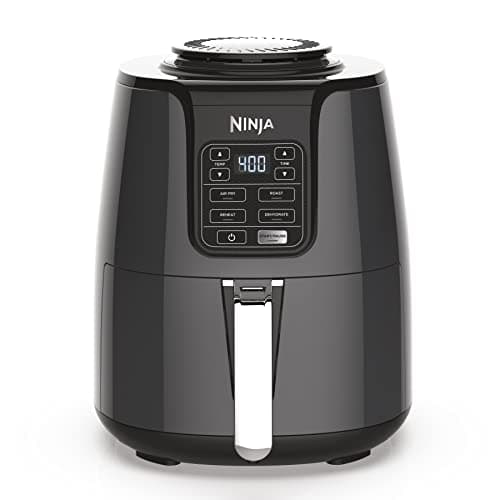
The AF101 is the air fryer most people picture when they picture an air fryer. It has been on sale for years, it sits at the price point where impulse purchases happen, and it is the machine that converted a very large number of households to the category. It is also, quietly, the model most likely to be the wrong purchase — not because it is bad, but because 4 quarts is smaller than almost everyone expects.
This review is mostly about that number. The AF101 is a well-built, straightforward, 1,550-watt machine with a genuinely useful 105°F to 400°F range, and at its usual price it is hard to argue with. But the difference between it and the 5-quart AF141 is roughly the difference between cooking dinner for two and cooking dinner for two plus a side, and that gap is where most of the regret in this category lives.
Four quarts, translated into actual dinners
Quart ratings describe the volume of the basket, not the volume of food you can cook in it, and the gap between those two is where the disappointment comes from. An air fryer crisps by moving air around every surface of the food, so the usable load is a single layer — roughly two-thirds of the rated volume at most. In practice that means the AF101 handles two chicken breasts, or a bag of fries for two, or vegetables for two as a side. It will not do a main and a side together, and it will not do a family's fries in one go. If any of those sentences describe your weeknight, read what size air fryer do I need before you buy anything.
Running cost, worked out
Ninja prints the 1,550-watt rating on the machine, so this is arithmetic rather than estimation: 1.55 kW × 0.33 hours × $0.17/kWh works out at roughly nine cents for a twenty-minute cook at the U.S. average residential electricity rate, and about three cents for a short reheat. Used four times a week that is somewhere around eighteen dollars a year in electricity. Against heating a full-size oven for the same small jobs, it is not close. Plug your own utility rate into our running-cost calculator to see your number rather than the national average.
The 105°F floor is the underrated feature
Most compact air fryers bottom out around 180°F or 200°F, which makes their “dehydrate” preset largely decorative. The AF101 goes down to 105°F, which is a genuine dehydrating temperature — fruit, herbs, jerky. This is the one spec on this machine that is meaningfully better than its price suggests, and it is the reason it still holds a place in the range years after the AF141 arrived. If you have never dehydrated anything you will not care, and that is fine; if you have, this is a real capability rather than a preset button.
Who should skip it, and what to buy instead
Households of three or more: step up to the 5-quart AF141, which is the same design philosophy with the capacity most people actually need, or to a dual-basket if you cook full meals. Anyone avoiding nonstick: the AF101 uses a conventional PTFE basket, and the glass and ceramic alternatives are in the non-toxic roundup. Anyone cooking flat food often: the round basket is less efficient than the square baskets that most of the current field has moved to — a square 5-quart holds more usable fish fillets and flatbreads than a round 4-quart by a wider margin than the quart ratings imply.
Is it still worth buying in 2026?
Yes, for the right person, and with one condition: buy it at its usual discounted price, not at list. At the low end of its price range it is one of the best value machines you can own, and it will happily last years — Ninja's build quality at this tier is genuinely good and parts remain available. At full list price the gap to a 5- or 6-quart machine narrows enough that the capacity argument wins. Our deals page tracks what a fair price looks like at each basket size, which is the useful frame here.
How we picked
We did not lab-test this gear
Everyone in this category says they tested twenty air fryers. We have not lab-tested any of these, and we say so. What we did instead: compiled the published specifications — wattage, capacity, materials — worked out what each machine actually costs to run at the national electricity rate, read the manuals and owner reviews, and scored each one against a published rubric. The scores are judgments from documented research — not measurements we took, because we do not have a lab and we will not pretend we do. Where a number came from someone else's work, we name them in Sources.