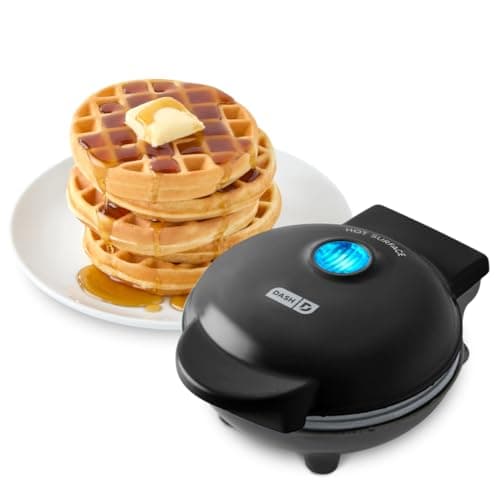
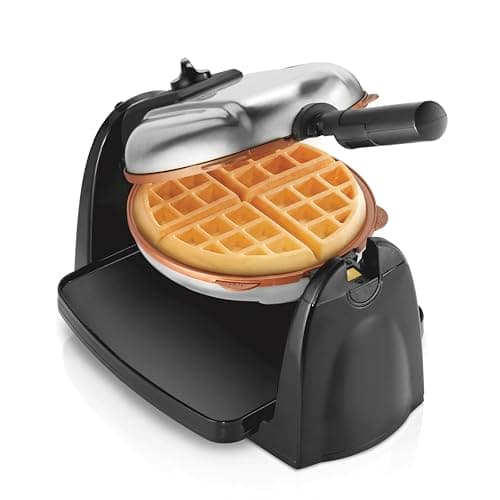
A waffle iron is the most intimate appliance in this hub. There is no basket, no bowl and no jug between the machine and your food — wet batter is poured directly onto a hot coated plate, sits there for several minutes, and is then scraped off. On an air fryer you can pull the basket out, put it in the dishwasher, and buy a new one when the coating goes. On almost every waffle maker sold, you cannot do any of those three things.
That is the fact this page is built around, because it is the one the category never leads with. Manufacturers sell waffle makers on shade dials, flip mechanisms and how deep the pockets are. Those matter a little. What matters more is that the plate is a permanent, non-replaceable, usually non-dishwasherable food-contact surface, so its coating is the component you are really buying — and when it wears, the machine is finished rather than repaired.
So we ranked on three things, in this order. What the maker publishes about the coating, because a checkable claim beats a reassuring word: Hamilton Beach publishes a PTFE- and PFOA-free claim for its Durathon ceramic, while other brands here describe their plates only as “nonstick” and leave the material unstated. Whether the plates come out, because removable grids are the difference between a machine you can actually clean and one you wipe with a paper towel and hope. And watts per waffle, which is the closest thing this category has to a recovery specification — a waffle iron dumps its stored heat into cold batter, and how fast it climbs back decides whether waffle number four is as good as waffle number one.
A note on what we are not claiming. We have not lab-tested these machines and we do not make health claims about any coating — that reasoning is set out in are air fryers toxic? and are ceramic coatings safe? What we do is read what each manufacturer publishes about its own food-contact surfaces and report it plainly, including the ones that publish nothing. Prices are pulled live and date-stamped on every card.
The plate is the appliance
Strip a waffle maker down and there is very little to it: two coated plates, a thermostat, a hinge and an indicator light. There is no fan to fail, no motor to burn out and no electronics worth the name on most of them. What wears out is the coating, and because the plates on nearly every model are bonded into the machine, a worn coating is not a part you replace — it is the end of the appliance.
That changes how you should read the price. On an air fryer, a scratched basket is a twenty-dollar problem, which is why our basket-peeling guide is about replacement rather than despair. On a waffle iron it is a whole-machine problem. So the cheapest machine is not automatically the best value: a documented, durable coating on a forty-dollar machine can easily outlast an unspecified one on a hundred-dollar machine, and that is the calculation this page is trying to make legible.
What each maker actually publishes about its coating
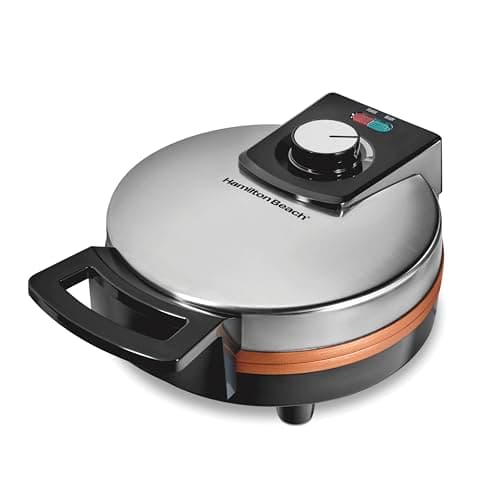
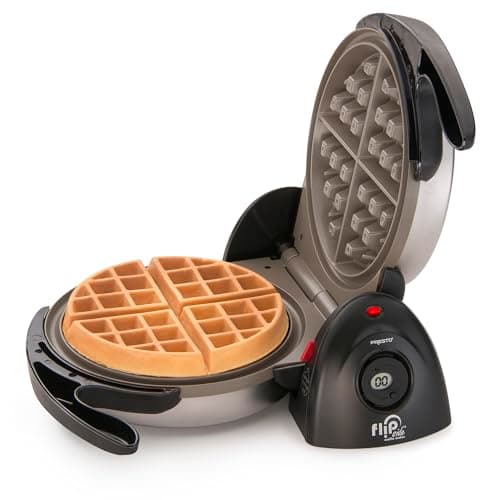
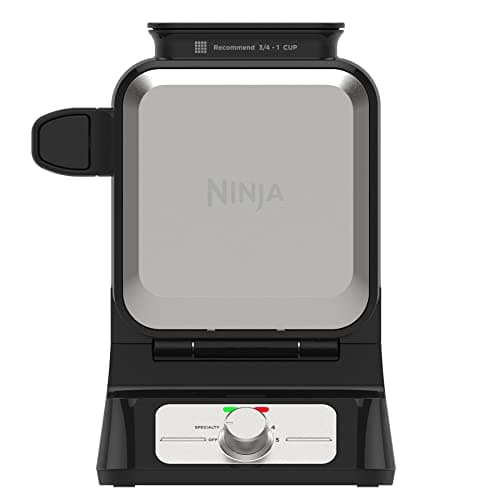
This is the part we can check, so it is the part we rank on. Hamilton Beach is the most forthcoming: its Durathon ceramic grids are published as PTFE and PFOA free on the 26031, and as PFAS free on the 26081, with a stated durability claim that they will not crack or peel. Dash lists the mini here specifically as a ceramic nonstick surface. Presto describes a ceramic nonstick interior but publishes no PFAS, PTFE or PFOA wording that we could find. Cuisinart describes the plates as nonstick without naming the material. Ninja markets NeverStick on release and durability rather than on composition, and we found no material-free claim for it.
None of that is an accusation. A manufacturer that does not publish a claim has not necessarily got something to hide — plenty of perfectly good coatings are simply described as nonstick. But if avoiding a particular chemistry is why you are reading this page, an unstated coating cannot answer your question, and we would rather say so than imply an answer that is not there. The same brand-by-brand discipline is applied across the site in which air fryer brands are actually non-toxic.
Watts per waffle, which nobody publishes
Waffle irons are sold on total wattage, and total wattage is misleading the moment a machine has two sets of plates. What decides whether your fourth waffle is as good as your first is how much heat the machine can put back into the plate between pours, and the honest version of that number is watts divided by the number of waffles it bakes at once.
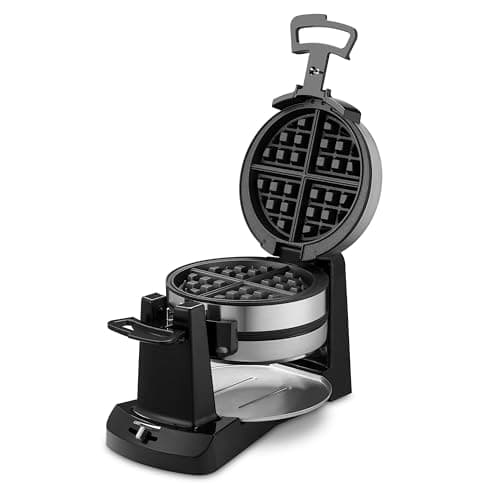
Run the division on the full-size Belgian machines here and the order changes. The Presto is 1,100 W into one waffle. The Ninja is 1,000 W into one. The Hamilton Beach 26031 is 800 W into one and the 26081 is 560 W into one. The Cuisinart, despite carrying the biggest number on the box at 1,400 W, is baking two waffles, so it is 700 W per waffle — less per waffle than the Presto, the Ninja or the 26031. That does not make it the wrong machine; it makes it a volume machine rather than a fast one, which is a different thing and the reason to buy it.
One caveat, stated because the arithmetic invites misuse: this comparison only holds between machines making similar waffles. The Dash is 350 W into a four-inch waffle, and a four-inch waffle needs far less energy than a seven-inch Belgian one, so its number is not comparable to the rest of the column. We apply the same watts-per-unit reasoning to oil capacity in the deep fryer roundup, where recovery is the specification the category also refuses to print.
Flipping: what it does and what it does not
Three of these machines flip 180°, and the marketing around it tends to imply the flip makes waffles crisper. It does not, directly. What it does is redistribute batter while it is still liquid, so the deep Belgian pockets fill evenly on both plates instead of the batter pooling on the lower one. The result is a more uniform waffle rather than a fundamentally better one, and it is genuinely useful if you are using a thin batter that runs.
The cost of a flip mechanism is bulk. A flipping machine needs a yoke and a base to rotate in, which is why the Hamilton Beach 26031 is sixteen inches wide and the Cuisinart weighs over thirteen pounds. If your storage is the constraint rather than your batter, the Presto locking upright and the Ninja standing vertically are the two designs that took the problem seriously.
Belgian versus classic, and why nearly everything here is Belgian
Belgian waffles have deep pockets and are typically about an inch thick; classic American waffles are thinner with a shallower grid. Almost every machine sold in this price range is Belgian, which is what the market wants, and it is worth knowing that deep pockets are also harder to clean — batter that overflows into a deep grid and carbonizes is the single most common reason these machines get thrown out early. That is another argument for the removable grids on the 26031 and for using the measuring cup the Cuisinart and Ninja both include.
Running cost, briefly
Waffle makers are cheap to run because they run for minutes, not hours. A 1,100-watt machine baking for five minutes uses under a tenth of a kilowatt-hour — a fraction of a single air fryer session, and far less than heating an oven. The preheat is the larger share of the energy on a single-waffle morning, which is a mild argument for making a batch once the plate is already hot. If you want to put your own machine's rating and your own utility rate into the arithmetic rather than trust a generic figure, our running-cost calculator does exactly that.
How to make the coating last
Since the plate is effectively unreplaceable on five of these six machines, treatment matters more here than on any other appliance in this hub. Three things kill waffle plates: metal utensils prying at a stuck waffle, abrasive scourers, and cooking spray. The third surprises people — aerosol propellants and emulsifiers leave a varnish-like residue that builds up, goes sticky, and then gets scrubbed off with exactly the abrasive that ruins the coating. Use a brush and a little oil or melted butter instead. That is the same guidance we give for air fryer baskets in how to clean an air fryer, and it applies with more force to a surface you cannot swap out.