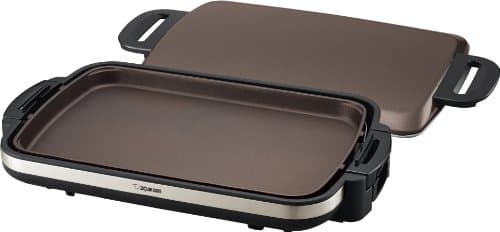
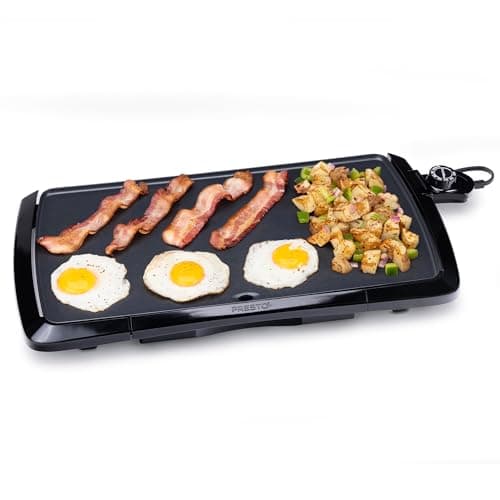
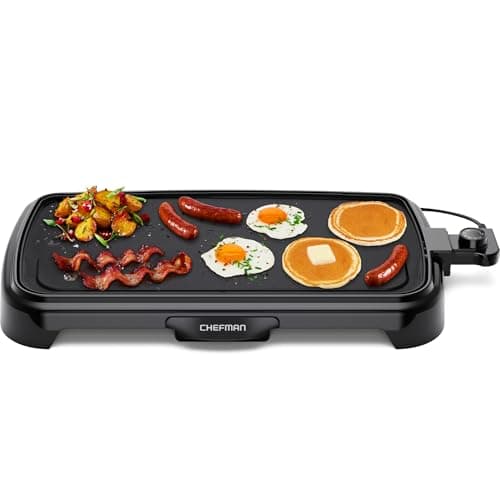
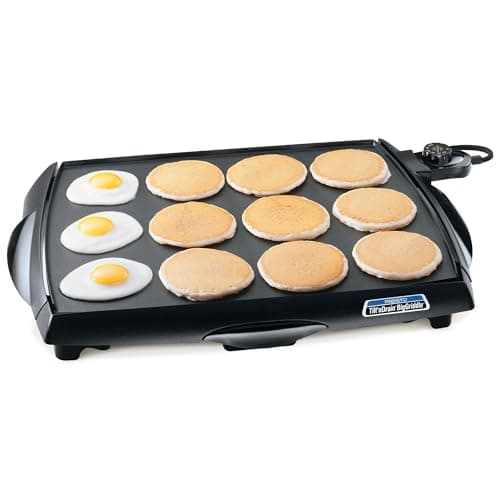
Buy the Presto Tilt'nDrain BigGriddle (07046).It is the only griddle here that publishes all three of the things that decide whether a griddle survives in a kitchen: 1,500 watts with a Control Master thermostat that holds the temperature, a ceramic nonstick surface Presto states is PFAS free, and — the one that matters most — a body that is fully immersible with the heat control removed, in Presto's own words. It also tilts, so bacon fat runs off the plate instead of pooling around the eggs. If you want the best-documented machine regardless of price, the Zojirushi at number two is the only pick here that publishes an actual temperature range. If you are spending the least, the Presto 07030 at number five keeps the named ceramic coating and gives up the tilt.
Here is why this page is not ranked on surface area. Every maker prints the dimensions, every listing leads with how many pancakes fit, and the spread across these six is roughly 200 to 286 square inches — a real difference, and not the one that decides anything. The reason electric griddles end up in the back of a cupboard is cleanup. A griddle is a large flat pan with an electrical heating element bonded into it, which means the single most important published fact about one is whether you can take the electrics off and put the rest in the sink. Three of our six makers say so in plain words. The other three leave you guessing, which in practice means wiping a cooling plate with a paper towel and resenting it.
The four things we ranked on
- Does the probe unplug, and does the maker say the base is immersible?Nearly every electric griddle has a removable temperature probe; far fewer makers will commit in writing to the body being washable once it is out. Presto publishes “fully immersible with the heat control removed” for the Tilt'nDrain. Broil King publishes that with the plug-in probe removed the base can be cleaned in the sink or the dishwasher. Chefman publishes an immersible flat top. Those three statements are worth more than any number on this page.
- Does the dial have numbers on it?Pancakes want a steady 375°F and smash burgers want everything the plate has got, so a temperature range is a real specification — and only two makers here publish one. Zojirushi states a Keep Warm setting at 176°F through to 425°F; Broil King states even heat up to 425°F. Presto publishes a thermostat that holds temperature but no range; the two cheapest picks publish nothing at all, which means their dials are relative rather than absolute.
- How does the grease leave the plate?There are two designs and they are not equivalent. A drip tray catches what runs off the edge; a tilting plate makes the fat run off in the first place. Presto's Tilt'nDrain is the only pick here that publishes a tilt mechanism — pull the handles out to drain bacon, push them in for eggs and pancakes. Everything else is a tray, and a tray only helps once the fat has already crossed the food.
- Is the coating named?“Nonstick” is not a specification. Both Presto picks publish a ceramic nonstick surface and state it is PFAS free. BLACK+DECKER describes a nonstick surface and publishes a PFAS-free ceramic coating on a sibling model rather than clearly on this one. Zojirushi's triple-layer titanium-and-ceramic description comes from retailers rather than from Zojirushi's own spec page, and the cheapest pick on this page names nothing whatsoever. We apply this same test across the counter on our non-toxic appliances page.
Watts, and the one case where they matter
Four of these six are 1,500-watt machines on a 120-volt circuit, which is close to the practical ceiling for a plug-in griddle. The Zojirushi publishes 1,350 watts and Broil King publishes no figure for this model at all. For pancakes, eggs and grilled cheese the difference is invisible: the plate holds its set temperature and the thermostat does the work. Where wattage shows up is recovery— putting eight cold burger patties or a tray of frozen hash browns onto a hot plate pulls the temperature down, and watts are what bring it back. If smash burgers are the reason you are buying a griddle, buy the biggest published wattage with the biggest plate and accept that no 120-volt countertop appliance behaves like a restaurant flat top.
The running cost is not worth a thought. A griddle draws its rated power for a few minutes of preheat and then cycles on and off under thermostat control, which puts it in the same bracket as every other countertop machine we have costed out on the energy-efficient appliances page.
One format question before the picks. A griddle and an indoor grill are not the same appliance and the difference is not the temperature — it is whether the surface is flat or ridged, and therefore whether fat stays under the food or drains away from it. Electric griddle vs indoor grill works through which foods physically require which surface, and the grills themselves are on the indoor grill roundup.
The published-specification table
Every entry below is what the maker publishes on its own page, or — where marked — what only retailers state. The blanks are the point of the page.
| Griddle | Surface | Published watts | Published temp range | Base washable (published) | Coating named |
|---|
| Presto 07046 Tilt'nDrain | Not published | 1,500 W | None (thermostat only) | Yes, fully immersible | Ceramic, PFAS free |
| Zojirushi EA-DCC10 | 19 × 12½ in | 1,350 W | 176°–425°F | Not published | Retailer-stated only |
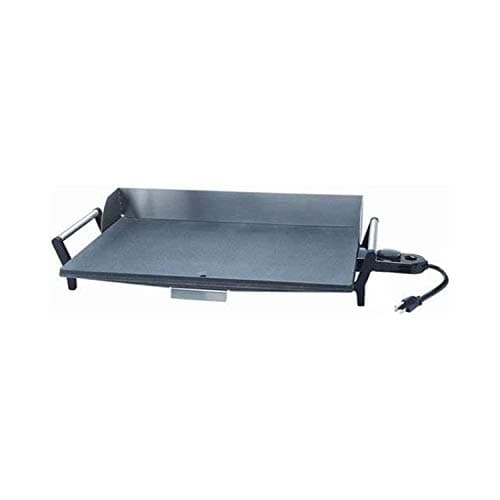
| Broil King PCG-10 | 21 × 12 in | Not published | Up to 425°F | Yes, probe removed | Not published |
| BLACK+DECKER GD2051B | 13 × 22 in | Retailer-stated 1,500 W | None | Dishwasher-safe parts | “Nonstick” only |
| Presto 07030 Cool Touch | 10½ × 20 in | 1,500 W | None (thermostat only) | Not published | Ceramic, PFAS free |
| Chefman XL | 10 × 20 in | Not published | None | Yes, immersible flat top | Not published |
Read the last three columns together and the category sorts itself. Nobody is strong in all three: the two machines that publish a temperature ceiling are the two that say least about washing, and the cheapest machine that publishes an immersible body says nothing about what is on it. The Presto Tilt'nDrain wins because it is the only pick that is blank in just one column.
Griddle temperatures worth knowing
Since four of six makers publish no numbers, these are the settings worth learning by result rather than by dial:
- Pancakes and French toast.Medium, around 375°F on a griddle that states it. The test is a drop of water that skitters rather than instantly vanishing. Too hot and the outside sets before the middle rises.
- Eggs. Low to medium-low. A griddle is the easiest surface in the kitchen for eggs precisely because the thermostat holds a low temperature a gas burner will not.
- Bacon and sausage. Medium, and this is where the tilt earns its money. Rendered fat on a level plate means the second half of the batch is frying rather than griddling.
- Smash burgers and anything seared. Everything the plate has. This is the one job where published wattage and plate mass matter, because the temperature you care about is the one after the cold meat lands.
- Grilled cheese and quesadillas. Medium-low and patient. A griddle beats a pan here for the same reason it beats one for pancakes: the whole surface is the same temperature.
Cleaning one of these without ruining it
- Unplug the probe before anything touches water. The probe is the electrical part; the plate is a pan. Every manufacturer instruction on this page starts here, and it is the step people skip once and regret.
- Scrape while warm, wash when cool. Residue lifts off a warm ceramic surface with a plastic scraper and bonds to a cold one. Do not shock a hot plate with cold water either; warping a cast plate is a real failure mode.
- Nothing abrasive, ever. A griddle is a single large coated surface with no spare. Steel wool on a ceramic nonstick plate is the fastest way to turn a working appliance into a sticky one.
- Empty the drip tray every time. Old fat in a tray is the smell people blame on the appliance. It is the same principle we set out in our guide to appliance smells.
What a griddle does not replace
- Grill marks and drained fat. That is a ridged surface, and the honest comparison is on electric griddle vs indoor grill.
- Anything with a lid. A griddle is open by design: no steaming, no braising, no simmering. That is a skillet or a slow cooker.
- Crisp without oil. A flat plate browns one side at a time. For all-around crisping the appliance is an air fryer, and the two are complements rather than competitors.
The short version
Check the cleanup claim first, the coating second and the plate size last. If you want one answer, it is the Presto Tilt'nDrain: published immersible body, named PFAS-free ceramic surface, a thermostat that holds, and the only tilt in the group. If you cook to numbers, pay for the Zojirushi. If you are feeding five, the BLACK+DECKER's warming tray is the feature nobody else here has. The rest of our countertop picks are on the kitchen appliances hub.
How we picked
We did not lab-test this gear
Everyone in this category says they tested twenty air fryers. We have not lab-tested any of these, and we say so. What we did instead: compiled the published specifications — wattage, capacity, materials — worked out what each machine actually costs to run at the national electricity rate, read the manuals and owner reviews, and scored each one against a published rubric. The scores are judgments from documented research — not measurements we took, because we do not have a lab and we will not pretend we do. Where a number came from someone else's work, we name them in Sources.