Most people reading this should buy an air fryer instead, and we are not going to pretend otherwise — the long version is in air fryer vs deep fryer and the ranked answer is in best air fryers. But an air fryer is a small convection oven, and moving air cannot set a wet batter: it runs off the food before the heat reaches it. If beer-battered fish, doughnuts, tempura, croquettes or proper twice-fried chips are things you genuinely make rather than things you imagine making, no amount of circulating 450°F air will get you there and a pot of oil will. This page is for that reader, and only that reader.
The category is easy to shop badly, because every listing leads with the same two numbers — liters of oil and watts — and neither means very much alone. What matters is the ratio between them. Frying is a heat-transfer race: you drop cold, wet food into hot oil, the oil temperature falls immediately, and everything good about deep frying depends on how fast the element pushes it back up. Get that wrong and the batter absorbs oil instead of sealing against it, which is the technical description of greasy food. A 4.5-liter machine on 1,800 watts recovers more slowly than a 3.5-liter machine on 1,700, and no listing will tell you that.
So the ranking turns on four things, in this order. Recovery, which is watts divided by liters of oil rather than either number by itself. Temperature control, which in this category is a much shorter conversation than you would expect — the USDA puts frying at 350 to 375°F, and almost every machine here stops at exactly 375°F, leaving no headroom at all. Oil handling: how the several liters you just bought get filtered, stored and eventually thrown away, which is the single thing that decides whether a fryer stays on the counter or moves to the basement. And what the pot is made of, because in a deep fryer the oil sits against that surface at 350°F for the whole session.
One thing that does not belong on the list is electricity. A full frying session costs around fifteen cents to run. The oil costs many times that, every time, and the arithmetic is below — it is the running-cost calculation this category never publishes, and it is the number that should decide which size you buy.
Recovery is the specification, and nobody prints it
Frying is a race between the food and the element. Cold, wet food hits 350°F oil, the oil temperature collapses, and the batter either seals fast enough to keep oil out or it does not. Everything people dislike about home frying — heavy, greasy, pale results — traces back to oil that never climbed back to temperature. What decides that is not watts and not liters but watts divided by liters, and no manufacturer publishes the division.
| Machine | Watts | Oil | Watts per liter |
|---|
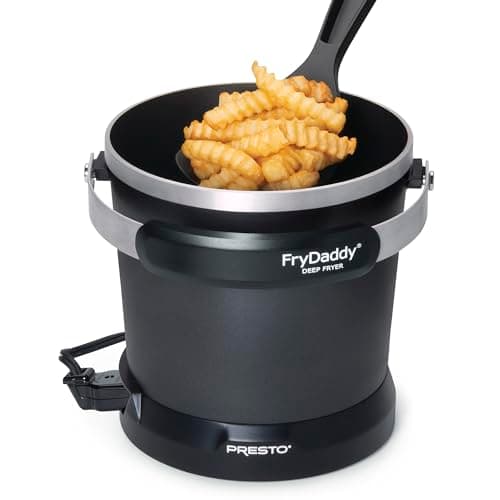
| Presto FryDaddy | 1,200 | 0.95 L (4 cups) | ~1,260 |
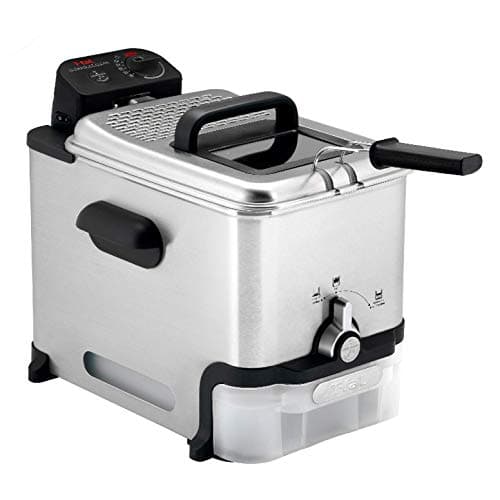
| T-fal FR8000 | 1,700 (listing) | 3.5 L | ~486 |
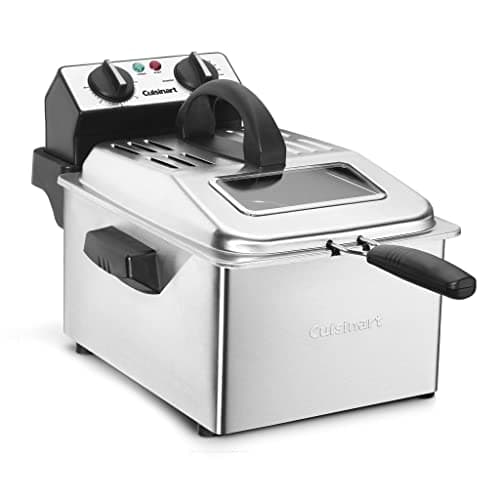
| Cuisinart CDF-200P1 | 1,800 | 3.8 L (4 qt) | ~474 |
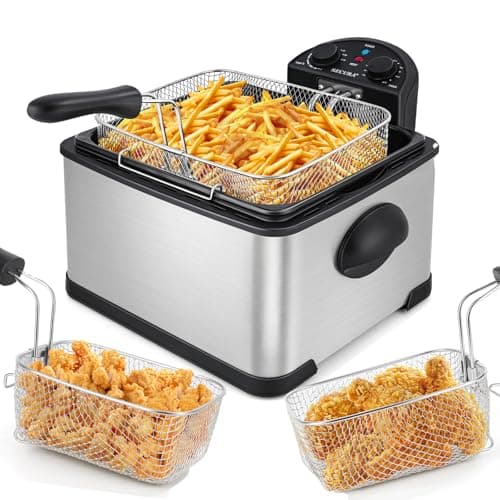
| Secura 4 L | 1,700 | 4.0 L | ~425 |
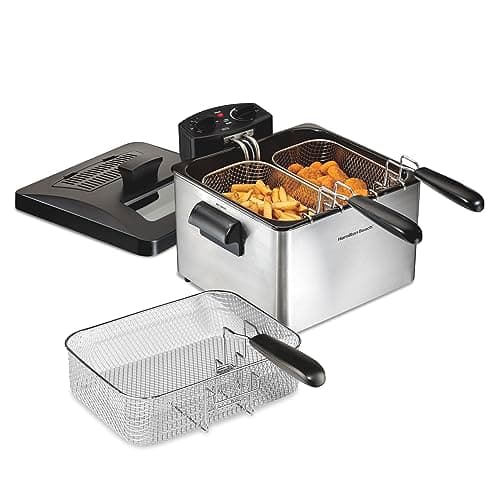
| Hamilton Beach 35034 | 1,800 (listing) | 4.5 L | ~400 |
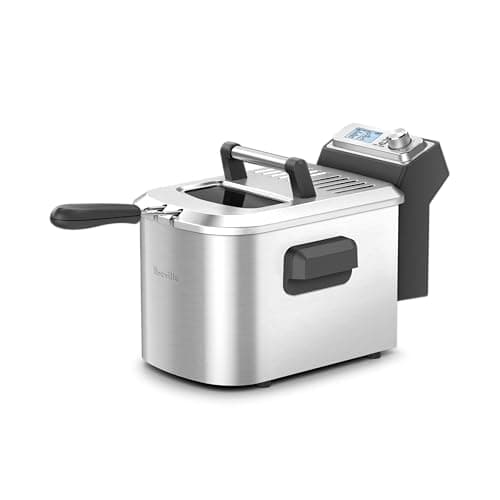
Read the top row again, because it is the most useful thing on this page. The cheapest machine here recovers roughly two and a half times faster per liter than the largest one, for the simple reason that it heats a quarter of the oil with two-thirds of the power. That is why a basic fryer can produce better chips than an expensive one, provided you only want four servings. The Breville is missing from the table because Breville publishes an 1,800-watt element but no oil capacity, so the division cannot honestly be done.
Practically, this means load size matters more than which machine you choose. Half a basket twice beats a full basket once on every fryer on this list, and it is free.
Everything here stops at exactly 375°F
The USDA Food Safety and Inspection Service puts deep frying at 350 to 375°F. Now look at the published ranges: the T-fal tops out at 375°F, the Secura at 375°F, the Cuisinart at 375°F. The FryDaddy has no adjustment at all, and Breville does not publish a range. The entire category, in other words, maxes out at the top of the recommended window with nothing in reserve.
That is not a defect — it is a deliberate safety limit, and it is why the previous section matters so much. In a restaurant you would pre-heat above your target so that a big cold load lands you on it. At home you cannot, so you manage the drop instead: smaller batches, thawed rather than frozen food where the recipe allows it, and a pause between loads. A fryer that recovers quickly is doing the job that headroom would do in a commercial kitchen.
It also makes a separate oil thermometer a genuinely useful accessory on five of these six machines, since only the Breville displays real oil temperature rather than a dial position. The same argument, applied to a different appliance, is in air fryer cooking times: cook to a measured temperature, not to a setting.
The oil is the running cost. The electricity is a rounding error
This is the calculation the category never publishes, and it inverts what most buyers assume. Start with the power, using the same arithmetic as everywhere else on this site — kilowatts times hours times your rate, at the US average residential price of about 17 cents per kWh.
| Run | Energy | Cost |
|---|
| 1,800 W, 15 min (heat-up) | 0.45 kWh | $0.08 |
| 1,800 W, 30 min (a full session) | 0.90 kWh | $0.15 |
| 1,200 W, 30 min (FryDaddy) | 0.60 kWh | $0.10 |
| 1,800 W, one full hour | 1.80 kWh | $0.31 |
Fifteen cents. Now the oil. A gallon jug is 128 fluid ounces, and here is what one fill of each machine takes out of it.
| Machine | Oil per fill | Share of a gallon jug |
|---|
| Presto FryDaddy | 4 cups (32 fl oz) | One quarter |
| T-fal FR8000 | 3.5 L (118 fl oz) | Most of one jug |
| Cuisinart CDF-200P1 | 4 qt (128 fl oz) | Exactly one jug |
| Secura 4 L | 4.0 L (135 fl oz) | Just over one jug |
| Hamilton Beach 35034 | 4.5 L (152 fl oz) | About one and a fifth jugs |
We do not quote an oil price, because it moves constantly and varies by store and by oil — but you know roughly what a gallon jug costs where you shop, and that number is your real running cost. Whatever it is, it dwarfs fifteen cents, and it recurs every time the oil is spent. Multiply it by four and a bit and you have the difference between the FryDaddy and the Hamilton Beach over the life of the machine, which will comfortably exceed the gap in their purchase prices.
The conclusion is the opposite of how people shop: buy the smallest fryer that fits what you actually cook, not the largest one you can afford. Every extra liter is a recurring bill and a slower recovery. If you want the same math applied to the appliance that uses a teaspoon of oil instead of a gallon, the calculator is on what an air fryer costs to run.
Getting the oil back out, which decides whether you keep the machine
Fryers do not end up in basements because they cook badly. They end up there because of the twenty minutes after dinner. FSIS is specific about what to do: if you plan to reuse the oil, strain it through cheesecloth or a sieve, store it in a sealed, light-proof container for up to three months, and refrigerate it for best quality. That is three steps and two pieces of equipment, performed while the pot is still warm enough to pour and hot enough to hurt you.
This is the entire argument for the T-fal. Its filtration system drains and filters the oil into a sealed box automatically, and the box goes in the fridge and then the dishwasher. The Cuisinart takes the second-best approach: no filtration, but the oil container lifts out with a pouring spout, so you carry a gallon rather than tipping an appliance. The FryDaddy takes the third approach and arguably the smartest one at its size — the oil never leaves the pot, because the lid snaps on and the whole thing goes in a cupboard.
When the oil is finally spent, it goes into a sealed container in the trash, never down the drain. Cooled fat congeals in the trap and then in the sewer line, and that is a plumbing bill rather than an environmental abstraction.
What the pot is made of
Materials matter here for a different reason than they do on an air fryer. In an air fryer the coating meets food for twenty minutes at a time, which is why we spend most of the non-toxic air fryer roundup separating what is documented from what is merely marketed. In a deep fryer, hot oil sits against the pot for the whole session, and hot oil is a far better solvent than dry heat.
The good news is that the full-size machines here are mostly metal by design: Cuisinart publishes a stainless oil container and a stainless basket, T-fal a stainless bowl, Secura a stainless body with a removable tank. Hamilton Beach does not publish its tank material at all, which is worth knowing before you buy. The only coated pot in the roundup is the FryDaddy's, and Presto publishes it as a PFAS-free ceramic nonstick — the same distinction between coating families that we draw in are ceramic air fryers safe.
We are not going to inflate this into a health warning. Frying oil at 350°F in a stainless pot is still frying oil at 350°F. But if the food-contact surface is why you are reading a buying guide at all, the honest ranking is bare stainless first, published PFAS-free ceramic second, and unpublished third — and unpublished is a fair reason to pick a different machine.
Two safety rules, and one boundary
FSIS is blunt on both rules. First, water and hot oil: at around 350°F, water vaporizes instantly into superheated steam and expands, throwing oil out of the pot. Do not let water get into the oil, do not use water to cool or clean the appliance while food is frying, and dry food before it goes in. Second, if oil does catch fire: never use water on a grease fire. A kitchen fire extinguisher, or covering the pot with a metal lid, is the way to put it out. Every machine here except the FryDaddy has a lid; know where yours is before you need it.
The boundary: this page covers countertop electric fryers only. Outdoor propane turkey fryers — the large stand-mounted kind — are a different and far more dangerous category, and the National Fire Protection Association discourages their use outside trained professional settings. Nothing on this page is designed for a turkey, and nothing on this page should be taken outside and set on a burner.
On oil choice, FSIS names the high-smoke-point oils suitable for deep frying: olive, peanut, canola, corn, grape seed, safflower, sunflower and vegetable. Any of those will do the job. The one to avoid is an oil that starts smoking below your target, because past its smoke point it breaks down and takes the flavor of the food with it — the same mechanism behind a smoking air fryer, which we cover in why an air fryer smokes.