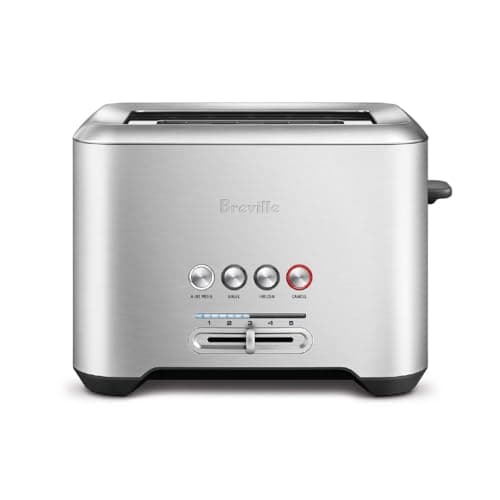
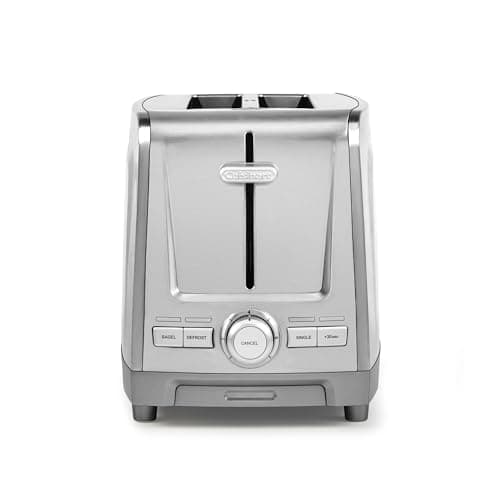
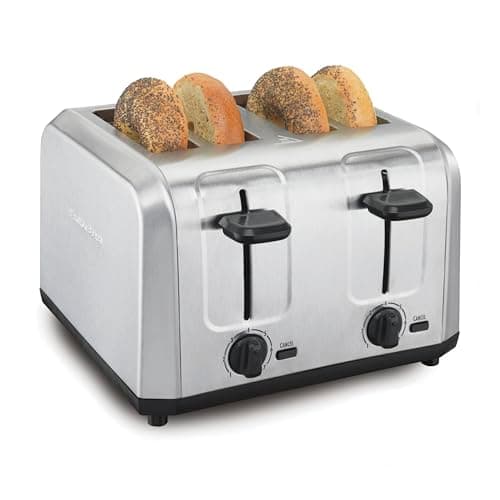
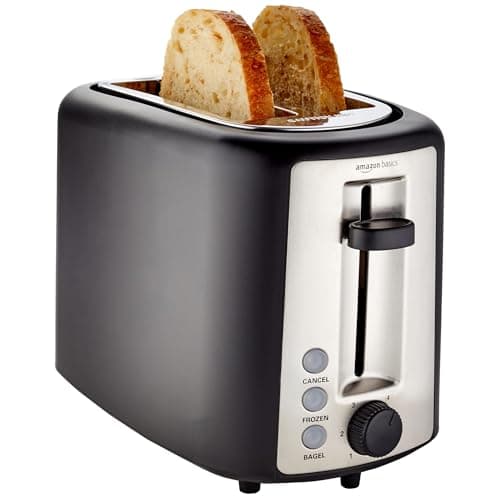
The pop-up toaster is the odd one out in this hub. Everything else we rank here has a coated basket, a plastic jug or a bonded plate, and most of our arguments are about what touches the food. A toaster has none of that. Bread sits in a bare metal cage a fraction of an inch from exposed heating elements, and the whole machine is a timer, a lever and a spring. There is very little to go wrong and very little to hide.
Which is why the category is sold on almost nothing. Retail pages lead with shade counts, finishes and words like “even” and “fast,” and the three numbers that actually decide whether you will like the thing — how long and wide the slot is, how much heat each slot gets, and whether you can check on the toast without ending the cycle — are either buried or not published at all. Two of the seven makers on this page publish no wattage on their own product pages. We say which ones.
So we ranked on three things, in this order. Slot geometry, because a toaster you cannot fit your bread into is not a toaster you own — a standard slot is about five inches long, a sourdough slice is often seven or more, and only two picks here publish a slot length at all. Watts per slot, which is the division nobody prints and the reason a cheap 2-slice toaster is often faster per slice than a mid-price 4-slice one. And what you can do about a bad cycle— a lever you can lift without canceling, a “bit more” button, an extra-lift for small slices — because every toaster gets the first slice of a new loaf wrong and the difference is how cheaply you fix it.
A note on what we are not claiming. We have not lab-tested these machines, and watts per slot is a proxy: element layout, slot length and reflector design all move the result too, and we say where a maker's own explanation differs from the arithmetic. What we do is read what each manufacturer and its listing publish, report it plainly — including the gaps — and pull the prices live and date-stamped on every card. If you already own a toaster oven and are wondering whether you need one of these at all, that question gets its own honest section below the picks.
The slot is the spec, and almost nobody prints it
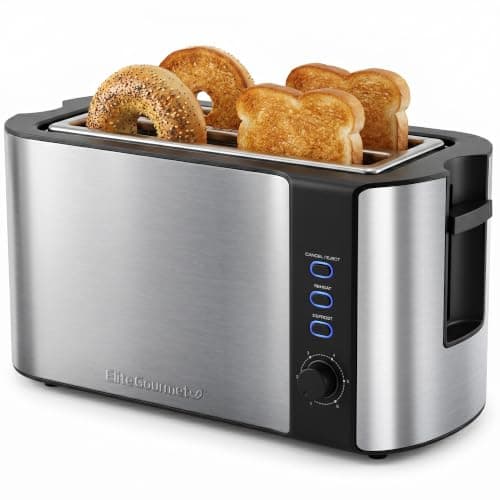
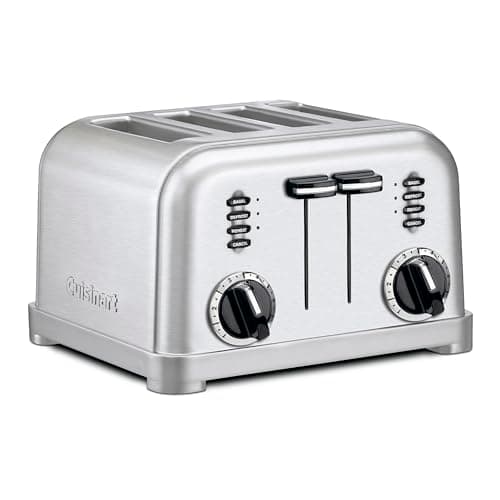
Every complaint about a toaster that is not about burnt toast is about fit. Bagel halves that have to be forced in, sourdough that sticks two inches out of the top and toasts in a horizontal band, English muffins that vanish below the lip and have to be fished out. All of that is decided by two numbers — slot length and slot width — and of the seven machines here, only two publish both. Amazon Basics states 5.25 by 1.25 inches. Elite Gourmet states 10 by 1.5 inches. Cuisinart publishes a width of 1.5 inches on the CPT-180 and the phrase “40 percent larger” on the CPT-1600, with no length for either. Breville says “wider.” Hamilton Beach says “extra-wide.” Revolution says nothing.
So here is the rule of thumb we would use. A standard slot is around five to five and a half inches long; supermarket sandwich bread fits it. A bakery or homemade loaf is often six to eight inches across the slice, and for that you want either a long-slot machine or to accept turning the slice halfway. Width matters less than the marketing suggests: 1.25 inches takes most bread, 1.5 inches takes most bagel halves without persuasion, and nothing here is wider than that. If a maker will not tell you the length, assume it is standard.
Watts per slot, which is why cheap 2-slice toasters are often faster
Toasters are sold on total wattage when they are sold on wattage at all, and the total is misleading the moment a machine has more than two slots. What decides how quickly each slice browns is the heat going into that slice, and the closest published proxy is the total divided by the number of slots.
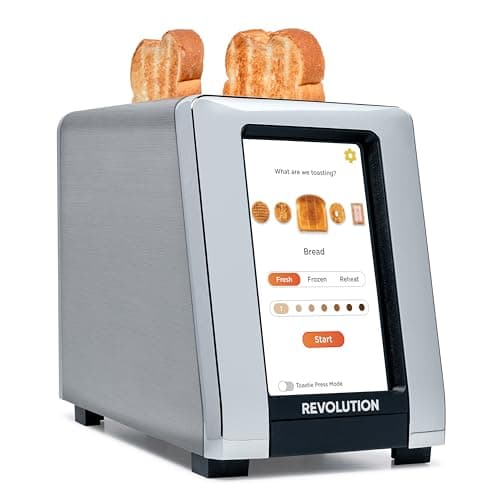
Run that division across this page and the order surprises people. The Breville and the Cuisinart CPT-1600 are 1,000 watts into two slots, or 500 watts per slot. The Cuisinart CPT-180 is 1,800 into four, or 450 — and so is the cheapest machine on the page, the Amazon Basics, at 900 into two. The Hamilton Beach 4-slice is 1,500 into four, or 375. The Elite Gourmet is 1,300 watts into two long slots that hold four slices, which is 325 per slice when it is full. And the Revolution is 1,500 into two, or 750, which is the whole basis of its speed claim and the reason it costs what it costs. A 4-slice toaster is not automatically a more powerful one; two of the three here give each slot less than the cheapest 2-slice.
Two honest caveats. First, this is a proxy, not a measurement: element placement, the reflectors behind them and how far the bread sits from the wire all change the result, and Revolution attributes its speed to the alloy of its element rather than to its wattage alone. Second, three of these wattages are not published by their makers — Breville, Hamilton Beach and Elite Gourmet state none on their own product pages, and we have taken the figure from the retailer listing and said so on each card. We apply the same watts-per-unit reasoning to waffle irons in the waffle maker roundup and to quart capacity in the frozen-food air fryer picks, and it has the same limits in all three places.
How you fix a pale slice is the real feature list
Every toaster gets the first slice of a new loaf wrong, because the shade dial is a duration and not a judgment about your bread. A thicker slice, a colder slice, a denser crumb — the same number produces a different color. What separates the machines here is what they let you do about it, and that is worth more than a seventh shade setting.
The Breville gives you the two best tools: lift the lever mid-cycle to look and drop it back, or press “A Bit More” for a short extra burst without a full second run. The Cuisinart CPT-1600 gives you both in its own words — a High-Lift QuickView lever and a +30 Seconds button. The Revolution shows you a countdown. Everything else on the page gives you a cancel button and the option of a second cycle, which works but overshoots often enough that most people learn to pull the toast early. If you toast a variety of bread, that correction mechanism will matter every week. If you toast one kind at one setting, it will matter once.
Do you need a toaster if you own a toaster oven or an air fryer?
This is the question we get asked most, and our own toaster oven rounduphalf-answers it by noting that a good toaster oven's toast and bagel functions make a pop-up redundant. That is true if you toast occasionally. It is less true if you toast every morning, for two reasons that are both about geometry rather than quality.
A pop-up toaster heats both faces of the slice at once from elements an inch away, so a cycle is a couple of minutes with no preheat. A toaster oven or an air-fry oven heats from the top and bottom of a cavity, further from the bread, and most take a preheat or a longer cycle to reach the same color; a basket air fryer only browns the face the fan can reach and has to be flipped. And a 900- to 1,800-watt toaster running for two and a half minutes uses somewhere between four hundredths and eight hundredths of a kilowatt-hour — a fraction of a cent to a little over one cent at the national average rate we use in our running-cost calculator. A 1,800-watt toaster oven doing two slices in four minutes uses about 0.12 kilowatt-hours, or around two cents. None of this is a lot of money. But if toast is a daily habit for more than one person, the pop-up is faster, cheaper per slice, and frees the oven for the things only an oven does. If it is a weekend habit, keep the counter space and use the oven you have.
What touches your bread, for readers who came here from the air-fryer pages
A large share of this site's readers arrive from the materials questions — are air fryers toxic, where the plastic is, whether a ceramic coating is different from a PTFE one. The toaster is the one appliance in this hub where that question mostly dissolves. There is no nonstick anything: bread rests against bare metal guide wires and is browned by radiant heat from exposed elements. The housing is stainless on six of these seven and plastic on the Amazon Basics, and the housing does not touch the food on any of them. What is left is the crumb tray, which is why the section below is about fire rather than chemistry.
The crumb tray, and the two rules the safety bodies actually publish
Every toaster here has a slide-out or drop-down crumb tray, and the reason it matters is not tidiness. Dried crumbs collecting under an exposed heating element are fuel, and the Electrical Safety Foundation International's kitchen guidance includes two toaster lines we would put on every product page: keep appliance cords away from hot surfaces like the range or toaster, and unplug the toaster and other countertop appliances when not in use. The U.S. Fire Administration gives the same instruction for small appliances generally. Unplugging before you empty the tray, and before you go after a stuck slice with anything at all, is the whole of toaster safety. We cover the circuit side — why a 1,800-watt toaster and a 1,700-watt air fryer should not share one outlet — in can you plug an air fryer into an extension cord.
On the trays themselves: the Breville and the Cuisinart CPT-1600 are described as pulling from the front, which means you can empty them without moving the toaster. The Elite Gourmet tray drops from the bottom, and the Amazon Basics tray is at the back. Cuisinart and Hamilton Beach say only “slide-out” for the CPT-180 and the 24910G. It is a small thing, but it decides whether the tray gets emptied weekly or yearly.
Warranties, and who publishes one
Cuisinart publishes a three-year limited warranty on both of its machines here, which is the longest on the page and a real point in favor of a brand that otherwise publishes less than we would like. Revolution publishes two years. Breville and Elite Gourmet publish one. Hamilton Beach and Amazon Basics state no term on the pages we read. On a category where the machine is a spring, a timer and an element, a long warranty mostly signals how confident the maker is in the element, and Cuisinart's confidence is the reason the CPT-180 sits at the top of this page rather than second.