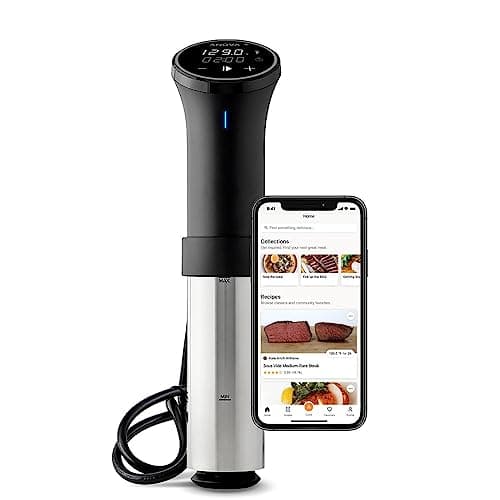
Sous vide is the only method on this site that removes the variable every other appliance is trying to manage. An air fryer, an oven and a grill all work by putting something far hotter than your target against the food and pulling it out at the right moment — the skill is the timing. A sous vide circulator sets the water to the temperature you want the food to finish at, and then lets time do the rest. A steak in a 130°F bath cannot go past 130°F however long you forget about it. That is the entire pitch, and unlike most appliance pitches it is literally true.
What is also true is that the hardware is very nearly commoditized. Every machine on this page is the same three parts in a waterproof tube — an immersion heater, a pump and a thermostat — and every one of them publishes a temperature accuracy of about a tenth of a degree Celsius. Ranking on accuracy, in other words, means ranking on a number that no longer separates anything. So we rank on the four things that still differ, and that the listings are much quieter about.
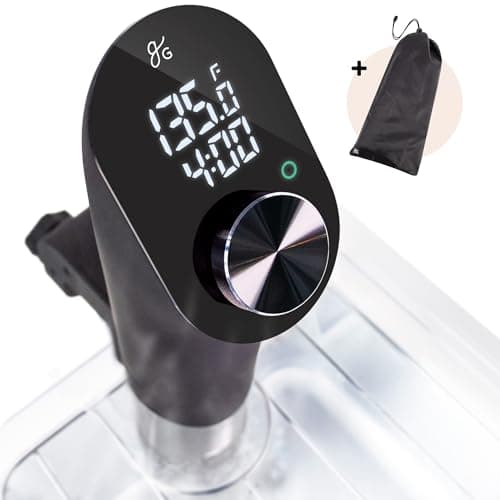
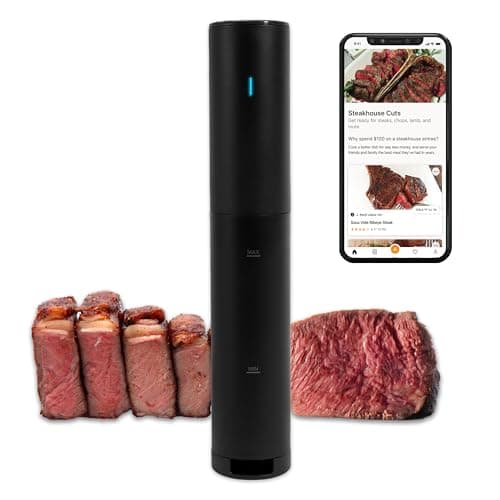
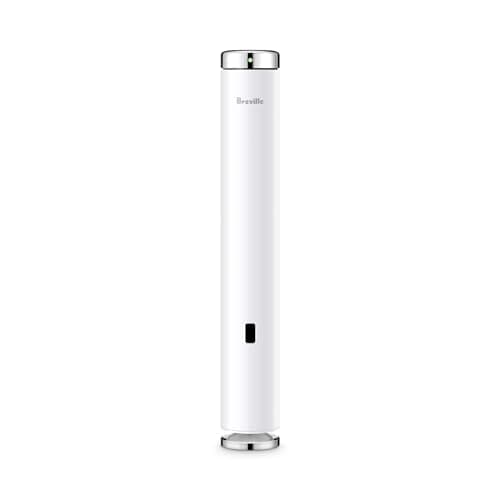
Whether it works without a phone.This is the biggest split in the category and almost nobody leads with it. One machine here — the most expensive one — has no onboard controls at all: Breville's manual describes control exclusively through the Breville+ app. Another, the Greater Goods, has no app and no radio of any kind. That is a bigger difference than any spec on the box, and it is the first question to answer about yourself before you shop. Flow rate, because a circulator that does not move enough water leaves cold pockets in a big container, and only two of the five publish a figure at all. Waterproofing, because this is an appliance whose entire job is to stand in hot water for hours, and an IPX rating is either published or it is not. And what the maker publishes generally — capacity in liters, materials, warranty length — because a company that will not print a temperature range is telling you something.
One thing we do not rank on is running cost, and it is worth saying why up front, because the fear of it is what stops people buying. A twelve-hour cook sounds ruinous and is not: almost all the electricity a sous vide bath uses is spent in the first half hour getting the water up to temperature, and that part is pure arithmetic anyone can check. We do it below. The short version is that bringing a full bath from cold tap water to 130°F costs about eight cents — the same as one session in an air fryer.
The heat-up is the only running cost you can calculate
The thing that stops people buying a sous vide machine is the mental image of an appliance running for twelve hours. It sounds like leaving the oven on all day. It is nothing like leaving the oven on all day, and the reason is that a circulator spends almost all of its energy in the first half hour and then spends the rest of the cook replacing what leaks out.
The heat-up half is pure arithmetic, and it is the part nobody publishes. Water takes 4,186 joules to lift one kilogram by one degree Celsius, one liter of water weighs one kilogram, and a kilowatt-hour is 3,600,000 joules. That is the whole calculation. At the US average residential rate of about 17 cents per kWh, here is what it costs to bring a bath up to temperature — and the fastest it could possibly happen on an 1,100-watt machine, if every watt went into the water and none went into the room.
| Bath | From | To | Energy | Cost | Floor time at 1,100 W |
|---|
| 6 L (1.6 gal) | 70°F cold tap | 130°F | 0.23 kWh | 4¢ | 13 min |
| 12 L (3.2 gal) | 70°F cold tap | 130°F | 0.47 kWh | 8¢ | 25 min |
| 12 L (3.2 gal) | 110°F hot tap | 130°F | 0.16 kWh | 3¢ | 8 min |
| 12 L (3.2 gal) | 70°F cold tap | 165°F | 0.74 kWh | 13¢ | 40 min |
Three things fall straight out of that table. First, the whole heat-up costs about what a single air fryer session does — we put a 1,500-watt air fryer at roughly 0.5 kWh for twenty minutes on what an air fryer costs to run, which is eight or nine cents. Second, filling from the hot tap is the single biggest saving available in this category, and it is free: it cuts both the energy and the wait by roughly two-thirds. Third, wattage buys you time rather than money. The Anova Mini at 850 watts needs about 33 minutes for that 12-liter cold-tap row and the Inkbird at 1,000 watts about 28, but all three machines spend the same 0.47 kWh getting there, because the water needs what the water needs.
The holding half we will not put a number on, and it is worth being explicit about why. Once the bath is at temperature the element only replaces heat lost to the room and, far more importantly, to evaporation off the surface. That loss depends on your container, your kitchen and whether the bath is covered — none of which we can know, and none of which any manufacturer here publishes. The honest bound is this: the absolute worst case is continuous full power, which for four hours at 1,100 watts would be 4.4 kWh and about 75 cents, and the real figure is a small fraction of that because the element cycles. If you want that fraction to be smaller, cover the bath. A lid, a sheet of foil or a layer of ping-pong balls kills the evaporation, which is the dominant loss at these temperatures, and it also stops the water level falling below the machine's minimum sensor overnight — which is the actual failure mode of a long cook, not the electricity bill.
Time at temperature is the whole safety argument
This is the part that deserves care, because sous vide deliberately cooks inside the range every other food-safety message tells you to avoid. USDA FSIS defines the Danger Zone as 40°F to 140°F, and a steak held at 130°F for two hours is squarely inside it. The resolution is not that the rule is wrong — it is that the familiar single numbers (145°F for whole cuts with a three-minute rest, 160°F for ground meat, 165°F for poultry) are the instant version of a relationship between temperature and time. Lower the temperature and you have to add time; there is no third option.
The government version of that relationship is the FSIS Cooking Guideline for Meat and Poultry Products, the document processors know as Appendix A. Its tables put beef held at 130°F at roughly 112 minutes at that temperature for a 6.5-log reduction in Salmonella, and about 121 minutes for a 7-log reduction. Anova publishes a consumer-facing version of the same idea for its own machines: chicken at 136°F needs 68.4 minutes, at 140°F 27.5 minutes, at 145°F 9.2 minutes, at 150°F 2.8 minutes, and at 165°F it is instant. Read down that column and the entire method makes sense — you are not skipping pasteurization, you are paying for it in minutes instead of degrees.
Two practical consequences. Thin food reaches temperature quickly and then has to stay there long enough, so on a short cook the timer is the safety device, not the thermometer. And a finished cook left to sit in a cooling bath is a cook drifting back into the Danger Zone from the top — eat it, sear it, or chill it, but do not leave it. The same reasoning runs through the slow cooker roundup, where the rule is the mirror image: hold at or above 140°F, or refrigerate.
What the food actually touches
Readers arrive at this site from the materials cluster more than any other, so it would be dishonest to write a sous vide page that skipped the bag. Here is the accurate version. In an air fryer, the food-contact surface is a coating on metal and the heat is dry — which is why the non-toxic air fryer roundup spends its time separating documented claims from marketed ones. In sous vide, the food sits in plastic, in water, at 130°F to 185°F, for hours. That is a genuinely different exposure question and it deserves a genuinely different answer rather than a reassuring one.
What is publishable: SC Johnson states that Ziploc brand bags and containers are BPA free, and that dioxins — the internet's favorite plastic scare — form only where chlorine meets extremely high temperatures, around 1,500°F, which is not a temperature any kitchen reaches. What is not publishable is a clean bill of health for every bag on every shelf, because most bag brands publish far less than that. So the honest ranking is the same one we use everywhere: a manufacturer that states its material and its temperature rating beats one that does not, and a reusable silicone bag or a glass jar removes the question entirely for anything that will fit in one. If you are weighing a sealer rather than a zip bag, the vacuum sealer roundup takes the same question further — including the one system that stores food in borosilicate glass and skips the film altogether.
Two things worth knowing beyond the bag. The container is plastic too on most setups, and the clear rigid tubs sold for sous vide are commonly polycarbonate — the plastic family the BPA conversation is actually about. A stockpot you already own is stainless and sidesteps it. And none of this is a reason to panic: it is the same reasoning we apply, with the same restraint, in BPA-free air fryers, where the conclusion is that the appliance worth thinking hardest about is the one holding hot water, not the one blowing hot air.
Flow rate and the specs that get skipped
Two numbers separate these machines and neither is on the front of the box. Flow rate is how much water the pump moves per minute, and it is what decides whether a large container is one temperature or several. Anova publishes 8 L/min for the Precision Cooker 3.0 and 6 L/min for the Mini. Breville, Greater Goods and Inkbird publish nothing at all. That does not mean their pumps are bad; it means you cannot compare them, and in a category where accuracy has stopped differentiating, circulation is the specification that still does.
Water level limits are the second, and they matter more than wattage for anyone with an unusual pot. Anova is the only maker here that publishes both ends for the Mini — a 62 mm minimum and a 153 mm maximum — and that maximum is a hard constraint: a deep container filled high simply will not work, no matter how powerful the machine. Measure your pot before you buy, not after.
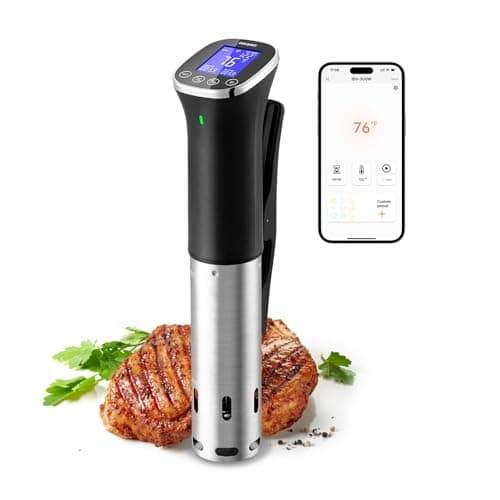
The third, less glamorous one is the IPX rating. Anova states IPX7 for both its machines and Inkbird states IPX7 for the ISV-300W. Greater Goods and Breville do not publish a rating on the pages we checked. For a device whose job description is standing in hot water for twelve hours, that is a gap worth noticing, and it is the same published-beats-unpublished test we apply to coatings in are ceramic air fryers safe.
You still have to sear it, and you may already own the machine
Sous vide finishes food at exactly the temperature you asked for and gives it no color whatsoever, because browning needs a surface well above the boiling point of water and the bath is by definition below it. Every sous vide steak needs a hard, fast finish afterwards, and the finish is where the two halves of this site meet. A ripping-hot skillet is still the best answer for a single steak. An air fryer at its top temperature is a good answer for chicken skin, wings and anything with an awkward shape, and the technique is the one in how to use an air fryer: dry the surface thoroughly first, because a wet surface steams instead of browning, and a piece of meat out of a bag is as wet as food gets. A contact grill is the fastest of the three, because it presses hot metal against both sides at once — which is exactly the job sous vide leaves undone.
And before you buy anything, check what is already on your counter. Several electric multi-cookers include a genuine sous vide program — the Instant Pot Pro and the Duo Crisp with the Ultimate Lid both do, and both are ranked in the pressure cooker roundup. The honest caveat is that a multi-cooker has no pump. It heats a still pot, so the water nearest the element is warmer than the water at the top, and evenness depends on the pot's own convection rather than on circulation. For a couple of steaks in a small volume that is usually good enough, and it is a free way to find out whether you like cooking this way before spending anything at all. If you do, come back and buy the circulator.