Skip to content
Preheat Club

Beyond air fryers · Kitchen Appliances

The best juicers, ranked on the speed of the part that touches your food

Half this category publishes watts and the other half publishes RPM, which is why cross-shopping a juicer feels impossible. Those two numbers describe opposite machines, and the one you need is decided by what you plan to juice.

By Stephen V.Updated How we review
#ad

We earn a commission when you buy through our Amazon links, at no extra cost to you. It never changes a verdict, and we say so when the cheaper product is the better buy. How this works.

Buy the Ninja NeverClog Cold Press Juicer (JC151). It is a slow auger-driven juicer at the price centrifugal machines sell for, Ninja publishes that every part touching juice is dishwasher-safe, and it ships two pulp filters so you choose how much fiber ends up in the glass. If you want a full pitcher in ninety seconds and do not care about yield, the Breville Juice Fountain Cold at number two is the fastest machine here. If you juice celery, kale and wheatgrass rather than apples, go straight to the Omega at number three. And if the budget is the whole question, the Hamilton Beach at number five is a real juicer for well under a hundred dollars with one compromise we name plainly.

Here is the problem this page exists to solve. Search “best juicer” and you get two completely different appliances presented as the same product. One spins a shredding disc at thousands of revolutions a minute and flings the juice through a mesh screen. The other turns a screw at fifty to eighty revolutions a minute and squeezes produce against a strainer. The first kind publishes wattage, because speed is its selling point. The second kind publishes RPM, because slowness is its selling point. You cannot compare 850 watts to 50 RPM, and no listing will tell you that you are not supposed to try.

The four things we ranked on

  • Extraction mechanism, and therefore yield. This is the one that decides how much juice you get out of the same bag of produce, and it is not a marketing claim. A published comparison of the two methods (Baykus and Unluturk, Food Science and Engineering, 2024) measured pineapple yield at about 92 percent with a cold press against about 47 percent with a centrifugal machine, and observed both more heat transfer and more air bubbles in the centrifugal juice. That is one study on specific produce rather than a universal constant — soft fruit widens the gap and hard carrots narrow it — but the direction is consistent and it compounds. A machine that leaves a third more juice in the pulp costs you money at the grocery store every week it is on your counter.
  • How much prep the chute forces on you.The published figure to look for is the feed opening. Three inches takes a whole apple; the narrow round chutes on horizontal slow juicers take batons you cut yourself. This is the difference between a five-minute juice and a twenty-minute one, and it is the single most common reason a juicer stops being used — not the taste, not the noise, the chopping board.
  • What you wash, and whether a maker will tell you.Every juicer in this category produces four to six wet parts plus a mesh screen that has to be brushed out before the pulp dries into it. Makers that publish “dishwasher-safe” against named parts are doing you a favor; makers that publish a cleaning brush and nothing else are telling you something too. One of our six picks publishes nothing about the dishwasher at all.
  • Whether the maker publishes anything you can check.We ranked published specifications and refused to invent the missing ones. Warranty length is the clearest example: one pick here publishes fifteen years on all parts, one publishes three, and the rest publish nothing we could verify on the maker's own page. On a machine with a screw, a motor and a strainer that all wear, that gap is worth real money.

Watts versus RPM, and why the two halves of this category never meet

A centrifugal juicer is a grater on top of a motor. It needs speed, so its makers print watts: 800 on the Hamilton Beach, 850 on the Breville, 1,000 on the Cuisinart. Those figures are real and they do predict something — how fast the machine chews through a hard beet without bogging down — but they do not predict yield, foam or how long the juice keeps. A masticating juicer is a screw in a tube. It needs torque at low speed, so its makers print RPM: 80 on the Omega, 50 on the Nama, and in Ninja's case a 150-watt “high-torque” motor, which is less than a fifth of the Breville's wattage doing a harder job more slowly.

If you take one thing from this page: a low wattage on a slow juicer is not a weak juicer, and a high wattage on a centrifugal juicer is not a better one. It is the same mistake the whole small-appliance aisle invites, and we have taken it apart before on the immersion blender roundup, where the winner publishes the lowest wattage in its field, and on the hand mixer roundup, where the two best machines publish no wattage at all.

One decision before the picks. If you are still weighing the two mechanisms against each other rather than choosing between models, masticating vs centrifugal juicers works through the yield, noise, cleaning and keeping-time trade in full, including the one case where the fast machine is genuinely the right buy.

The short answer

Quick picks

#ProductBest forScorePrice
01
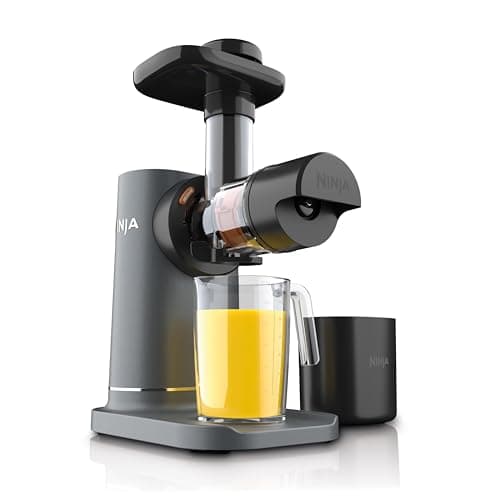
Ninja Ninja NeverClog Cold Press Juicer (JC151)
Ninja NeverClog Cold Press Juicer (JC151)

The best juicer for most kitchens, because it puts slow-auger extraction at a price the fast machines occupy. Ninja publishes a 150-watt high-torque auger, two interchangeable pulp filters so you set how much fiber comes through, two one-touch programs, and - the part that decides whether a juicer gets used twice - every part that touches juice rated dishwasher-safe. It is the complete answer rather than the cheapest or the highest-yielding one.

Best overall
8.2
$149.95Amazon
02
Breville Breville Juice Fountain Cold (BJE430SIL)
Breville Juice Fountain Cold (BJE430SIL)

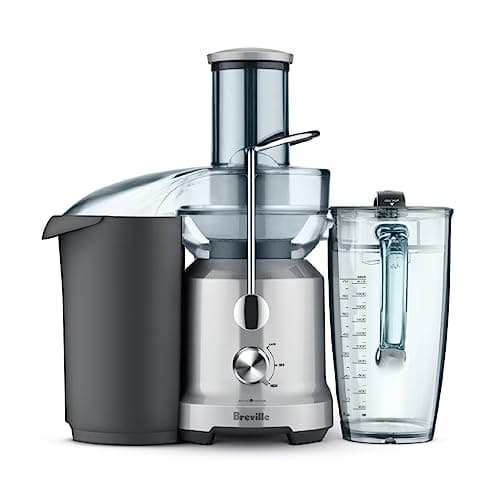
The fastest route from a bag of apples to a full jug, and the best-documented centrifugal machine here. Breville publishes an 850-watt motor, a 3-inch chute that swallows whole fruit without prep, a 70-ounce jug with a froth separator, a 3.6-quart pulp container and an Italian-made precision mesh filter. Its Cold Spin claim is specific enough to check: Breville states the system has been shown to transfer less than 1.8 degrees Fahrenheit to the juice.

Best centrifugal
8.0
$199.95Amazon
03
Omega Omega Cold Press Juicer (triple-stage, 80 RPM)
Omega Cold Press Juicer (triple-stage, 80 RPM)

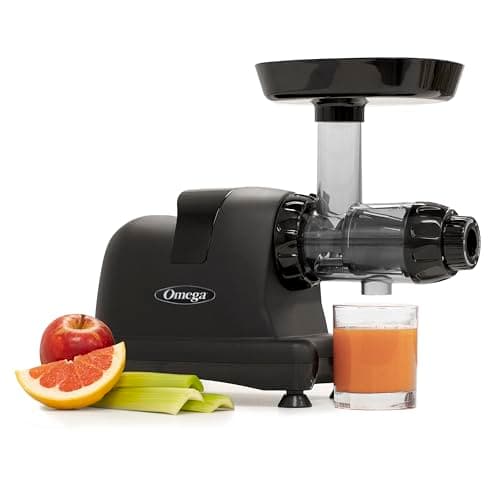
The pick for anything fibrous. A horizontal auger turning at a published 80 RPM through a triple-stage screw is the arrangement that gets juice out of celery, kale, chard and wheatgrass, which a spinning disc fundamentally cannot. Omega's listing publishes a 200-watt motor and an all-in-one spec: the same body makes nut butters, baby food, pasta and sorbets, which is the real argument for a horizontal machine over a vertical one.

Best for leafy greens
6.8
$199.87Amazon
04
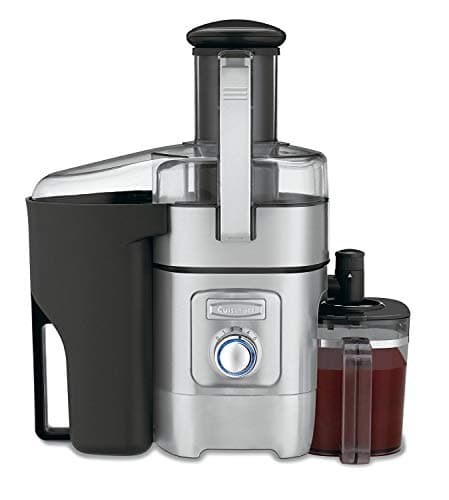
Cuisinart Cuisinart Die-Cast Juice Extractor (CJE-1000)
Cuisinart Die-Cast Juice Extractor (CJE-1000)

The centrifugal machine to buy for hard produce and big batches. A published 1,000-watt motor, five speeds on a dial rather than the usual one or two, a 3-inch feed tube, a 1-liter juice pitcher and a 2-liter pulp container - and a die-cast metal body rather than the molded plastic the rest of the price bracket uses. Cuisinart publishes a 3-year limited warranty, which is the longest verifiable one here outside the premium pick.

Best for hard produce
7.6
$199.95Amazon
05
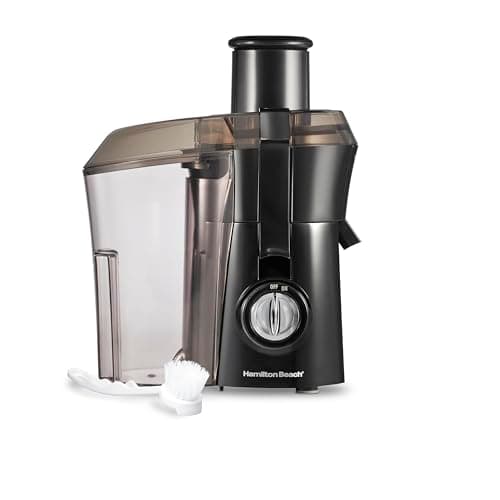
Hamilton Beach Hamilton Beach Big Mouth Juice Extractor
Hamilton Beach Big Mouth Juice Extractor

A genuine juicer for well under a hundred dollars, and the right first machine if you are not yet sure you will keep juicing. Hamilton Beach publishes an 800-watt motor, the 3-inch Big Mouth chute that takes whole fruit, and BPA-free dishwasher-safe parts - the pulp bin, juice bowl, lid and pusher all go in. That is the core of a centrifugal juicer with nothing missing except refinement.

Best budget
7.4
$74.95Amazon
06
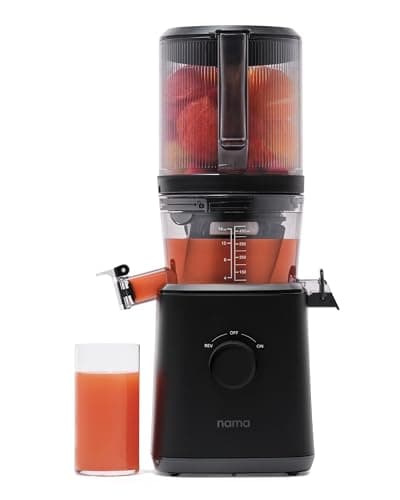
Nama Nama J2 Cold Press Juicer
Nama J2 Cold Press Juicer

The buy-it-once pick, and the only machine here you do not have to stand over. Nama publishes a 200-watt motor at 50 RPM, a wide hands-free hopper that takes a whole recipe at once, and a 15-year warranty on all parts - the longest published guarantee in this category by a decade. You load it, close the lid, and it feeds itself while you do something else, yielding a stated 16 to 32 ounces per load.

Best buy-it-once
8.0
$599.00Amazon

#ad · Live prices from the Amazon Product API, as of October 25, 2026. Where we have no verified live price, we show none — a gap beats a number that has rotted.

In detail

The picks, in full

01
Ninja Ninja NeverClog Cold Press Juicer (JC151)

Best overall

Ninja NeverClog Cold Press Juicer (JC151)

150 W high-torque auger24 oz jug / 36 oz pulp bin2 pulp filtersDishwasher-safe juice parts
8.2/10

The best juicer for most kitchens, because it puts slow-auger extraction at a price the fast machines occupy. Ninja publishes a 150-watt high-torque auger, two interchangeable pulp filters so you set how much fiber comes through, two one-touch programs, and - the part that decides whether a juicer gets used twice - every part that touches juice rated dishwasher-safe. It is the complete answer rather than the cheapest or the highest-yielding one.

Yield
9
Prep time
6
Cleaning
9
Published specs
8
Value
9

Pros

  • Cold-press extraction at roughly centrifugal money, which nothing else here manages
  • Two pulp filters published - less pulp or lots of pulp, chosen at the machine rather than with a sieve
  • Ninja publishes dishwasher-safe for all juice-contact parts, so cleaning is not a negotiation
  • Quiet in the way every slow juicer is quiet; this is not a machine you avoid using early in the morning
  • Two one-touch programs instead of a speed dial you have to learn

Cons

  • The 24-ounce jug is the smallest catch volume on this page - a family batch means emptying it mid-run
  • No wide hopper: you feed it piece by piece, standing there, unlike the Nama below
  • Narrow feed means real prep time on apples and beets
  • Ninja publishes no warranty length for this model that we could verify on its own US product page

Don't buy this if…

…you want a full pitcher of juice in under two minutes for four people. This is a slow machine by design and a small-batch one by capacity - the Breville or the Cuisinart below are the ones built for volume.

The reason this wins is a price-bracket argument rather than a performance one. Choosing cold-press extraction used to mean paying several times what a centrifugal machine cost, which is why most kitchens that wanted to juice ended up with a fast machine and a lot of wet pulp. Ninja put an auger into the mid-price bracket and published the two specifications that decide whether it gets used: the pulp filters and the dishwasher rating. The compromise it makes is capacity, and that is the honest reason it is not a unanimous pick — a 24-ounce jug suits one or two people and frustrates four.

$149.95View on Amazon

Price as of October 25, 2026. Prices change — Amazon's at checkout is the one that counts.

#ad · we may earn a commission from this link to Ninja NeverClog Cold Press Juicer (JC151)

02
Breville Breville Juice Fountain Cold (BJE430SIL)

Best centrifugal

Breville Juice Fountain Cold (BJE430SIL)

850 W3 in chute70 fl oz jug + froth separator3.6 qt pulp container
8.0/10

The fastest route from a bag of apples to a full jug, and the best-documented centrifugal machine here. Breville publishes an 850-watt motor, a 3-inch chute that swallows whole fruit without prep, a 70-ounce jug with a froth separator, a 3.6-quart pulp container and an Italian-made precision mesh filter. Its Cold Spin claim is specific enough to check: Breville states the system has been shown to transfer less than 1.8 degrees Fahrenheit to the juice.

Yield
6
Prep time
10
Cleaning
7
Published specs
9
Value
8

Pros

  • 3-inch chute takes whole apples - the lowest prep time on this page by a wide margin
  • 70-ounce sealed jug with a froth separator, so a family batch happens in one run
  • Breville publishes a measurable temperature claim rather than a vague cold-press adjective
  • Extra-large 3.6-quart pulp container means you are not emptying it every two apples
  • The most thoroughly documented product page of the six, which is why it scores well on specs

Cons

  • Centrifugal extraction: expect visibly less juice from the same produce than the slow machines here
  • Breville's product page states neither the number of speeds nor which parts are dishwasher-safe
  • Loud in the way every high-RPM juicer is loud
  • Froth and separation are a feature of the mechanism, not a defect - you will be using that separator
  • Large footprint; this is a machine that lives on the counter rather than in a cupboard

Don't buy this if…

…leafy greens, celery or wheatgrass are the reason you are buying a juicer. A spinning disc cannot get much out of a fibrous leaf; the Omega below is built for exactly that and this is not.

It is worth being precise about what Cold Spin is and is not. Breville is not claiming this is a cold press; it is claiming that its centrifugal system transfers less than 1.8 degrees Fahrenheit into the juice, which is a narrow, checkable statement about heat and says nothing about yield or oxidation. We rate it because a specific number is worth more than the adjectives the rest of the category uses — and because, heat aside, this is the machine that gets a family's juice made before anyone changes their mind about wanting it.

$199.95View on Amazon

Price as of October 25, 2026. Prices change — Amazon's at checkout is the one that counts.

#ad · we may earn a commission from this link to Breville Juice Fountain Cold (BJE430SIL)

03
Omega Omega Cold Press Juicer (triple-stage, 80 RPM)

Best for leafy greens

Omega Cold Press Juicer (triple-stage, 80 RPM)

80 RPM published200 WTriple-stage augerHorizontal, all-in-one
6.8/10

The pick for anything fibrous. A horizontal auger turning at a published 80 RPM through a triple-stage screw is the arrangement that gets juice out of celery, kale, chard and wheatgrass, which a spinning disc fundamentally cannot. Omega's listing publishes a 200-watt motor and an all-in-one spec: the same body makes nut butters, baby food, pasta and sorbets, which is the real argument for a horizontal machine over a vertical one.

Yield
10
Prep time
4
Cleaning
5
Published specs
7
Value
8

Pros

  • 80 RPM with a horizontal auger is the configuration that actually extracts from leaves and stalks
  • Triple-stage screw is published, not implied - the pulp comes out notably drier than a centrifugal machine's
  • Doubles as a nut-butter, baby-food, pasta and sorbet attachment set, so it earns more of its footprint
  • Very quiet, and slow enough that it does not aerate the juice into foam

Cons

  • The narrow feed chute means the most prep of any pick here - everything gets cut to batons
  • Most parts to wash, and the screen needs brushing before the pulp dries into it
  • Omega's own site does not carry a page for this exact variant, so the warranty is not verifiable from the maker
  • Long horizontal footprint - it takes counter depth rather than height

Don't buy this if…

…you juice mostly whole fruit and value your mornings. The chopping this machine requires is the thing people quietly stop doing, and the Breville above removes it entirely.

A horizontal slow juicer is the specialist tool in this category and the scores above reflect that honestly: it wins on yield by a margin nothing else here approaches, and it loses on every convenience row. If your juice is apple, orange and carrot, you are paying in prep time for an advantage you will barely notice. If it is celery, cucumber, kale and ginger, this is the only pick on the page that will not disappoint you — and the dry pulp coming out of the end is the visible proof of where the difference goes.

$199.87View on Amazon

Price as of October 25, 2026. Prices change — Amazon's at checkout is the one that counts.

#ad · we may earn a commission from this link to Omega Cold Press Juicer (triple-stage, 80 RPM)

04
Cuisinart Cuisinart Die-Cast Juice Extractor (CJE-1000)

Best for hard produce

Cuisinart Die-Cast Juice Extractor (CJE-1000)

1,000 W5 speeds3 in feed tube2 L pulp bin / 1 L pitcher
7.6/10

The centrifugal machine to buy for hard produce and big batches. A published 1,000-watt motor, five speeds on a dial rather than the usual one or two, a 3-inch feed tube, a 1-liter juice pitcher and a 2-liter pulp container - and a die-cast metal body rather than the molded plastic the rest of the price bracket uses. Cuisinart publishes a 3-year limited warranty, which is the longest verifiable one here outside the premium pick.

Yield
6
Prep time
9
Cleaning
7
Published specs
9
Value
7

Pros

  • Five published speeds, so soft berries and hard beets are not run at the same setting
  • 1,000 watts is the highest published figure here, and dense root vegetables are the one place it matters
  • Die-cast metal housing instead of plastic, which is why it weighs what it weighs
  • 3-year limited warranty published, against nothing at all from most of this category
  • Removable parts published as dishwasher-safe, with a cleaning brush in the box

Cons

  • Around fifteen pounds - this is not a machine you lift in and out of a cupboard
  • Centrifugal, so the yield gap against the slow juicers here applies in full
  • Tall and wide; check your under-cabinet clearance before buying
  • Five speeds are five decisions, and the manual rather than the machine tells you which to use

Don't buy this if…

…you have a small kitchen. The weight and footprint are the price of the metal body, and a compact counter is the one situation where that trade stops making sense.

This is the pick for a specific household: one that juices a lot of carrots, beets and apples, and does it for more than one person at a time. The five-speed dial is not a gimmick in that context — a low speed moves soft fruit through without throwing it around the bowl, and the top speed is what a beet actually needs. The honest limit is that no amount of wattage converts a centrifugal juicer into a high-yield one, so if celery and greens creep into your shopping, this will be the wrong machine and the Omega above will be the right one.

$199.95View on Amazon

Price as of October 25, 2026. Prices change — Amazon's at checkout is the one that counts.

#ad · we may earn a commission from this link to Cuisinart Die-Cast Juice Extractor (CJE-1000)

05
Hamilton Beach Hamilton Beach Big Mouth Juice Extractor

Best budget

Hamilton Beach Big Mouth Juice Extractor

800 W3 in chuteBPA-free, dishwasher-safe partsCleaning brush included
7.4/10

A genuine juicer for well under a hundred dollars, and the right first machine if you are not yet sure you will keep juicing. Hamilton Beach publishes an 800-watt motor, the 3-inch Big Mouth chute that takes whole fruit, and BPA-free dishwasher-safe parts - the pulp bin, juice bowl, lid and pusher all go in. That is the core of a centrifugal juicer with nothing missing except refinement.

Yield
5
Prep time
9
Cleaning
8
Published specs
6
Value
9

Pros

  • By far the lowest price here, for a machine that does the same job as the mid-price centrifugal picks
  • 3-inch chute means no pre-cutting, which is the main thing budget juicers usually cut
  • Named dishwasher-safe parts - pulp bin, juice bowl, lid and pusher
  • Light enough to actually store in a cupboard between uses, unlike the Cuisinart

Cons

  • Single speed: soft fruit and hard beets run at the same setting whether that suits them or not
  • Smallest juice-catch capacity of the centrifugal picks - plan on emptying it
  • Molded plastic body and the noise that comes with it
  • Retailer listings state a 3-year limited warranty but we could not confirm that on Hamilton Beach's own page for this exact model number
  • Centrifugal yield, so the wet pulp is the real cost of the low price

Don't buy this if…

…you already know you will juice daily. At that frequency the yield gap pays for a better machine inside a year, and the Ninja at number one is the one to start from.

We keep a sub-hundred-dollar pick on roundups like this one for a reason that has nothing to do with price-shopping: juicing is a habit a lot of people try and abandon, and finding that out on the cheapest real machine in the category is much better than finding it out on the dearest. If the habit sticks, this machine will have told you what you actually juice, which is the information you need to spend properly the second time. The same logic drives our budget air fryer picks.

$74.95View on Amazon

Price as of October 25, 2026. Prices change — Amazon's at checkout is the one that counts.

#ad · we may earn a commission from this link to Hamilton Beach Big Mouth Juice Extractor

06
Nama Nama J2 Cold Press Juicer

Best buy-it-once

Nama J2 Cold Press Juicer

50 RPM200 WHands-free hopper15-year warranty published
8.0/10

The buy-it-once pick, and the only machine here you do not have to stand over. Nama publishes a 200-watt motor at 50 RPM, a wide hands-free hopper that takes a whole recipe at once, and a 15-year warranty on all parts - the longest published guarantee in this category by a decade. You load it, close the lid, and it feeds itself while you do something else, yielding a stated 16 to 32 ounces per load.

Yield
9
Prep time
8
Cleaning
8
Published specs
9
Value
6

Pros

  • Hands-free hopper: load the whole recipe, walk away, come back to juice
  • 15-year warranty on all parts published on Nama's own US product page - nothing else here is close
  • 50 RPM slow extraction, with the yield and low-foam behavior that comes with it
  • Fewer wet parts than a horizontal masticating juicer, and a published 12.1-pound weight that is manageable

Cons

  • The most expensive pick here by a wide margin - this is a several-hundred-dollar appliance
  • Nama publishes a yield per load rather than a hopper volume, so batch size is harder to plan than it should be
  • Published height is 17.7 inches, which will not clear a standard 18-inch under-cabinet gap with room to load it
  • Still a slow juicer: fibrous greens go through well, but a big pitcher takes real minutes

Don't buy this if…

…you are not already juicing several times a week. The hands-free hopper and the warranty are both arguments about years of use, and at a glass on Sunday they are an expensive convenience - the Ninja at number one does the same kind of extraction for a fraction of it.

The feature worth paying for here is not the motor, it is the lid. Every other slow juicer on this page requires a person holding produce and a plunger for the whole run, which is the reason a lot of expensive masticating juicers end up in cupboards. A self-feeding hopper converts juicing from a task you perform into a task you start. Pair that with fifteen published years of warranty on all parts and this is the only machine here whose price is defensible as a long purchase rather than an indulgence — provided you juice often enough to amortize it.

$599.00View on Amazon

Price as of October 25, 2026. Prices change — Amazon's at checkout is the one that counts.

#ad · we may earn a commission from this link to Nama J2 Cold Press Juicer

The published-specification table

Every figure below is one the maker or its own listing prints. The blanks are blanks because nobody publishes the number, not because we could not find it — and the pattern in the two speed columns is the whole argument of this page.

JuicerMechanismPublished wattsPublished RPMFeedWarranty published
Ninja JC151Auger (cold press)150 WNot publishedNarrow, piece by pieceNot verifiable
Breville BJE430SILCentrifugal850 WNot published3 in chuteNot stated on page
Omega triple-stageHorizontal auger200 W80 RPMNarrow, pre-cutNot verifiable
Cuisinart CJE-1000Centrifugal, 5 speeds1,000 WNot published3 in feed tube3 years limited
Hamilton Beach Big MouthCentrifugal, 1 speed800 WNot published3 in chuteRetailer-stated only
Nama J2Vertical auger, hands-free200 W50 RPMWide hopper15 years, all parts

Read down the two speed columns. Not one machine publishes both numbers, and that is not an oversight — it is each maker printing the figure that flatters the mechanism it chose. The warranty column is the other one worth your attention: in a category of moving screws and mesh screens, four of six makers publish nothing you can hold them to.

Which juicer suits what you actually juice

  • Apples, oranges, carrots, whole and in volume. A centrifugal machine with a 3-inch chute. The yield penalty is real but hard produce narrows it, and the five minutes you save on prep every single morning is what decides whether you keep juicing at all.
  • Celery, kale, chard, parsley, wheatgrass. A slow auger, and preferably a horizontal one. A spinning disc has almost nothing to grip on a leaf; it shreds it and throws it into the pulp bin damp. This is not a yield preference, it is a mechanism requirement.
  • Ginger, turmeric and other hard roots. Either mechanism manages, but watch the published speed options. A single-speed centrifugal machine run at full tilt on ginger is the classic way to end up with a warm, foamy juice.
  • Soft fruit: berries, peaches, melon. A slow juicer, every time. Soft produce is where the centrifugal yield gap is at its widest, because there is nothing firm for the disc to grate against.
  • Nut milks, sorbets, baby food.A horizontal masticating machine with published attachments — the Omega pick here states all four jobs on its listing. Nothing centrifugal does any of them.

The running costs nobody puts on the box

Electricity is not one of them. Even the 1,000-watt Cuisinart runs for a minute or two at a time, which is a rounding error next to an oven — the arithmetic we set out on the energy-efficient appliances page applies here as it does everywhere else on this hub. The real costs are produce and parts. Produce is where the yield figure cashes out: if a slow juicer returns meaningfully more juice per pound than a fast one, then over a year of regular juicing the cheaper machine can be the one with the higher total cost. Parts are the quieter one. Mesh screens tear, augers wear, and gaskets perish. That is why the warranty column above is not a formality, and why the pick with fifteen published years on all parts earns its bracket.

What a juicer does not replace

Three jobs sit outside this category no matter which machine you buy:

  • Smoothies. A juicer removes fiber by design; a smoothie is fiber. If what you want is a thick drink with the whole fruit in it, you want a blender, and a juicer will be a disappointing and expensive way to find that out.
  • Soups and sauces. Hot liquid and a mesh strainer are not friends. That is an immersion blender's work.
  • Chopping, shredding and dough. A food processor's job — blender vs food processor sorts out which of those two belongs on your counter.

The short version

Ignore the wattage unless you juice beets. Decide instead whether your shopping list is mostly hard whole fruit (buy centrifugal, save the prep time) or mostly leaves and stalks (buy an auger, accept the chopping). If you want one answer and no further reading, it is the Ninja NeverClog JC151: cold-press extraction, dishwasher-safe parts, mid-price. The rest of our picks across this part of the kitchen are on the kitchen appliances hub, and the best kitchen appliance brands page covers who is reliable across more than one category.

How we picked

We did not lab-test this gear

Everyone in this category says they tested twenty air fryers. We have not lab-tested any of these, and we say so. What we did instead: compiled the published specifications — wattage, capacity, materials — worked out what each machine actually costs to run at the national electricity rate, read the manuals and owner reviews, and scored each one against a published rubric. The scores are judgments from documented research — not measurements we took, because we do not have a lab and we will not pretend we do. Where a number came from someone else's work, we name them in Sources.
Questions

Frequently asked

What is the best juicer?
The Ninja NeverClog Cold Press Juicer (JC151). It is the only pick on our page that puts slow auger extraction in the mid-price bracket, publishes two pulp filters so you choose the fiber level, and rates every juice-contact part as dishwasher-safe. If you juice mostly leafy greens, the Omega horizontal masticating pick beats it on yield; if you need a family-sized jug in two minutes, the Breville Juice Fountain Cold is the one.
Is a masticating juicer really better than a centrifugal one?
On yield, the published evidence points that way. A 2024 comparison in Food Science and Engineering measured pineapple yield at about 92 percent for cold-press extraction against about 47 percent for a centrifugal machine, and observed more heat transfer and more air bubbles in the centrifugal juice. That is one study on specific produce, and the gap narrows on hard carrots and apples. On prep time and speed the centrifugal machine wins outright, which is why we rank one second.
How many watts should a juicer have?
It depends which half of the category you are in, which is the trap. Centrifugal juicers publish 800 to 1,000 watts because they need speed; slow masticating juicers publish 150 to 200 watts because they need torque at 50 to 80 RPM. A 150-watt auger is not a fifth as capable as an 850-watt centrifugal machine - it is a different mechanism doing the same job more slowly and with less waste.
Can a centrifugal juicer handle celery and kale?
Poorly. A centrifugal juicer works by grating produce against a fast-spinning disc, and a leaf or a fibrous stalk gives it very little to grate. You get damp pulp and a thin yield. If celery, kale, chard or wheatgrass are the reason you are buying a juicer, a slow horizontal auger is a mechanism requirement rather than an upgrade.
How long does fresh juice keep?
Treat it as a same-day drink and refrigerate it immediately in a sealed container filled to the top. Cold-press juice is widely given about a three-day window in commercial settings, and slow extraction incorporates less air, which is the mechanism behind that difference - but we have not found a controlled refrigerated study directly comparing home machines, so we would not promise you a specific number of hours.
Are juicer parts dishwasher-safe?
Sometimes, and it is worth checking before you buy rather than after. Ninja publishes dishwasher-safe for all juice-contact parts on the JC151, Hamilton Beach names the pulp bin, juice bowl, lid and pusher, and Cuisinart states that its removable parts go in. Breville's own product page for the BJE430SIL does not say. Whatever the answer, the mesh screen still wants brushing out before the pulp dries into it.

Keep reading

Receipts

Sources

We do not run a testing lab, and we do not pretend to. Where a measured number came from someone else's work, we name them and link them. Where we could not verify something, we say so on the page rather than quietly leaving it out. Read our full method.