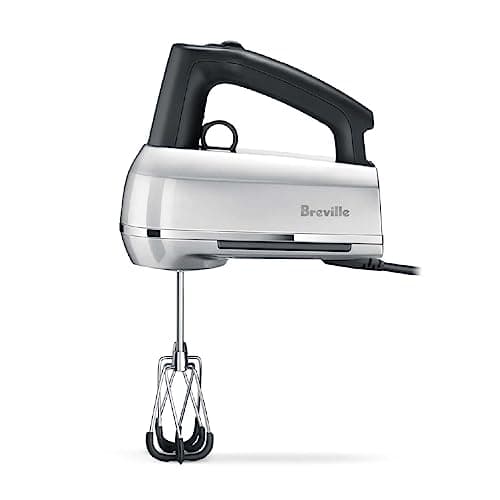
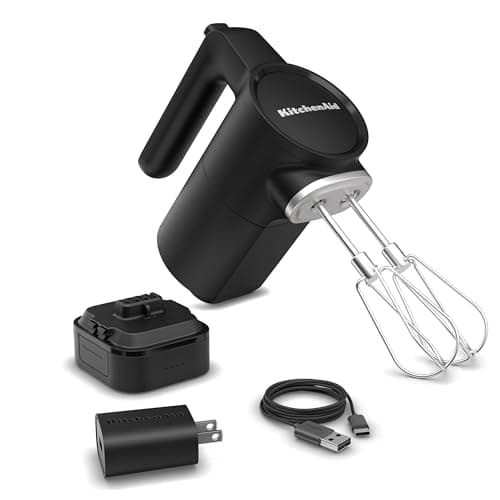
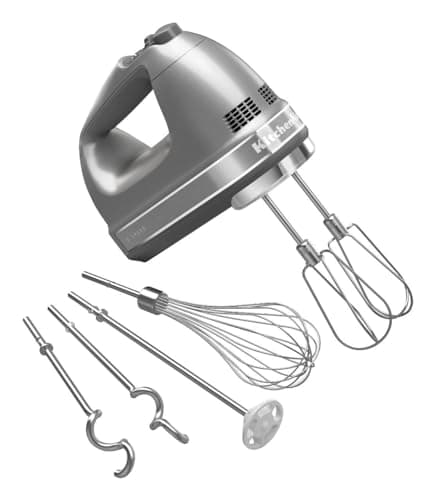
Buy the KitchenAid 9 Speed Hand Mixer (KHM926).A hand mixer is a motor, a speed dial and two beaters, and the only one of those three you ever actually touch is the beaters. KitchenAid ships this one with post-free stainless Turbo Beater II beaters, a pro whisk and a dough hook, all rated dishwasher-safe — which is the full job for most people. If you bake enough to care about scraping the bowl, the Breville at number two has the most interesting beaters in the category. If the budget is the whole question, the Hamilton Beach at number five is a genuinely good mixer with one specific compromise we name.
Here is why this page is not ranked on power. Wattage is the number every listing leads with and it predicts almost nothing: the most expensive mixer in this group publishes no wattage at all on its own product page, the cheapest publishes 250 watts, and a mid-priced Braun publishes 350. None of that ordering matches how these machines behave, because a hand mixer is not power-limited for the work people give it — creaming butter, whipping cream, beating eggs, and at the hard end a single batch of cookie dough. What it is limited by is the shape of the beaters and how controllable the bottom of the speed range is.
The four things we ranked on
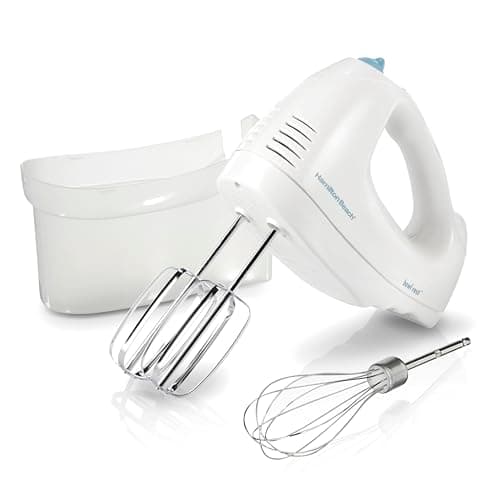
- Beater design, post or no post.Older beaters have a central post with wire loops around it. Dough climbs that post, batter packs into it, and washing it means getting into the gap. Modern stainless beaters delete the post entirely — KitchenAid calls its version Turbo Beater II, and the published description of our budget pick says “Traditional Beaters” in so many words, which is the maker telling you honestly which design you are getting. This is the single clearest physical difference across the field and the easiest thing to check before you buy.
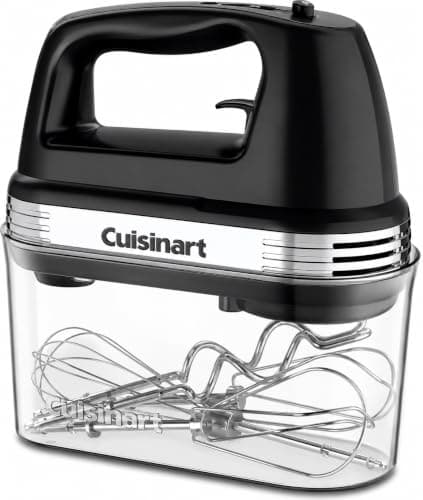
- How slow speed 1 actually is. The complaint nobody anticipates is flour on the ceiling. Two makers here publish something about the bottom of the range rather than the top: Cuisinart states three low mixing speeds, and KitchenAid states a soft-start feature on its cordless model. Everybody else publishes a speed count and leaves you to find out. A nine-speed mixer whose first speed throws flour is a one-speed mixer with eight decorations.
- What is in the box. Beaters only, or beaters plus dough hooks plus a whisk. Dough hooks are what let a hand mixer do the one job people buy a stand mixer for, and a balloon whisk is what makes it competent at cream and egg whites. Buying those attachments separately afterward routinely costs more than the gap between two mixers.
- Where it lives between uses. A snap-on storage case is an unglamorous feature that decides whether the attachments are still together in two years. The mixers here split roughly evenly on this, and the ones without a case are the ones whose dough hooks go missing.
What wattage does and does not tell you
The published figures across this page run from 250 watts to 350 watts, with two models publishing none. If power were the story, the ordering would be obvious and this would be a short page. It is not, for a structural reason: the load on a hand mixer is small and intermittent, and the limit you actually hit is torque at low speed in stiff dough, which no maker publishes and which wattage does not describe. Cuisinart comes closest by publishing that its motor feeds in extra power automatically under load, which is a claim about behavior rather than about a number.
We apply the same reasoning on the immersion blender roundup, where our winner also publishes the lowest wattage in its field. In both categories the number on the box is the one the whole industry prints because it is easy to print.
One size question before the picks. If you are weighing a hand mixer against a full stand mixer rather than against another hand mixer, that is a different decision and we have given it its own page: stand mixer vs hand mixer works through which jobs each one physically cannot do, including the batch-size ceiling nobody mentions. The stand mixer roundup has the picks on that side.
The published-specification table
Everything in this table is a figure or a phrase the maker prints itself. The blanks are blanks because the maker publishes nothing, not because we could not be bothered.
| Mixer | Speeds | Published watts | Beater design | Low-speed claim |
|---|
| KitchenAid KHM926 | 9 | Not published | Post-free stainless | None published |
| Breville BHM800 | 9 + boost | Not published | Rubber-edged scrapers | None published |
| Cuisinart Power Advantage Plus | 9 | 220 W | Conventional, extra-long | Three low mixing speeds |
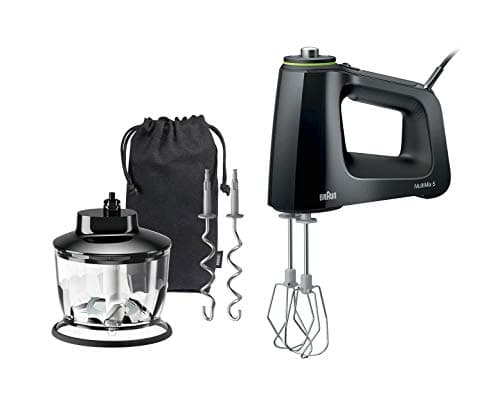
| Braun MultiMix 5 | 9 + turbo | 350 W | Conventional | None published |
| Hamilton Beach 62682G | 6 | 250 W | Traditional, center post | None published |
| KitchenAid Go KHMR762 | 7 | Not published | Stainless | Soft start |
Two columns are doing the work. The beater column is the physical difference you will notice every time you wash up, and the low-speed column is nearly empty — four of six makers publish nothing at all about the end of the dial that causes the mess. The wattage column, meanwhile, has the most expensive and the best-equipped mixers both reading “not published”, which is the clearest possible evidence that it is not the spec the category competes on.
Which attachments actually matter
- Beaters. Included with everything. The only question is the design, and post-free stainless is the one to want: there is nothing for dough to wrap around and nothing to clean inside.
- Dough hooks. The attachment that changes what a hand mixer can do. A pair of spiral hooks will handle a single batch of bread or cookie dough; without them, stiff dough stalls the beaters and strains the motor. Three of our six picks include them.
- A balloon whisk. The difference between acceptable and good on cream, egg whites and meringue. A beater aerates incidentally; a whisk is built for it.
- A scraper edge. Rare, and only Breville publishes it here. Worth real money if you bake weekly, and close to pointless if you do not.
- A storage case. Not a cooking feature and still the thing that decides whether the dough hooks exist in two years.
When a hand mixer is the wrong tool
Three jobs sit outside this category no matter which mixer you buy, and it is cheaper to know that now:
- Double batches and long kneads. A hand mixer is a two-handed tool with no bowl of its own. If you make bread weekly or double every cookie recipe, the right machine is on the stand mixer page — and stand mixer vs hand mixer sets out exactly where the line falls.
- Pureeing and blending. Beaters incorporate air; they do not cut. Soup, smoothies and sauces want a blade, which means an immersion blender or a countertop jug.
- Chopping, slicing and dough that is really pastry.That is a food processor's work — blender vs food processor covers which of those two you need.
The short version
Ignore the wattage. Look at the beaters, find out whether the maker says anything at all about its slowest speed, and count what is in the box. If you want one answer and no further reading, it is the KitchenAid KHM926. If you bake, it is the Breville. If the budget is fixed, it is the Hamilton Beach, and the compromise you are accepting is the center post on the beaters. Our wider picks across this part of the kitchen are on the kitchen appliances hub, and the best kitchen appliance brands page covers who is reliable across more than one category.
How we picked
We did not lab-test this gear
Everyone in this category says they tested twenty air fryers. We have not lab-tested any of these, and we say so. What we did instead: compiled the published specifications — wattage, capacity, materials — worked out what each machine actually costs to run at the national electricity rate, read the manuals and owner reviews, and scored each one against a published rubric. The scores are judgments from documented research — not measurements we took, because we do not have a lab and we will not pretend we do. Where a number came from someone else's work, we name them in Sources.