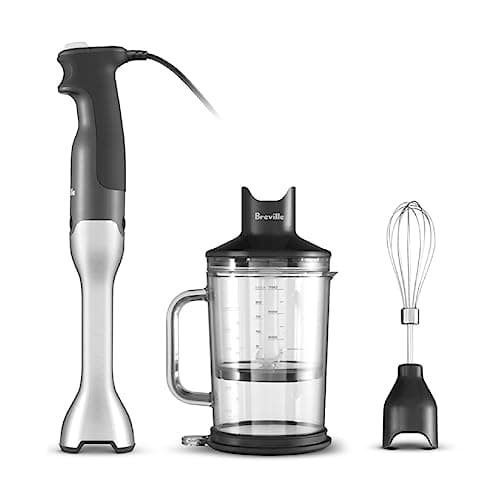
Buy the Breville Control Grip, and ignore the fact that it claims the least power on this page. Breville publishes 280 watts. The cheapest machine here publishes 500, and the most expensive publishes 625. The Breville is still the one we would put in a kitchen, because the thing that makes a stick blender pleasant or infuriating is not the motor — it is the shape of the shroud around the blade, and whether the wand is long enough to reach the bottom of the pot you already own.
That is an unusual claim for a shopping page, so here is the evidence up front: the wattage figures in this category range from 280 to 625 across six machines that all do the same job at roughly the same speed, and only three of the six makers will publish a shaft length at all. The number everybody prints is the one that matters least, and the number that decides whether you can blend a stockpot of soup without your knuckles near the surface is the one most of them leave off the box.
The five things we ranked on
- Blade-guard geometry.A stick blender either has a bell-shaped guard around the blade or an open cage. The bell matters twice: it stops the blade suctioning itself to the bottom of the pan, and it keeps hot soup circulating through the blade instead of being flung up the sides. Two of our six publish a bell design and name it. None of the other four publishes one, and the standard alternative is an open blade cage — which is why cheap stick blenders have a reputation for splattering.
- Published shaft length. Reach is the one spec that can make a machine useless to you specifically. An 8-inch wand in a 10-inch stockpot means your hand ends up close to the surface of boiling soup. Only Breville (8 in.), Cuisinart (8 in.) and All-Clad (9-1/4 in.) publish a figure for the models here. Measure the inside depth of the pot you make soup in before you spend anything.
- Speed control, and what kind. There is a real difference between two buttons and a variable control. Fixed-high aerates soup into foam and takes whipped cream straight past the point you wanted. The control type also changes how you hold the thing: a trigger lets your hand rest, a push-button means thumb pressure for the whole blend.
- Cleaning, and whether the wand comes off. The part that goes in the food should be the only part you wash. A detachable shaft is a genuine convenience feature; on a fixed-shaft machine you are rinsing a blade two inches below a motor housing that must not get wet.
- Value, measured in pieces you will actually use. Almost every one of these ships with a whisk or a chopper bowl, and the honest truth is that most people use the wand and nothing else. We scored the extras on whether they replace another appliance or just occupy a cupboard.
What we did not rank on, and why
Wattage. These are corded motors spinning a small blade in a narrow column of food. Within this field, published input power has no visible relationship to how well a machine purees soup, and the ranking below inverts it twice over: the lowest figure comes first and the highest comes fifth. Wattage starts to matter when you are grinding something genuinely hard, which is not what this appliance is for. If you want the long version of why a peak-watts number is the least trustworthy figure in small appliances, we go through it on the most energy-efficient kitchen appliances, where blenders are one of the three categories that publish nothing you can check.
Cordless. Battery stick blenders exist and we are not recommending one yet. The entire appeal of this tool is that it is always ready, and a cordless one is a thing you discover is flat while the soup goes cold. When a battery model publishes a real run-time at full speed rather than a vague minute count, we will revisit it.
You may not need one at all
A stick blender is for things that are already in a pot: soup, sauce, apple sauce, baby food, and emulsions like mayonnaise and hollandaise that come together faster in a narrow jar than in a wide one. It is bad at the thing people buy it for by mistake, which is smoothies — it cannot do ice, it struggles with fibrous greens, and it is maddening in anything shallow. If smoothies are the job, you want a countertop machine from our blender roundup, and we lay out which jobs belong to which appliance in immersion blender vs countertop blender. If you own a decent countertop blender already and you do not make soup, skip this category entirely and buy nothing.
The wattage table, which is the argument of this page
Every figure below is the published specification for that exact model, taken from the maker's or the retailer's own listing. Where a cell says “Not published,” we could not find a figure and we are not going to estimate one. Read the first two columns together: the machine we rank first claims the least power, and the machine that claims the most is ranked fifth.
| Machine | Published watts | Published shaft length | Bell guard | Our rank |
|---|
| Breville BSB510XL | 280 W | 8 in. | Yes, published | 1 |
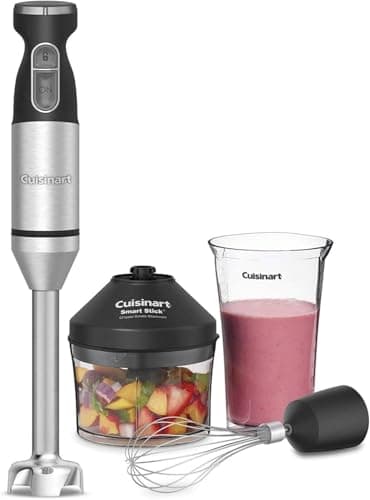
| Cuisinart CSB-179 | 300 W | 8 in. | Not published | 2 |
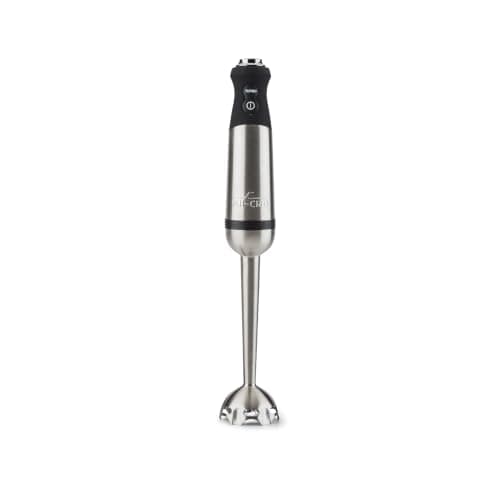
| All-Clad Electrics | 600 W | 9-1/4 in. | Not published | 3 |
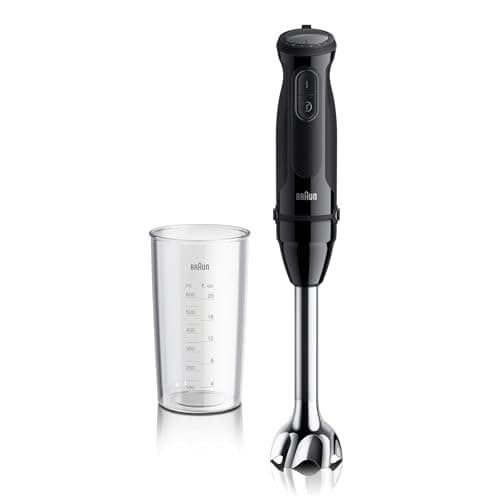
| Braun MQ50001M Vario | 500 W | Not published | Not published | 4 |
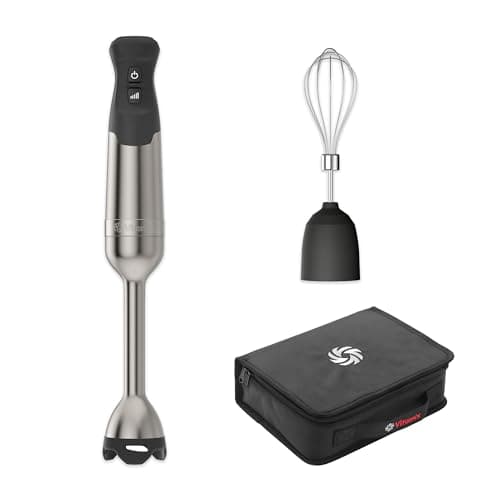
| Vitamix 5-Speed | 625 W | Not published | Yes, published | 5 |
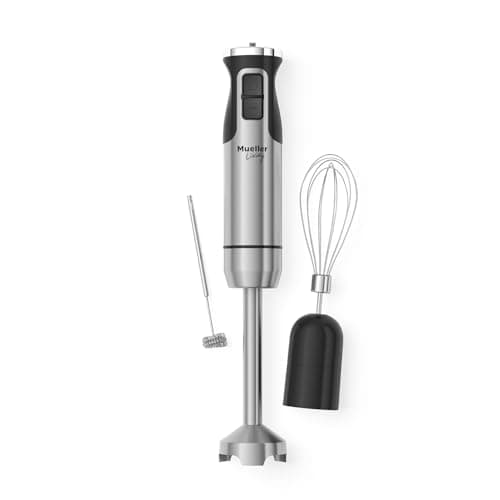
| MuellerLiving Ultra-Stick | 500 W | Not published | Not published | 6 |
Half the makers here will not tell you how long the wand is. That is the state of a category that has been selling the same object for decades, and it is why “measure your pot first” is the most useful sentence on this page.
Why the bell shape matters more than the motor
Put an open blade cage flat on the bottom of a pan full of soup and two things happen. The blade clears the liquid immediately beneath it, the pressure difference holds the cage down, and the machine stalls against the base — the suction-cup effect anyone who has used a cheap stick blender recognizes. Then, when you break it free, that pressure difference releases and soup goes up the wall. A bell-shaped guard fixes both at once: it holds the blade a fixed distance off the base and leaves a path for liquid to flow in at the sides and out at the top. Breville calls it a scratch guard, which undersells it; Vitamix describes it as reducing suction and helping ingredients flow through the blades, which is exactly right.
Nothing about that is a function of power. It is a molded shape, it costs almost nothing to manufacture, and it is the clearest line between a machine you will keep and one you will quietly stop using.
How to use one without redecorating the kitchen
- Put the head all the way in before you switch on, and switch off before you lift it out. Nearly every splatter story is a blade spinning at the surface.
- Take the pot off the heat. You are not cooking any more, and a simmering pot plus a spinning blade is how people get scalded.
- Tilt the pot rather than chasing the food. Pooling the last of a soup in one corner is faster than ten more passes.
- Start low. High speed into thin liquid aerates it; you end up with a paler, foamier soup than you wanted and you cannot un-whip it.
- Clean it in the pot.Hot water, a drop of dish soap, two seconds on low, rinse. Then dry the wand properly — this is the part people skip, and water sitting in the bearing is what ends these machines.
What the attachments are really worth
Four of the six machines here ship with a whisk, and it is the most useful extra: for one or two egg whites or a cup of cream, a stick-blender whisk beats getting a stand mixer out and is far easier to wash. The chopper bowls are more marginal. A 3-cup chopper will do herbs, nuts, a small onion and breadcrumbs, and it genuinely replaces a mini food processor for those jobs — but it does not replace a real one, and if you were thinking of skipping that purchase, read our food processor roundup first. The milk frother on the Mueller is a nice object that most people use twice.
Where this sits against the rest of the counter
A stick blender is the cheapest appliance in this hub that genuinely earns its space, because it stores in a drawer. That is the whole argument for it in a small kitchen, and it is why it belongs alongside our appliances for small kitchens page and its jobs-per-square-foot test. If you are buying for someone else, the Cuisinart is the safest version of this gift: cheap enough to not be awkward, good enough to not be replaced.
The materials question, briefly and honestly
Stick blenders are mostly fine on this front, and we are not going to inflate it. The blade and the lower shaft are stainless on all six of these; what varies is whether the guard and the housing are plastic, and the guard is the only plastic part that touches hot food. Contact is seconds, not the half-hour a rice cooker pot gets, which is the distinction our non-toxic kitchen appliances page ranks on. If you want plastic out of the food path entirely, the honest answer in this category is a stainless wand with a metal guard, and none of the six here publishes one.
The short version
Measure your pot. Then buy the Breville if you make soup regularly, the Cuisinart if you want most of it for a third of the money, and the All-Clad if your stockpot is deeper than eight inches. Ignore the wattage on all of them.