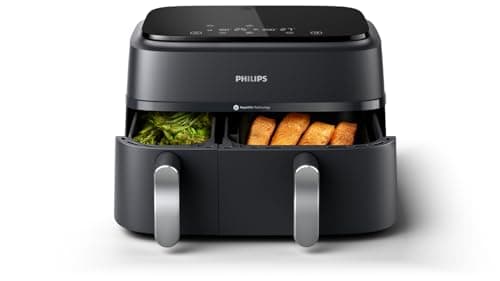
Philips brought the domestic air fryer to market, patented the airflow design everyone else worked around, and then watched Ninja and Instant take the volume by shipping features faster and cheaper. The 3000 Series Dual Basket is the company doing the sensible thing: building the format that is actually selling, with the engineering discipline that made its reputation.
Nine and a half quarts across two independent zones puts this squarely against the Ninja DZ201, which is the machine most people in this market are choosing between. The interesting question is not which has more functions — it is whether Philips' build quality and parts longevity are worth what is usually a higher price. This review answers that, and it does not answer it the same way for everyone.
Two zones is a capacity number and a scheduling feature
The reason dual-basket machines took over the family end of this market is not the total quart figure — it is that a main and a side can cook at different temperatures and land at the same moment. That turns an air fryer from an appliance that makes one component of dinner into one that can make the whole thing. At 9.5 quarts total, each zone here is a little under five quarts, which is enough for a real portion rather than a token one. The number to shop on is always the individual zone size, never the headline total — a point we make at length in single vs dual basket.
Philips versus Ninja, honestly
On features per dollar, Ninja wins, and anyone telling you otherwise is being sentimental about who invented what. The DZ201 typically costs less, offers comparable capacity, and Ninja iterates faster. What Philips offers instead is a build that feels engineered rather than assembled, a shorter and more honest function list, and a long track record of parts and support remaining available years after a model is discontinued. If you replace appliances when something better arrives, buy the Ninja. If you buy an appliance intending it to be the last one for a decade, the Philips argument is real. Our kitchen appliance brands guide applies exactly this test across the whole counter.
Running cost, worked out
Two zones running at once draw more than one, and there is no way around that. Machines in this class typically sit in the 1,700 to 2,000 watt range with both zones active, which puts a twenty-minute two-zone cook at roughly eleven to fourteen cents at the U.S. average residential electricity rate. That looks like the most expensive number on this site until you compare it with the alternative: heating a full-size oven for forty minutes to make the same main and side, which costs several times more. The two-zone machine is expensive per cook and cheap per meal. Your own figure is a rate away in the running-cost calculator.
The footprint problem nobody mentions
Side-by-side dual baskets are wide. This is a machine that will claim a serious run of counter and keep it, because a 9.5-quart appliance is not something you lift in and out of a cupboard. Measure before you order — and if the width is the obstacle rather than the price, the stacked Ninja DoubleStack XL solves exactly that problem by going vertical instead. That machine is the only real alternative if your kitchen cannot spare the width.
Who should skip it
One- and two-person households, without hesitation: nine and a half quarts is a great deal of machine for two portions, and the small air fryer roundup is where you should be. Anyone avoiding nonstick coatings, since Philips uses conventional coated baskets here. And anyone whose priority is the lowest price per quart, where the value brands in our budget roundup will beat this comfortably — at the cost of exactly the longevity that is the reason to consider Philips in the first place.
How we picked
We did not lab-test this gear
Everyone in this category says they tested twenty air fryers. We have not lab-tested any of these, and we say so. What we did instead: compiled the published specifications — wattage, capacity, materials — worked out what each machine actually costs to run at the national electricity rate, read the manuals and owner reviews, and scored each one against a published rubric. The scores are judgments from documented research — not measurements we took, because we do not have a lab and we will not pretend we do. Where a number came from someone else's work, we name them in Sources.