Skip to content
Preheat Club

Beyond air fryers · Kitchen Appliances

The best rice cookers, ranked by what changes the rice

A rice cooker is a pot with a thermostat, until it isn’t. The difference between $25 and $280 is whether the machine adjusts as it cooks — and whether the pot has a coating on it at all.

By Stephen V.Updated How we review
#ad

We earn a commission when you buy through our Amazon links, at no extra cost to you. It never changes a verdict, and we say so when the cheaper product is the better buy. How this works.

Every rice cooker works the same way at the bottom: heat the pot until the water is gone, at which point the temperature rises past 212°F and a thermostat or a magnet trips the machine to keep warm. A $23 cooker does exactly that, and for plain long-grain rice it does it well enough that most people never need anything else.

What the money buys above that is adjustment. Fuzzy-logic machines — Zojirushi’s Neuro Fuzzy is the reference — use a microcomputer to vary temperature and heating time through the cook rather than running one profile until the water is gone. Zojirushi describes it as the cooker thinking for itself and making fine adjustments, and the practical result is that brown rice, sushi rice, porridge and quick-cook settings all behave differently instead of sharing one program.

The second thing worth paying attention to is the pot itself. Almost every inner pot is nonstick-coated aluminium, and nonstick over years of scooping with a plastic paddle is the part that fails. Aroma’s Select Stainless line uses an uncoated food-grade 304 stainless inner pot, which is the same structural answer to the coating question we make for air fryers in are ceramic air fryers safe: nothing coated means nothing to wear off.

The short answer

Quick picks

#ProductBest forScorePrice
01
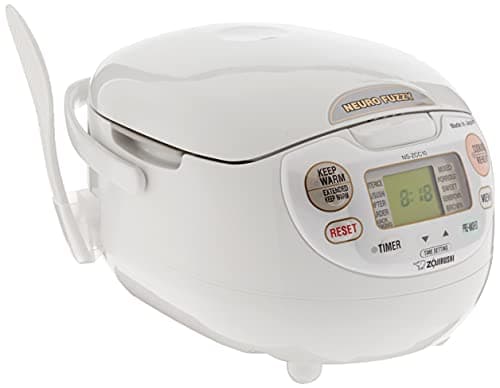
Zojirushi Zojirushi Neuro Fuzzy NS-ZCC10 (5.5 cup)
Zojirushi Neuro Fuzzy NS-ZCC10 (5.5 cup)

The machine everyone who cares about rice ends up owning. Zojirushi publishes 5.5 cups (1.0 L) at 120 V / 680 W, with menu settings for white in three textures, mixed, porridge, sweet, semi-brown, brown, rinse-free and quick cooking — each one a different heating profile rather than a different timer. Expensive, and the only one here we would call an heirloom purchase.

Anyone who eats rice more than twice a week
9.0
$279.95Amazon
02
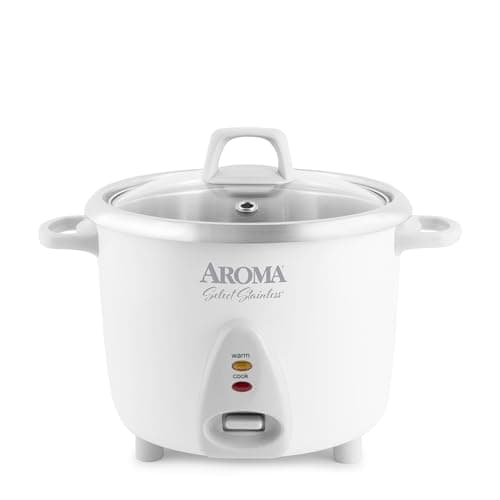
Aroma Aroma Select Stainless (uncoated pot, 14 cup cooked)
Aroma Select Stainless (uncoated pot, 14 cup cooked)

The coating-free answer, and the one we would buy if that is why you are shopping. Aroma’s inner pot is food-grade 304 stainless with no nonstick on it at all — nothing to scratch, nothing to wear off, dishwasher-safe along with the accessories. Rice sticks more than it does in a coated pot, which is the entire trade and an honest one.

Anyone who does not want a coated pot in the house
8.0
$44.99Amazon
03
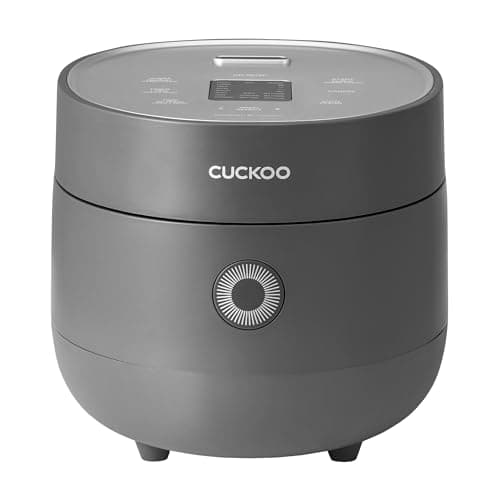
Cuckoo Cuckoo Micom Fuzzy Logic CR-0675FG (12 cups cooked)
Cuckoo Micom Fuzzy Logic CR-0675FG (12 cups cooked)

Fuzzy logic at roughly a third of the Zojirushi’s price, from the brand that dominates Korean kitchens. Micom control means real per-grain profiles rather than one thermostat, and 12 cups cooked is a genuinely family-sized machine. The obvious buy if you want the technology and not the heirloom.

Fuzzy-logic cooking without Zojirushi money
8.6
$104.99Amazon
04
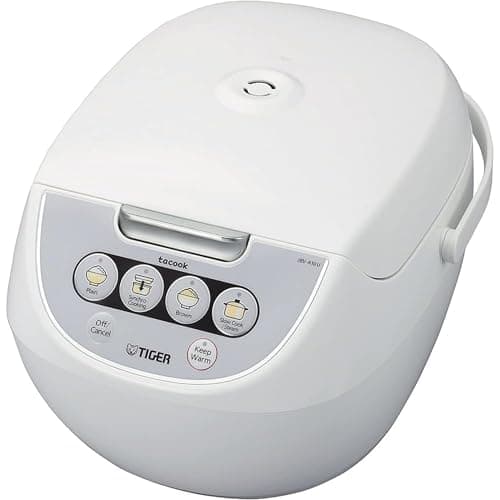
Tiger Tiger JBV-A10U Micom with Tacook (5.5 cup)
Tiger JBV-A10U Micom with Tacook (5.5 cup)

The one that cooks your main course while it cooks the rice. Tiger’s Tacook plate sits above the rice and steams a protein or vegetables in the same cycle, without the flavours crossing — a genuinely different capability rather than another preset, and the reason this machine has a following.

Cooking rice and a main course in one cycle
8.4
$109.99Amazon
05
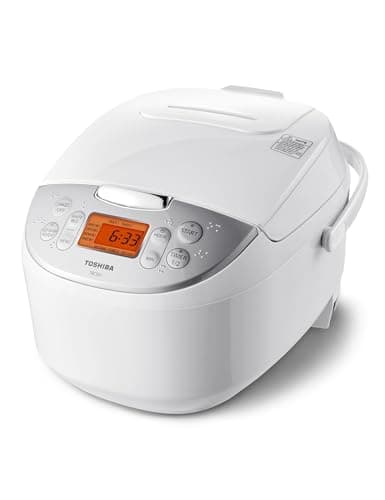
Toshiba Toshiba Fuzzy Logic Rice Cooker (6 cup uncooked)
Toshiba Fuzzy Logic Rice Cooker (6 cup uncooked)

The middle of the fuzzy-logic market, and a sensible one: six cups uncooked with seven cooking functions from a brand with a long history in Japanese rice cookers. It does what the expensive machines do at a price that does not require you to care very much about rice.

A first fuzzy-logic cooker at a sane price
8.2
$149.99Amazon
06
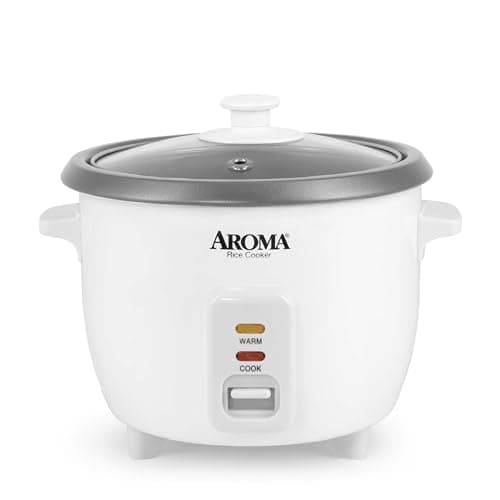
Aroma Aroma 3-Cup Uncooked Rice Cooker
Aroma 3-Cup Uncooked Rice Cooker

The honest bottom of the market. Three cups uncooked, one button, an automatic switch to keep warm, and a price that makes the whole debate above look slightly ridiculous if you cook plain white rice twice a month. It will not do brown rice well and it does not claim to.

One or two people, dorms, offices, plain white rice
7.4
$23.07Amazon

#ad · Live prices from the Amazon Product API, as of Aug 19, 2026. Where we have no verified live price, we show none — a gap beats a number that has rotted.

In detail

The picks, in full

01
Zojirushi Zojirushi Neuro Fuzzy NS-ZCC10 (5.5 cup)

Anyone who eats rice more than twice a week

Zojirushi Neuro Fuzzy NS-ZCC10 (5.5 cup)

5.5 cups / 1.0 L120 V / 680 WNeuro Fuzzy logic9 menu settings
9.0/10

The machine everyone who cares about rice ends up owning. Zojirushi publishes 5.5 cups (1.0 L) at 120 V / 680 W, with menu settings for white in three textures, mixed, porridge, sweet, semi-brown, brown, rinse-free and quick cooking — each one a different heating profile rather than a different timer. Expensive, and the only one here we would call an heirloom purchase.

Rice quality
10
Versatility
10
Keep warm
10
Build
9
Value
6

Pros

  • Fuzzy logic genuinely varies temperature and time through the cook
  • Separate profiles for white, sushi, brown, semi-brown, porridge and sweet rice
  • Extended keep-warm that holds rice without turning the bottom to glue
  • Measuring cups, spatula and holder included
  • The most reliable long-term reputation in the category

Cons

  • Costs more than five of the other machines on this page combined
  • 5.5 cups uncooked is plenty for four and tight for a crowd
  • Coated inner pot, like almost every machine here
  • The interface has a learning curve for something that cooks rice

Don't buy this if…

you make plain white rice twice a month — a $25 one-button cooker produces near-identical results for that job.

$279.95View on Amazon

Price as of Aug 19, 2026. Prices change — Amazon's at checkout is the one that counts.

#ad · we may earn a commission from this link to Zojirushi Neuro Fuzzy NS-ZCC10 (5.5 cup)

02
Aroma Aroma Select Stainless (uncoated pot, 14 cup cooked)

Anyone who does not want a coated pot in the house

Aroma Select Stainless (uncoated pot, 14 cup cooked)

14 cups cookedUncoated 304 stainless potAuto keep-warmDishwasher-safe
8.0/10

The coating-free answer, and the one we would buy if that is why you are shopping. Aroma’s inner pot is food-grade 304 stainless with no nonstick on it at all — nothing to scratch, nothing to wear off, dishwasher-safe along with the accessories. Rice sticks more than it does in a coated pot, which is the entire trade and an honest one.

Materials
10
Value
9
Rice quality
7
Versatility
7
Cleaning
7

Pros

  • Food-grade 304 stainless inner pot with no coating whatsoever
  • Inner pot and accessories go in the dishwasher
  • Automatic switch to keep warm with no monitoring
  • Cheapest route to a coating-free pot by a wide margin
  • Also does grains, oatmeal, soup, pasta and eggs

Cons

  • Rice sticks to bare stainless — soak the pot rather than scrubbing it
  • No fuzzy logic: one heating profile for everything
  • Brown rice results are noticeably behind the fuzzy-logic machines

Don't buy this if…

you cook brown or sushi rice often — one profile cannot serve both, and this is where fuzzy logic earns its money.

$44.99View on Amazon

$51.6013% off

Price as of Aug 19, 2026. Prices change — Amazon's at checkout is the one that counts.

#ad · we may earn a commission from this link to Aroma Select Stainless (uncoated pot, 14 cup cooked)

03
Cuckoo Cuckoo Micom Fuzzy Logic CR-0675FG (12 cups cooked)

Fuzzy-logic cooking without Zojirushi money

Cuckoo Micom Fuzzy Logic CR-0675FG (12 cups cooked)

12 cups cookedMicom fuzzy logicNonstick inner potKeep warm
8.6/10

Fuzzy logic at roughly a third of the Zojirushi’s price, from the brand that dominates Korean kitchens. Micom control means real per-grain profiles rather than one thermostat, and 12 cups cooked is a genuinely family-sized machine. The obvious buy if you want the technology and not the heirloom.

Rice quality
9
Value
9
Capacity
9
Versatility
8
Build
8

Pros

  • Genuine microcomputer control at a mid-range price
  • 12 cups cooked feeds a family without a second batch
  • Strong reputation for Korean short-grain and mixed-grain rice
  • Simpler interface than the Zojirushi

Cons

  • Coated inner pot, and coatings are the wear item on any cooker
  • Support and parts network in the US is thinner than Zojirushi’s
  • Larger footprint than the 5.5-cup machines

Don't buy this if…

you cook for one or two — a 12-cup machine spends its life two-thirds empty.

$104.99View on Amazon

$125.9917% off

Price as of Aug 19, 2026. Prices change — Amazon's at checkout is the one that counts.

#ad · we may earn a commission from this link to Cuckoo Micom Fuzzy Logic CR-0675FG (12 cups cooked)

04
Tiger Tiger JBV-A10U Micom with Tacook (5.5 cup)

Cooking rice and a main course in one cycle

Tiger JBV-A10U Micom with Tacook (5.5 cup)

5.5 cupsMicom controlTacook cooking plateKeep warm
8.4/10

The one that cooks your main course while it cooks the rice. Tiger’s Tacook plate sits above the rice and steams a protein or vegetables in the same cycle, without the flavours crossing — a genuinely different capability rather than another preset, and the reason this machine has a following.

Versatility
10
Rice quality
8
Value
8
Build
9
Capacity
7

Pros

  • Tacook synchronised cooking is a real second function, not a saved program
  • Micom control across white, brown, porridge and quick settings
  • Compact for its capacity
  • Japanese build quality below Zojirushi prices

Cons

  • Coated inner pot
  • The Tacook plate is another thing to store and wash
  • 5.5 cups is a four-person ceiling

Don't buy this if…

you will never use the cooking plate — then you are paying for an accessory and a mid-range micom cooker.

$109.99View on Amazon

Price as of Aug 19, 2026. Prices change — Amazon's at checkout is the one that counts.

#ad · we may earn a commission from this link to Tiger JBV-A10U Micom with Tacook (5.5 cup)

05
Toshiba Toshiba Fuzzy Logic Rice Cooker (6 cup uncooked)

A first fuzzy-logic cooker at a sane price

Toshiba Fuzzy Logic Rice Cooker (6 cup uncooked)

6 cups uncookedFuzzy logic7 cooking functionsKeep warm
8.2/10

The middle of the fuzzy-logic market, and a sensible one: six cups uncooked with seven cooking functions from a brand with a long history in Japanese rice cookers. It does what the expensive machines do at a price that does not require you to care very much about rice.

Rice quality
8
Value
9
Capacity
8
Versatility
8
Build
8

Pros

  • Fuzzy logic at a mid-market price
  • Six cups uncooked is generous for the footprint
  • Seven functions cover white, brown, porridge and quick cooking
  • Simple, legible control panel

Cons

  • Coated inner pot
  • Keep-warm performance is behind Zojirushi over several hours
  • Not the machine to buy if brown rice is your staple

Don't buy this if…

you want the best possible rice — the Zojirushi is a genuine step up and this does not pretend otherwise.

$149.99View on Amazon

Price as of Aug 19, 2026. Prices change — Amazon's at checkout is the one that counts.

#ad · we may earn a commission from this link to Toshiba Fuzzy Logic Rice Cooker (6 cup uncooked)

06
Aroma Aroma 3-Cup Uncooked Rice Cooker

One or two people, dorms, offices, plain white rice

Aroma 3-Cup Uncooked Rice Cooker

3 cups uncooked / 6 cookedOne-buttonAuto keep-warmAlso oatmeal and soup
7.4/10

The honest bottom of the market. Three cups uncooked, one button, an automatic switch to keep warm, and a price that makes the whole debate above look slightly ridiculous if you cook plain white rice twice a month. It will not do brown rice well and it does not claim to.

Value
10
Footprint
10
Rice quality
6
Versatility
5
Build
6

Pros

  • Costs less than a takeaway and does the core job
  • Tiny footprint — fits where nothing else will
  • One control, nothing to learn
  • Doubles for oatmeal and soup

Cons

  • One heating profile: brown rice is a compromise
  • Coated pot, and a thin one
  • Keep warm is functional rather than good over hours

Don't buy this if…

rice is a staple rather than an occasional side — the fuzzy-logic machines exist for exactly that difference.

$23.07View on Amazon

Price as of Aug 19, 2026. Prices change — Amazon's at checkout is the one that counts.

#ad · we may earn a commission from this link to Aroma 3-Cup Uncooked Rice Cooker

Fuzzy logic, in plain terms

A basic cooker runs one heating profile and stops when the water is gone. A fuzzy-logic — or micom — cooker uses a microcomputer to adjust temperature and heating time as it goes, which is what allows genuinely different programs for white, sushi, brown, mixed and porridge rather than one program with different timers. Zojirushi describes its Neuro Fuzzy system as the cooker making fine adjustments to cook perfect rice every time; Cuckoo and Toshiba build the same idea into their micom lines.

Where it matters most is brown rice, which needs a long soak and a slower, lower ramp to hydrate the bran without turning the outside to paste. If brown or mixed grains are a staple, fuzzy logic is the single specification worth paying for. If you cook white rice and nothing else, it changes very little.

The inner pot is the part that wears out

Nearly every inner pot is nonstick-coated aluminium, and the coating is the failure point — a plastic paddle over years, plus the occasional metal spoon, and eventually it flakes. The answers are the same as they are for air fryers: replace the pot if the manufacturer sells one, or buy a machine with no coating in the first place. Aroma’s Select Stainless line uses an uncoated food-grade 304 stainless pot, which is the only genuinely coating-free option here. The trade is real — rice sticks to bare steel, and you soak the pot rather than wiping it.

If the coating question is what brought you to this site, the same reasoning across appliances is in BPA-free air fryers and best non-toxic air fryers.

The leftover-rice rule, which matters more than the machine

This is the part of rice cooking that is genuinely a safety issue, and it is widely misunderstood. Uncooked rice carries Bacillus cereus spores that survive cooking. If cooked rice then sits at room temperature, those spores can grow and produce a toxin that is heat-stable — meaning reheating kills the bacteria but does not destroy the toxin already formed. No amount of reheating rescues rice that was left out.

The prevention is all in the cooling. Get cooked rice into the fridge within two hours, in a shallow container so it cools quickly, and reheat it once to 165°F. A good keep-warm cycle helps here in a way nobody markets: it holds rice above the danger zone rather than letting it drift down through it on the counter. Reheating technique, including rice, is in reheating food in an air fryer.

Cups: the unit nobody explains

Rice cookers are sold in “cups,” and the cup is a Japanese rice cup of about 180 ml rather than a US measuring cup — which is why a 5.5-cup machine comes with its own measuring cup and why you should use it. Manufacturers also switch between uncooked and cooked capacity in their marketing: Cuckoo’s 12-cup cooked machine is a 6-cup uncooked machine. Compare like with like, and assume roughly a doubling from uncooked to cooked.

What it costs to run

Almost nothing. Zojirushi publishes 680 watts for the Neuro Fuzzy, so a 50-minute cook is about 0.57 kWh — roughly ten cents at the US average residential rate, and comparable to a single air-fryer cook. Extended keep-warm draws far less than that but runs for hours, so if you leave rice warming all day the standby is the bigger number. The arithmetic, and a calculator for your own rate, are on what an air fryer costs to run.

What a rice cooker will not replace

A pressure cooker, mostly. Multi-cookers do rice adequately and beans, stews and stock far better; a dedicated rice cooker does rice better and nothing else nearly as well. If you are choosing between the two categories, the pressure-cooker field is ranked in best pressure cookers, and the same one-machine-versus-two argument we make about air fryers and pressure cookers applies here.
How we picked

We did not lab-test this gear

Everyone in this category says they tested twenty air fryers. We have not lab-tested any of these, and we say so. What we did instead: compiled the published specifications — wattage, capacity, materials — worked out what each machine actually costs to run at the national electricity rate, read the manuals and owner reviews, and scored each one against a published rubric. The scores are judgments from documented research — not measurements we took, because we do not have a lab and we will not pretend we do. Where a number came from someone else's work, we name them in Sources.

Questions

Frequently asked

Is a fuzzy logic rice cooker worth it?
If you cook brown, mixed or sushi rice, yes — fuzzy logic varies temperature and time through the cook, which is what those grains need. If you cook plain white rice occasionally, a basic thermostat cooker produces very similar results for a fraction of the money.
Is there a rice cooker without a nonstick coating?
Yes. Aroma’s Select Stainless line uses an uncoated food-grade 304 stainless inner pot, and it is the cheapest genuinely coating-free option we know of. Rice sticks more than it does to nonstick, which is the honest trade. The same structural argument for air fryers is in are ceramic air fryers safe.
How long can you keep rice warm in a rice cooker?
A good keep-warm cycle holds rice above the food-safety danger zone rather than letting it cool through it, which is safer than leaving rice on the counter. Quality falls off after several hours regardless — Zojirushi’s extended keep-warm handles this best of the machines here. Refrigerate within two hours of switching the machine off.
Why is reheated rice risky?
Uncooked rice carries Bacillus cereus spores that survive cooking, and rice left at room temperature can develop a heat-stable toxin that reheating does not destroy. Cool it fast, in a shallow container, into the fridge within two hours, and reheat once to 165°F. Technique is in reheating food in an air fryer.
How many cups of rice cooker do I need?
Rice-cooker cups are Japanese rice cups of about 180 ml, not US measuring cups — use the cup that came in the box. A 5.5-cup uncooked machine suits up to four people; 6 to 6.5 cups uncooked (often marketed as 12 cups cooked) suits a family. Assume roughly a doubling from uncooked to cooked when comparing listings.

Keep reading

Receipts

Sources

We do not run a testing lab, and we do not pretend to. Where a measured number came from someone else's work, we name them and link them. Where we could not verify something, we say so on the page rather than quietly leaving it out. Read our full method.