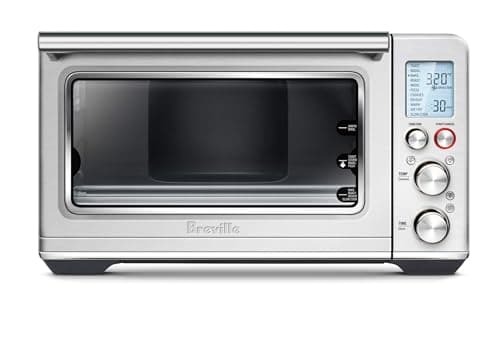
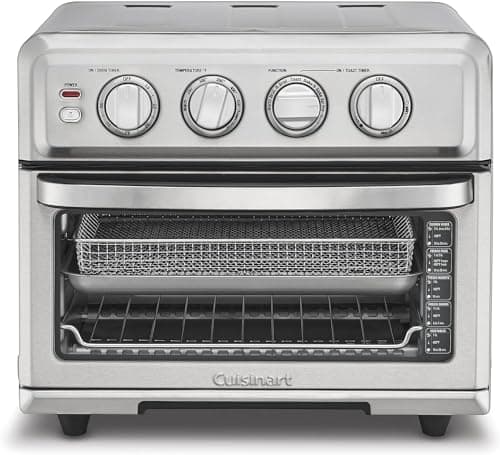
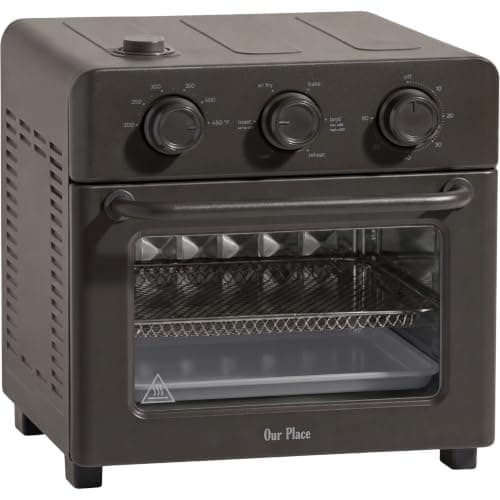
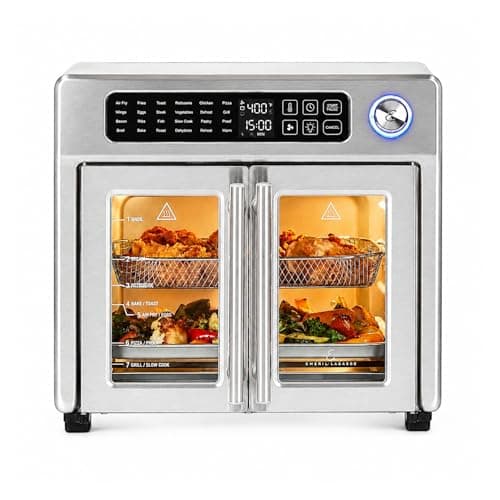
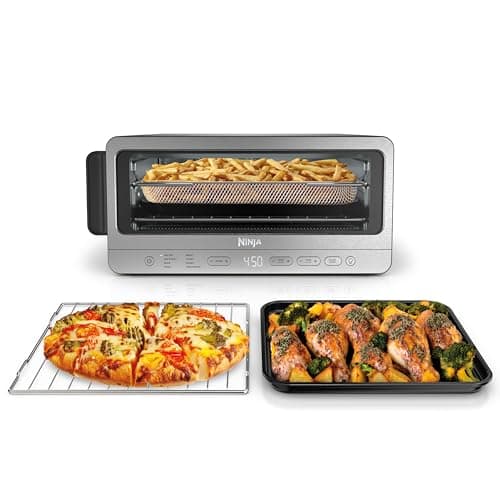
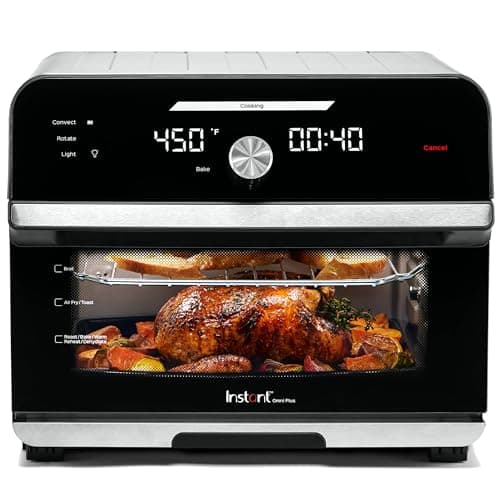
Buy the Instant Omni Plus 19 Qt. It is the pick for baking because Instant publishes a 170°Ffloor to its temperature range — the lowest published minimum of any machine here — and because it bakes on a flat rack in a real cavity rather than in a basket two inches under the element. If you will bake seriously and can catch it discounted, the Breville Smart Oven Air Fryer is the better machine. If all you own is a basket air fryer, read the last section before you buy a cake tin.
Baking is where the air fryer category quietly stops being good. A basket air fryer is a small, sealed box with a powerful fan and a heating element a couple of inches above the food. That arrangement is close to ideal for a chicken wing and close to the worst case for a cake: the fan skins the top of a wet batter before it has set, and the element is near enough to brown that skin long before the middle has cooked. Every “air fryer cake” video you have seen worked around those two facts rather than solving them.
The three specifications that decide a bake
- Published minimum temperature.Most baking happens between 325°F and 375°F, and a good deal of it lower. A machine whose range starts at 200°F cannot hold a 170°F proof or a low, slow bake. This is a number the maker either publishes or does not, and we report which.
- Flat, level shelf space. A loaf tin or a cake pan has to sit flat with room to rise. A sloped basket with a perforated plate is not a shelf, and a tin wedged into one bakes unevenly for a boring geometric reason.
- Distance from the element. The further the top of your batter sits from the element, the more time the inside gets before the top sets. No manufacturer in this category publishes that distance, so we do not quote one. What we can say is that an oven cavity with multiple rack positions gives you the choice, and a fixed basket does not.
We have not baked a cake in all six of these. We do not have a lab and we say so. The ranking below is built from published temperature ranges, published function lists, published capacities and the format of the cooking chamber — all of which you can check against the manual before you buy.
The baking table: what each maker actually publishes
The column that matters is the first one, and it is the column the category is quietest about. We report a minimum temperature only where the manufacturer publishes one.
| Machine | Published min temp | Chamber | Rack positions |
|---|
| Instant Omni Plus 19 Qt | 170°F | 19 qt cavity | Multiple |
| Breville Smart Oven Air Fryer | Not published | Fits 6 toast slices | Multiple |
| Cuisinart Air Fryer Toaster Oven | Not published | Stainless cavity | Multiple |
| Our Place Wonder Oven | Not published | Ceramic-lined cavity | Single shelf |
| Emeril Lagasse 26 Qt | Not published | 26 qt cavity | Multiple |
| Ninja Flip | Not published | Compact cavity | Single shelf |
| Cosori TurboBlaze (basket, for reference) | 90°F | 6 qt basket | None |
Can you bake in a basket air fryer at all?
Yes, within limits, and the limits are worth knowing before you are disappointed. Small things bake well in a basket: cookies on a lined plate, muffins in silicone cups, brownies in a six-inch tin, a single-serve mug cake. What does not work is anything tall, anything with a wet batter that needs to rise, and anything that needs an even top. The reason is the two facts at the top of this page — fan over wet batter, element close overhead.
If a basket machine is what you own, the one useful specification is the bottom of its temperature range. The Cosori TurboBlazepublishes a 90°F floor, the lowest of any basket machine we cover, which makes it the one basket air fryer here that can genuinely hold a proving temperature or a low bake. Most of the category starts at 180°F or 200°F and some do not publish a floor at all. Drop the temperature about 25°F from your oven recipe, expect it to finish sooner, and cover the top with foil if it is browning before the middle sets — the rules for foil apply, including never putting a loose sheet into an empty basket.
Why a convection oven is the honest comparison
Every machine on this page is a small convection oven with a strong fan, and so is the oven in most kitchens built in the last twenty years. If yours has a convection setting and a working thermostat, it will out-bake all six of these on capacity and evenness, and the only thing you gain on the counter is speed and a smaller volume to heat. That is a real gain — our running-cost guideputs a 20-minute countertop cook at roughly 9 cents against several times that for a full-size oven — but it is a gain in energy and time, not in baking quality. Air fryer vs convection oven works the trade through properly, and basket vs oven air fryer is the format question this page is really an answer to.
Pans, tins and what fits
The practical constraint on baking in any of these is the pan, not the machine. Measure the interior width and subtract an inch on each side for airflow — a tin that touches the walls blocks the circulation the whole format depends on. Metal and ceramic are fine. Glass is the exception that catches people out: Pyrex publishes guidance that its glass cannot be used in an air fryer because the element is a direct heat source, which we cover in what you can put in an air fryer. Read that before you put a favourite dish in one of these.
How we picked
We did not lab-test this gear
Everyone in this category says they tested twenty air fryers. We have not lab-tested any of these, and we say so. What we did instead: compiled the published specifications — wattage, capacity, materials — worked out what each machine actually costs to run at the national electricity rate, read the manuals and owner reviews, and scored each one against a published rubric. The scores are judgments from documented research — not measurements we took, because we do not have a lab and we will not pretend we do. Where a number came from someone else's work, we name them in Sources.