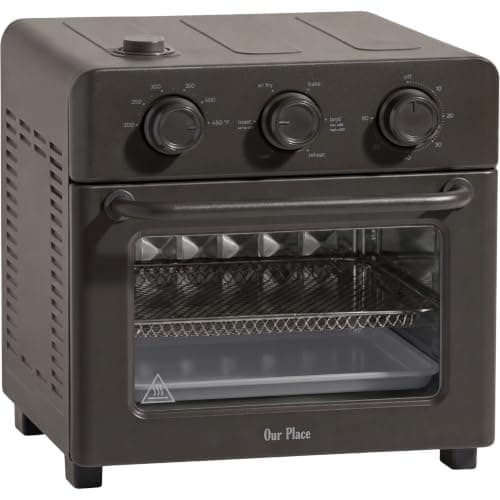
Our Place built a direct-to-consumer cookware brand on one promise — that you can see exactly what your cookware is made of — and the Wonder Oven is that promise applied to a countertop appliance. It is also, unusually for this category, a machine people buy partly because of how it looks, which is not a criticism. An appliance that lives on the counter is furniture as much as equipment, and most of this category is styled like a photocopier.
The materials disclosure is the most complete we have found for a countertop oven. Our Place describes the Wonder Oven as made without PFAS, including PTFE — the forever chemicals family — and then breaks the build down part by part: a stainless-steel interior with premium glass, a steel wire rack, basket and crumb tray, and a cast-aluminum bake pan carrying a non-toxic nonstick ceramic coating. That is a company answering the coating question at the level of the individual component rather than with a slogan.
The rest of it is a 6-in-1 machine — air fry, bake, roast, toast, broil and reheat — in a two-rack cavity Our Place rates for two to four people. The Amazon listing puts the standard size at 13 quarts; Our Place lists 12 liters for the same machine, which is the same volume expressed in different units and worth noticing if you are cross-shopping on numbers.
The materials list, in full, because it is the reason to buy this
Most brands answer the coating question with a single line about the basket. Our Place answers it about the whole machine: a stainless-steel interior, premium glass, a steel wire rack, basket and crumb tray, and a cast-aluminum bake pan with a non-toxic nonstick ceramic coating — the whole thing built without PFAS, including PTFE. Note what that does and does not say. The bake pan is coated; it is simply coated with something outside the fluoropolymer family. The rack, the basket and the cavity are bare metal.
That structure is what earns it a place in our non-toxic air fryers roundup. It sits alongside the glass Ninja Crispi, which removes coatings from the food path entirely, and the stainless Cuisinart, which does the same thing at a much lower price with less charm. What the coating claims mean, and which ones are worth checking, is in are ceramic air fryers safe.
What a two-rack cavity actually gets you
The two-rack layout is the functional difference between this and a basket machine, and it is the thing worth paying for if you are paying. You can toast on one level while something bakes on the other, and a flat rack holds foods a drawer simply cannot — a tray of cookies, four slices of bread, a small tray bake. Our Place rates the standard machine at two to four servings, which in our experience of oven-style machines is honest rather than optimistic; oven formats lose more usable space to rack spacing than a drawer does.
What you give up is crisping intensity. Food in a basket sits directly in a tight, fast airflow; food on a rack in a larger cavity does not. It is the same trade we set out in basket vs oven-style air fryers, and it is not a flaw in this machine so much as the definition of the format.
The price, addressed directly
There is no version of this review where the price does not come up, so we will not pretend otherwise: this is expensive per quart. You can buy a very good 5-quart basket machine, a set of accessories and a bag of chips for less. What the money buys is a complete materials disclosure, a stainless cavity, two racks, and an object you will not mind looking at every day for five years. Those are real things to want. They are not the same thing as cooking performance, and a review that blurred the two would be doing you a disservice.
If the materials are the point but the budget is not there, the honest alternative is the Cuisinart TOA-70: a stainless oven that air-fries on a bare mesh rack, at a fraction of the price and none of the design. If the design is the point and the materials are secondary, you are buying a look, and that is a legitimate purchase we are not going to argue you out of.
Living with it
Two practical notes. First, it is an oven-style machine, so it needs oven-style clearance — hot air leaves through the top and back, and a wall cabinet a few inches above it will take that heat every cook. The figures are in air fryer clearance and placement. Second, the ceramic-coated bake pan is the wear item. Keep aerosol sprays off it and use silicone or wooden tools, and it will last; treat it like a nonstick pan that owes you nothing and it will not. The routine is in how to clean an air fryer.
Who should buy it
Two to four people who want one machine that toasts, bakes and air-fries, who care enough about materials to want them published, and who will genuinely enjoy the object. That is a narrower group than Our Place’s marketing implies and a real one. Everyone else is better served by a basket machine from our best air fryers roundup — or, if the coating question is what brought you here, by the cheaper coating-free options ranked in the non-toxic roundup.