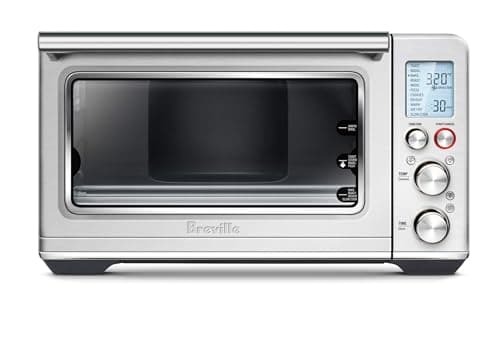
This is not really an air fryer. It is a countertop convection oven with a serious air-frying mode, and understanding that distinction is the whole review. Judged as an air fryer it looks absurdly expensive — several times the price of a machine that crisps chips just as well. Judged as an oven that also air-fries, toasts, bakes, roasts, slow-cooks and proves dough, it starts to look reasonable.
Breville publishes eleven cooking functions for the BOV860: toast (up to six slices), bagel, broil, bake, roast, warm, pizza, air fry, reheat, cookies and slow cook. The two pieces of technology it leans on are Element iQ, which directs power to the elements that need it rather than heating everything equally, and Super Convection, a high-airflow fan mode Breville describes as ideal for air frying and says can cut cooking time by up to 30%.
It is the “never buy this at list price” entry on our deals page and a top pick in the toaster-oven roundup. Here is the honest case.
The one condition that justifies the price
Buy this if it replaces two things. If you currently own — or were about to buy — both a toaster oven and an air fryer, the arithmetic changes completely, and you also get back the counter space one of them would have taken. If you already own a toaster oven you are happy with, and you just want crispier chips, this is the wrong purchase and a hundred-dollar basket machine is the right one. We would rather tell you that than sell you the expensive thing.
What Element iQ actually does
Conventional countertop ovens run their elements more or less uniformly and let the thermostat sort it out. Element iQ is Breville's system for steering power to particular elements depending on what you have asked for — more from above for browning, more from below for a pizza base. That is why the toast on this class of oven is noticeably more even than on a cheap one, and why the air-fry mode browns without needing the fan at maximum for the whole cook. It is a real engineering difference rather than a badge, though it is also the sort of thing you notice over months rather than on day one.
Air frying in an oven versus a basket
A basket machine wins on speed for small quantities: less space to heat, food closer to the element, and a drawer you can shake. An oven like this wins on quantity and shape — a full tray of vegetables, a rack of wings in a single layer, things that would need three batches in a 5-quart drawer. The Super Convection fan is what makes the air-fry mode credible rather than a marketing label, and Breville's claim is that it can cut cooking time by up to 30% against conventional convection. Our air fryer vs toaster oven comparison covers the full trade.
Space and power
At roughly 18.9 inches wide, 15.9 deep and 10.9 high it is a substantial object, and it needs clearance above and behind as well. Measure first. On energy, Breville states the oven uses up to 35% less power than a built-in oven — which is a comparison against a full-size oven, not against a small basket air fryer, and worth reading carefully. Breville does not publish a wattage figure on the BOV860 product page, so we do not quote one; if you want a precise running cost, take the rating from the plate and use our calculator.
Alternatives worth a look
The toaster-oven roundup has the cheaper Cuisinart and Ninja combination ovens, which do most of this for meaningfully less money and less polish. If you want the counter space back instead, a basket machine from the main roundup plus your existing oven is the pragmatic setup. And whatever you do, check the deals page before buying this one — it is the model on our list where waiting for a genuine discount matters most.
How we picked
We did not lab-test this gear
Everyone in this category says they tested twenty air fryers. We have not lab-tested any of these, and we say so. What we did instead: compiled the published specifications — wattage, capacity, materials — worked out what each machine actually costs to run at the national electricity rate, read the manuals and owner reviews, and scored each one against a published rubric. The scores are judgments from documented research — not measurements we took, because we do not have a lab and we will not pretend we do. Where a number came from someone else's work, we name them in Sources.