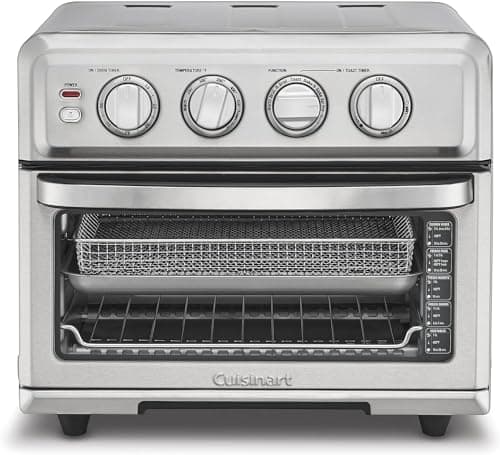
This machine has been earning places in our roundups for a while — it appears in the non-toxic picks, the window picks and the toaster oven roundup — and it has never had a review of its own. It earns one for a reason that is easy to miss on a spec sheet: it is the cheapest genuinely mainstream machine on this site that air-fries with no nonstick basket involved at all. Food sits on a stainless mesh rack inside a stainless cavity, and there is nothing coated for it to touch.
The published numbers are straightforward, and Cuisinart states them plainly, which we appreciate more than we should have to: 1,800 watts, an eight-function oven built around what Cuisinart calls AirAdvantage — a top fan and heater assembly that circulates air down over the food — a 0.6 cubic foot interior, a 60-minute timer, and a three-year limited warranty. It ships with an oven rack, a baking pan, the air-fry rack and basket, and a dual-sided grill and griddle plate. The whole thing is 25.6 pounds and 15.75 inches wide.
Those last two figures are the review in miniature, so we will not bury them: this is a large, heavy object with a small interior, and whether it belongs on your counter depends almost entirely on whether it is replacing two appliances or adding a third.
The real argument: no basket to coat
Most of the coating conversation on this site is about baskets, because that is where the coating is — a drawer with PTFE on it, which is stable at air-fryer temperatures and which a lot of people would still rather not own. The oven-style format sidesteps the question structurally rather than chemically: there is no basket, so there is nothing to coat. Food sits on a stainless mesh rack in a stainless cavity, and the only thing that will ever wear is the rack itself, which is a wire grid you can replace.
That is a stronger position than “PFAS-free ceramic,” which is a better coating but still a coating. It is the same reason a glass machine like the Ninja Crispi ranks where it does. If avoiding coatings is your reason for being on this site at all, the full field — glass, ceramic and stainless — is ranked in our non-toxic air fryers roundup, and the evidence behind the worry is in are air fryers toxic.
0.6 cubic feet, translated into dinners
Cuisinart publishes 0.6 cubic feet, and cubic feet is a number nobody can picture. In practice this is a small oven: a rack of chicken thighs for two to three people, a four-slice batch of toast, a couple of salmon fillets, or a personal-size pizza. It is not a full sheet-pan machine, and it will not do a family’s chips in one go the way an 8-quart basket will. The reason that matters more here than the quart figures elsewhere on this site is that oven-style machines lose more usable space to the rack spacing than a drawer does — you cannot pile food up in a single-rack oven without blocking the airflow, which is exactly the failure described in air fryer not crisping. Treat 0.6 cu ft as a two-to-three-person machine and you will be happy with it.
1,800 watts: the running cost, and a wiring note
Cuisinart printing 1,800 watts is genuinely useful, because most of this category will not tell you. It makes the arithmetic reproducible: 1.8 kW for a 20-minute cook is 0.6 kWh, which is around ten cents at the U.S. average residential rate — a little more than a basket machine, because there is a larger cavity to bring up to temperature, and still a fraction of what a full-size oven draws for the same job. Put your own utility rate into our running-cost calculator for an exact figure.
The wiring note matters more than the cents. At 120 volts, 1,800 watts is 15 amps — the entire nominal capacity of a standard 15-amp circuit, and most of a 20-amp one. Plug this into a kitchen circuit that is also running a microwave or a kettle and you will find the breaker. Plug it into an extension cord or a power strip and you have a worse problem than a tripped breaker. We work through exactly why, with the codes and the manufacturer guidance, in can you plug an air fryer into an extension cord.
Against the Breville, and against a basket
The obvious comparison up-market is the Breville Smart Oven Air Fryer, which is a better machine — more even heat, a larger cavity, an element-control system that genuinely does something — and costs a great deal more. Our position on the Breville has not changed: it is worth its price under one condition, that it replaces your toaster oven as well. The Cuisinart is the same argument at a much lower price with a smaller interior, and for most kitchens that is the better trade.
Down-market, the comparison is not another oven; it is a basket. A Ninja AF141 costs a fraction of this, takes a third of the counter, and crisps harder because the food sits directly in a fast, tight airflow. What it cannot do is toast bread, bake, broil, or fit a rack. The whole basket-versus-oven decision, with the trade-offs laid out, is in basket vs oven-style air fryers.
Who should skip it
Anyone who already owns a toaster oven they like, because then this is a third machine rather than a replacement and the footprint argument collapses. Anyone cooking for four or more regularly — 0.6 cubic feet will have you running two batches, and the family-capacity options are in our large air fryers roundup. And anyone whose kitchen counter is genuinely tight: at 15.75 inches wide and 25.6 pounds, this machine lives where you put it, and the small air fryer picks exist for exactly that constraint.