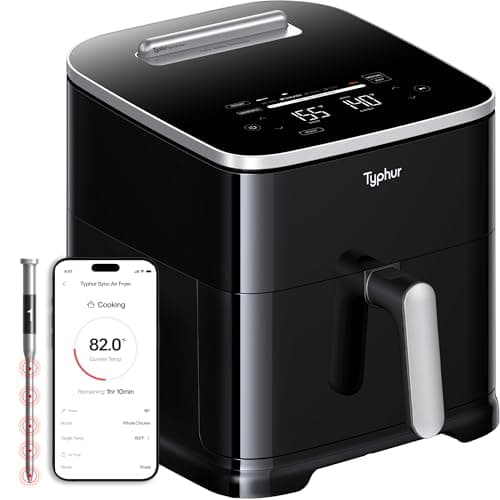
Almost every “smart” feature in this category is a recipe app wearing a Wi-Fi badge. The Typhur Sync has the one exception: a built-in wireless meat thermometer that lets the machine cook to a target internal temperature and stop, rather than running for a number of minutes somebody guessed. That is the difference between chicken that is safe and juicy and chicken that is safe and dry, and it is the only smart feature we have found that changes the food rather than the experience of making it.
The rest of the machine is a competent 8-quart air fryer — real family capacity, sensible controls, a newer brand without Ninja's decade of parts support behind it. This review is honest about both halves: the probe is genuinely excellent, and there is a fifteen-dollar way to get most of its benefit that we will tell you about rather than hide.
Why cooking to temperature beats cooking to time
Every air fryer cooking chart in the world, including ours, is a set of starting points rather than instructions, and we say so on the page. The reason is that a chicken breast does not take eighteen minutes because it is chicken; it takes as long as its thickness demands. A thin fillet and a thick one differ by five minutes or more, and the standard way people resolve that uncertainty is to add time — which is precisely how you get chicken that is safe and unpleasant. A probe removes the variable entirely: cook until the center reads 165°F, then stop. The USDA publishes those safe internal temperatures, and hitting them exactly rather than overshooting is the whole game.
The fifteen-dollar version of this feature
We are not going to pretend you need a connected machine to get this benefit. A manual instant-read thermometer costs about fifteen dollars, works with any air fryer, oven, grill or pan you will ever own, and gives you the same information — you just have to open the basket and check rather than watching a number on your phone. It is the highest-value accessory in the category and it tops our air fryer accessories roundup for exactly this reason. What the built-in probe buys you over that is convenience and an automatic stop: you are not opening the basket, dumping the heat and interrupting the cook to take a reading. For someone cooking protein several times a week, that is a real difference. For someone cooking it occasionally, the fifteen-dollar route is the honest recommendation.
Eight quarts, and what that actually holds
A single 8-quart basket is a different proposition from two 4-quart zones, and better for some jobs and worse for others. Better: a whole chicken, a large roast, a full tray of wings in one layer — anything where the constraint is the size of the item rather than the number of dishes. Worse: cooking a main and a side at different temperatures, which is what a dual-basket does and this cannot. That trade is set out fully in single vs dual basket, and it is worth five minutes before you spend this much on either format.
Running cost, worked out
Large-capacity air fryers with dual heating elements sit at the top of the wattage range for the category, which typically puts a twenty-minute cook somewhere around ten to thirteen cents at the U.S. average residential electricity rate. The probe has a second-order benefit here that nobody advertises: cooking to temperature rather than to a padded time means you stop the machine when the food is done rather than four minutes later, so you are not paying for the overshoot. It is a small saving, but it runs the right direction. Your own number is in the running-cost calculator.
The brand question, addressed honestly
Typhur is a newer name than Ninja, Philips, Instant or Cosori, and that is a legitimate thing to weigh on an appliance you expect to own for years. The concern is not build quality — this is a well-made machine — it is what happens in year four when you need a replacement basket or the app stops being updated. We checked the important part: the machine has full physical controls and works as an ordinary air fryer without the app, so a discontinued app costs you the probe automation, not the appliance. That is the right architecture, and it is more than several bigger brands manage. Our brands guide explains why we weight parts availability so heavily.
How we picked
We did not lab-test this gear
Everyone in this category says they tested twenty air fryers. We have not lab-tested any of these, and we say so. What we did instead: compiled the published specifications — wattage, capacity, materials — worked out what each machine actually costs to run at the national electricity rate, read the manuals and owner reviews, and scored each one against a published rubric. The scores are judgments from documented research — not measurements we took, because we do not have a lab and we will not pretend we do. Where a number came from someone else's work, we name them in Sources.