Skip to content
Preheat Club

Beyond air fryers · Kitchen Appliances

The best food dehydrators, and whether you need one at all

Check the machine you already own first. If your air fryer goes below about 110°F, it dehydrates. If it starts at 200°F, its Dehydrate button is Bake with a smaller number — and one of these is the answer.

By Stephen V.Updated How we review
#ad

We earn a commission when you buy through our Amazon links, at no extra cost to you. It never changes a verdict, and we say so when the cheaper product is the better buy. How this works.

Before you buy any of these, check the machine already on your counter. A dehydrator is a box that holds a low temperature for a long time, and a growing number of air fryers do exactly that: the Cosori Pro LE publishes a 90°F floor, the Instant Vortex Plus Mini 95°F, and the Ninja AF101 105°F. If yours goes that low, it will dry a tray of apple rings or a bunch of herbs tonight for nothing, and you should find that out before spending a cent. If it starts at 170°F or 200°F, its Dehydrate button is Bake with a smaller number — the argument we make at length in air fryers with presets — and this page is for you.

What a dedicated machine adds is not heat. It is area multiplied by time. Six to ten trays, running for eight to fourteen hours, at a temperature held steadily, without tying up the appliance you cook dinner in and without a fan loud enough to drive you out of the room. That is the entire product. Everything else printed on the box is packaging.

So the ranking turns on three things, in this order. Drying area, which is not the same as tray count and is the specification manufacturers are vaguest about — one machine here gives you more space on six trays than another gives you on seven. Airflow direction: a rear-mounted fan blowing horizontally across the trays, or a top-mounted one blowing through a stack, which decides whether you have to rotate trays and how much strong flavors migrate between them. And the temperature range, especially the floor, because herbs and delicate fruit want 95 to 115°F while jerky wants everything the machine has.

One materials note, because it lands differently here than it does on an air fryer. In an air fryer the plastic is in the housing and the control panel, nowhere near the food, which is why we spend most of BPA-free air fryers gently talking readers out of worrying about it. In a dehydrator the trays are the food-contact surface, and they hold food against it for ten hours at a stretch rather than twenty minutes. Every plastic tray in this roundup is published BPA-free by its manufacturer, so this is a durability and preference call rather than a documented hazard — but it is the one countertop category where paying up for stainless answers a question instead of decorating one.

The short answer

Quick picks

#ProductBest forScorePrice
01
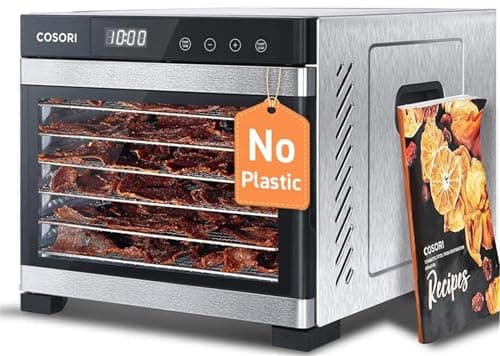
Cosori Cosori Premium 6-Tray Stainless Steel Dehydrator (CP267-FD)
Cosori Premium 6-Tray Stainless Steel Dehydrator (CP267-FD)

The one to buy if you are buying one. Cosori publishes 600 watts, a 95°–165°F range, six stainless-steel trays behind a glass front door, a rear-mounted fan that distributes heat across all six trays with no rotation, a 48-hour timer in 30-minute increments, and operation under 48 dB — quieter, the company notes, than its own air fryers. The listing puts the drying area at 6.5 square feet. Nothing here is a slogan; all of it is on the spec sheet.

Most kitchens: metal trays, front loading, quiet enough to run overnight
9.0
$143.99Amazon
02
Excalibur Excalibur Select Series 6-Tray Digital Dehydrator (DH06SCSS13)
Excalibur Select Series 6-Tray Digital Dehydrator (DH06SCSS13)

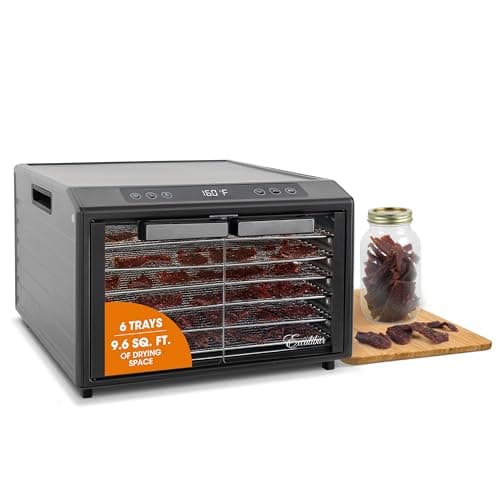
The enthusiast’s machine, and the right buy if drying is going to be a habit rather than an experiment. Excalibur publishes 9.6 square feet across six dishwasher-safe chrome trays — half again what the Cosori gets from the same tray count — with an 85°–165°F range, a 60-hour timer, glass French doors, and the horizontal Parallex airflow plus Hyperwave technology the brand built its reputation on. Three-year limited warranty, the longest here.

Jerky, big batches and anyone who will use it every week
8.8
$189.99Amazon
03
NESCO NESCO Snackmaster Pro Food Dehydrator (FD-75A)
NESCO Snackmaster Pro Food Dehydrator (FD-75A)

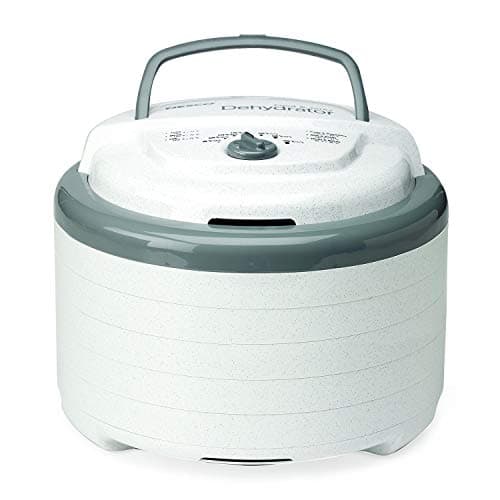
The value pick, and the cheapest route to a large drying area that exists. NESCO publishes 600 watts, an adjustable 95°–160°F range, five BPA-free trays at 0.8 square feet each, and expansion to twelve trays — which is 9.6 square feet, the same as the Excalibur, for well under half the money. The Converga-Flow fan sits on top, so nothing drips into the heater, and the round trays nest into almost no shelf space.

The most drying area per dollar, if plastic trays are acceptable
8.0
$80.51Amazon
04
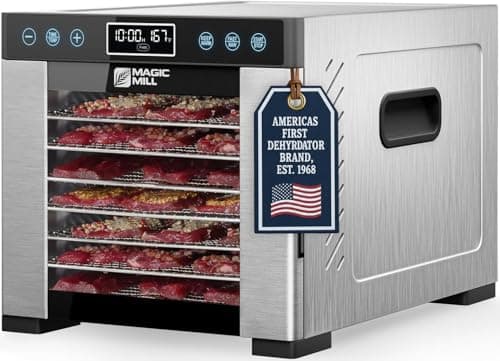
Magic Mill Magic Mill Pro 7-Tray Stainless Steel Dehydrator (MFD-7700)
Magic Mill Pro 7-Tray Stainless Steel Dehydrator (MFD-7700)

Seven stainless trays in the smallest box here, and the clearest lesson in why tray count is not drying area. Magic Mill publishes 600 watts, a 95°–167°F range, a timer from 30 minutes to 24 hours, a rear-mounted fan, and seven dishwasher-safe stainless trays measuring 10¾ by 9¾ inches — which works out to roughly 5.1 square feet in total, less than the Cosori manages with six. What you are actually buying is an all-metal food path in a 15½-inch-wide footprint.

Stainless trays when counter space, not batch size, is the constraint
8.0
$149.99Amazon
05
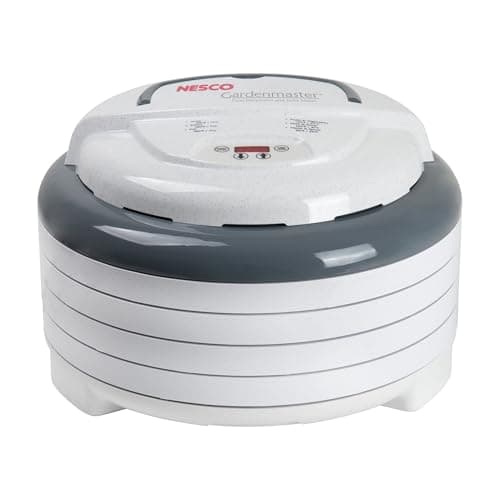
NESCO NESCO Gardenmaster Digital Pro Food Dehydrator (FD-1040)
NESCO Gardenmaster Digital Pro Food Dehydrator (FD-1040)

The harvest machine, and the only one here you can grow to twenty trays. NESCO publishes 1,000 watts — 400 more than anything else in this roundup — with digital 90°–160°F control, a 48-hour programmable timer, four BPA-free trays at a full square foot each, and the same top-mounted Converga-Flow fan as the Snackmaster. Fully expanded that is 20 square feet, more than double the biggest fixed machine here.

Preserving a garden: the largest drying area you can build, one tray at a time
8.2
$105.99Amazon
06
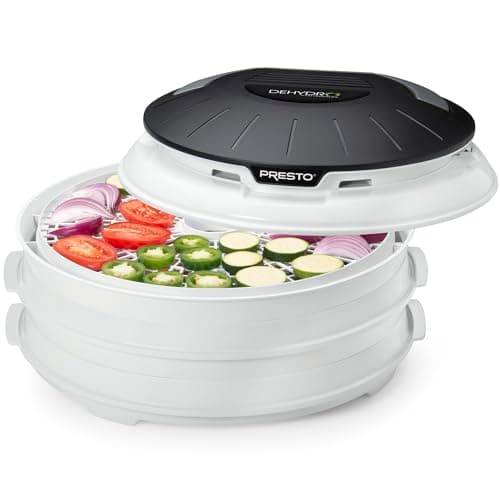
Presto Presto Dehydro Electric Food Dehydrator (06300)
Presto Dehydro Electric Food Dehydrator (06300)

The cheapest honest way to find out whether you will use a dehydrator, with one caveat large enough to disqualify it for some buyers: there is no temperature control. Presto publishes 600 watts, a top-mounted fan and heating element, four nesting trays expandable to eight, trays and base that are fully immersible, and a one-year warranty. Presto’s own range separates this model from the 06301 and 06302, which are the ones it sells on adjustable temperature control. This is not one of them.

Finding out whether the habit sticks, for the price of a takeout dinner
7.4
$54.87Amazon

#ad · Live prices from the Amazon Product API, as of Aug 31, 2026. Where we have no verified live price, we show none — a gap beats a number that has rotted.

In detail

The picks, in full

01
Cosori Cosori Premium 6-Tray Stainless Steel Dehydrator (CP267-FD)

Most kitchens: metal trays, front loading, quiet enough to run overnight

Cosori Premium 6-Tray Stainless Steel Dehydrator (CP267-FD)

600 W95°–165°F6 stainless trays / 6.5 ft²48 h timerUnder 48 dB
9.0/10

The one to buy if you are buying one. Cosori publishes 600 watts, a 95°–165°F range, six stainless-steel trays behind a glass front door, a rear-mounted fan that distributes heat across all six trays with no rotation, a 48-hour timer in 30-minute increments, and operation under 48 dB — quieter, the company notes, than its own air fryers. The listing puts the drying area at 6.5 square feet. Nothing here is a slogan; all of it is on the spec sheet.

Materials
10
Noise
10
Controls
9
Drying area
8
Value
8

Pros

  • Stainless trays behind a glass door — the food-contact surface is metal end to end
  • Rear fan blows horizontally across all six trays; Cosori states no rotation is needed
  • Published under 48 dB, the specification that matters on a machine you run overnight
  • 48-hour timer in 30-minute increments, with overheat protection and auto shutoff
  • Front-loading, so you can pull one tray without dismantling a stack

Cons

  • 6.5 ft² is less drying area than the Excalibur delivers from the same six trays
  • Six fixed trays with no expansion path — what you buy is what you get
  • Tray spacing is fixed, so anything tall costs you a shelf
  • Cosori’s own spec page does not publish a drying area; the 6.5 ft² figure comes from the listing

Don't buy this if…

you are drying a whole garden at once — six fixed trays is the ceiling here, and the expandable NESCOs go to twelve and twenty.

$143.99View on Amazon

$159.9910% off

Price as of Aug 31, 2026. Prices change — Amazon's at checkout is the one that counts.

#ad · we may earn a commission from this link to Cosori Premium 6-Tray Stainless Steel Dehydrator (CP267-FD)

02
Excalibur Excalibur Select Series 6-Tray Digital Dehydrator (DH06SCSS13)

Jerky, big batches and anyone who will use it every week

Excalibur Select Series 6-Tray Digital Dehydrator (DH06SCSS13)

600 W published85°–165°F6 chrome trays / 9.6 ft²60 h timer3-yr warranty
8.8/10

The enthusiast’s machine, and the right buy if drying is going to be a habit rather than an experiment. Excalibur publishes 9.6 square feet across six dishwasher-safe chrome trays — half again what the Cosori gets from the same tray count — with an 85°–165°F range, a 60-hour timer, glass French doors, and the horizontal Parallex airflow plus Hyperwave technology the brand built its reputation on. Three-year limited warranty, the longest here.

Drying area
10
Airflow
10
Range
9
Build
9
Value
6

Pros

  • 9.6 ft² from six trays — the most drying area per tray here by a wide margin
  • 85°F floor is the lowest in this roundup: genuine herb, yogurt and raw-food territory
  • Horizontal airflow across the trays; Excalibur states no rotation is required
  • Glass French doors let you watch a long batch without opening it and dumping the heat
  • Three-year limited warranty against the one year on the cheapest machine here

Cons

  • The most expensive machine in the roundup, by a distance
  • Large: a permanent counter or pantry resident, not something you stow between uses
  • The trays are chrome-plated, not stainless — Excalibur reserves that word for the construction
  • The listing advertises 700 watts; Excalibur’s own product page publishes 600 (see below)

Don't buy this if…

you are not yet sure you will use a dehydrator at all — start at the bottom of this list and trade up once the habit sticks.

$189.99View on Amazon

Price as of Aug 31, 2026. Prices change — Amazon's at checkout is the one that counts.

#ad · we may earn a commission from this link to Excalibur Select Series 6-Tray Digital Dehydrator (DH06SCSS13)

03
NESCO NESCO Snackmaster Pro Food Dehydrator (FD-75A)

The most drying area per dollar, if plastic trays are acceptable

NESCO Snackmaster Pro Food Dehydrator (FD-75A)

600 W95°–160°F5 trays, to 120.8 ft² per trayTop-mounted fan
8.0/10

The value pick, and the cheapest route to a large drying area that exists. NESCO publishes 600 watts, an adjustable 95°–160°F range, five BPA-free trays at 0.8 square feet each, and expansion to twelve trays — which is 9.6 square feet, the same as the Excalibur, for well under half the money. The Converga-Flow fan sits on top, so nothing drips into the heater, and the round trays nest into almost no shelf space.

Value
10
Expandability
9
Footprint
9
Materials
6
Controls
6

Pros

  • Expands to twelve trays — 9.6 ft² of drying area for a fraction of the Excalibur’s price
  • Top-mounted fan keeps liquid out of the heater chamber, which is why these last
  • Round trays nest inside each other; the machine stores in a cupboard rather than living out
  • NESCO states it is made in the USA of global and domestic components
  • Cheap enough to buy alongside a fuller machine as overflow capacity

Cons

  • Plastic trays — BPA-free per NESCO, but plastic is the food-contact surface for the whole run
  • Analog dial and no timer: you set a temperature and watch a clock
  • 160°F ceiling, the lowest in this roundup
  • Round trays waste area on rectangular food, and jerky strips are rectangular

Don't buy this if…

tray material is the reason you are buying a dedicated machine — go stainless instead, and the Magic Mill is the cheapest way to do that.

$80.51View on Amazon

$88.9910% off

Price as of Aug 31, 2026. Prices change — Amazon's at checkout is the one that counts.

#ad · we may earn a commission from this link to NESCO Snackmaster Pro Food Dehydrator (FD-75A)

04
Magic Mill Magic Mill Pro 7-Tray Stainless Steel Dehydrator (MFD-7700)

Stainless trays when counter space, not batch size, is the constraint

Magic Mill Pro 7-Tray Stainless Steel Dehydrator (MFD-7700)

600 W95°–167°F7 stainless trays / ~5.1 ft²24 h timer15½ × 11½ × 10¾ in
8.0/10

Seven stainless trays in the smallest box here, and the clearest lesson in why tray count is not drying area. Magic Mill publishes 600 watts, a 95°–167°F range, a timer from 30 minutes to 24 hours, a rear-mounted fan, and seven dishwasher-safe stainless trays measuring 10¾ by 9¾ inches — which works out to roughly 5.1 square feet in total, less than the Cosori manages with six. What you are actually buying is an all-metal food path in a 15½-inch-wide footprint.

Materials
10
Footprint
9
Range
8
Controls
7
Drying area
6

Pros

  • Seven stainless, dishwasher-safe trays — the cheapest all-metal food path in this roundup
  • The smallest external footprint of any full-size machine here
  • 167°F ceiling is the highest here, which gives the most headroom at the hot end
  • Rear-mounted fan, keep-warm function, overheat protection and auto shutoff
  • Magic Mill publishes tray dimensions, which is how the real drying area can be checked at all

Cons

  • About 5.1 ft² despite seven trays — the “full-size tray” framing is generous
  • 24-hour timer, half what the Cosori offers and well short of the Excalibur’s 60
  • The listing advertises 95°–176°F and a 48-hour timer; Magic Mill’s own page publishes 167°F and 24 hours
  • Trays sit close together, so tall items cost a shelf

Don't buy this if…

batch size is the point — seven small trays is less drying space than six large ones, and the arithmetic is below.

$149.99View on Amazon

Price as of Aug 31, 2026. Prices change — Amazon's at checkout is the one that counts.

#ad · we may earn a commission from this link to Magic Mill Pro 7-Tray Stainless Steel Dehydrator (MFD-7700)

05
NESCO NESCO Gardenmaster Digital Pro Food Dehydrator (FD-1040)

Preserving a garden: the largest drying area you can build, one tray at a time

NESCO Gardenmaster Digital Pro Food Dehydrator (FD-1040)

1,000 W90°–160°F digital4 trays, to 201 ft² per tray48 h timer
8.2/10

The harvest machine, and the only one here you can grow to twenty trays. NESCO publishes 1,000 watts — 400 more than anything else in this roundup — with digital 90°–160°F control, a 48-hour programmable timer, four BPA-free trays at a full square foot each, and the same top-mounted Converga-Flow fan as the Snackmaster. Fully expanded that is 20 square feet, more than double the biggest fixed machine here.

Expandability
10
Power
9
Controls
8
Value
8
Materials
6

Pros

  • Expands to twenty trays and 20 ft² — nothing else in this roundup comes close
  • 1,000 watts is what a tall stack needs; power is the limiting factor once you add trays
  • Digital thermostat with a 90°F floor, unlike its analog Snackmaster sibling
  • Programmable 48-hour timer, so an overnight batch does not need supervising
  • Larger 1 ft² trays than the Snackmaster’s 0.8 ft², so each added tray buys more

Cons

  • Ships with only four trays — every configuration worth having costs extra
  • Plastic trays again: BPA-free per NESCO, but plastic
  • 1,000 watts is also the highest running cost here, and these run for hours
  • 160°F ceiling, the same low limit as the cheaper Snackmaster

Don't buy this if…

you dry a couple of trays of fruit at a time — you would be paying for power and expansion you never use.

$105.99View on Amazon

$159.9934% off

Price as of Aug 31, 2026. Prices change — Amazon's at checkout is the one that counts.

#ad · we may earn a commission from this link to NESCO Gardenmaster Digital Pro Food Dehydrator (FD-1040)

06
Presto Presto Dehydro Electric Food Dehydrator (06300)

Finding out whether the habit sticks, for the price of a takeout dinner

Presto Dehydro Electric Food Dehydrator (06300)

600 WNo thermostat4 trays, to 8Top-mounted fan1-yr warranty
7.4/10

The cheapest honest way to find out whether you will use a dehydrator, with one caveat large enough to disqualify it for some buyers: there is no temperature control. Presto publishes 600 watts, a top-mounted fan and heating element, four nesting trays expandable to eight, trays and base that are fully immersible, and a one-year warranty. Presto’s own range separates this model from the 06301 and 06302, which are the ones it sells on adjustable temperature control. This is not one of them.

Value
10
Footprint
9
Cleaning
9
Expandability
6
Controls
3

Pros

  • By far the cheapest machine here, and cheap enough to buy on a hunch
  • Trays nest for storage and the cord stows in the base — it genuinely disappears
  • Trays and base are fully immersible, which makes cleaning trivial
  • 600 watts is the same rating as machines costing three times as much

Cons

  • No adjustable temperature at all — the single biggest limitation in this roundup
  • Four trays expanding only to eight, the smallest ceiling here
  • Presto publishes neither a drying area nor a tray material for it
  • No timer either: you are the timer

Don't buy this if…

jerky or herbs are the reason you are buying — without a thermostat you cannot set the drying temperature the safety guidance specifies, or drop to the low end delicate leaves need.

$54.87View on Amazon

$64.9916% off

Price as of Aug 31, 2026. Prices change — Amazon's at checkout is the one that counts.

#ad · we may earn a commission from this link to Presto Dehydro Electric Food Dehydrator (06300)

Tray count is not drying area

This is the specification the category hides behind, and it is the one that decides how much food you can dry in a session. Trays differ enormously in size, so a seven-tray machine can offer less space than a six-tray one. Here is every published figure in this roundup, side by side.

MachineTraysDrying areaPer tray
Excalibur Select 6-Tray69.6 ft²1.6 ft²
Cosori Premium (CP267-FD)66.5 ft²~1.1 ft²
NESCO Gardenmaster FD-10404, to 204 ft², to 20 ft²1.0 ft²
Magic Mill Pro MFD-77007~5.1 ft² (our arithmetic)~0.73 ft²
NESCO Snackmaster FD-75A5, to 124 ft², to 9.6 ft²0.8 ft²
Presto Dehydro 063004, to 8Not publishedNot published

The Magic Mill row is the only one we had to calculate rather than copy: the company publishes tray dimensions of 10¾ by 9¾ inches but no total, and seven trays of 104.8 square inches each is 5.09 square feet. That is less than the six-tray Cosori and roughly half the six-tray Excalibur. It is not a criticism of the machine, which is stainless, compact and priced accordingly — it is a warning about buying on the number printed largest.

Horizontal or stacked: the one structural choice

Horizontal, rear-fan machines — the Cosori, the Excalibur and the Magic Mill — sit like a small oven, load from the front, and blow air sideways across every shelf at once. Each tray sees roughly the same airflow, so you do not rotate anything, you can pull one shelf without disturbing the rest, and flavors migrate less because the air is not traveling up through six trays in series. They cost more and they occupy a fixed rectangle of counter.

Stacked machines — the two NESCOs and the Presto — are a base with a fan at one end and round trays piled on top. They are cheaper for the same drying area, they store inside themselves, and they expand: you buy more trays rather than a bigger machine. NESCO’s Converga-Flow design puts the fan on top and pushes air down an outer chamber and then inward across each tray, which is a real answer to the classic stacked-dehydrator complaint that the bottom tray dries first. It is still a stack, so tall items and mixed batches take more thought.

For most people the honest split is this: buy horizontal if drying is a hobby and the machine will live on the counter; buy stacked if it is a seasonal job and the machine will live in a cupboard for eleven months of the year.

The floor matters more than the ceiling

Every machine here reaches at least 160°F, which covers everything a home kitchen dries. The interesting end is the bottom. Herbs, leafy greens and anything you want to keep green and aromatic dry best around 95 to 115°F; go hotter and you drive off the volatile oils that are the entire point. Yogurt and dough proofing want a similar range. That is why the Excalibur’s 85°F floor and the Gardenmaster’s 90°F are worth more than another ten degrees at the top, and why the Presto — which has no thermostat at all — cannot do this category of work.

It is the same test we apply to air fryers with a Dehydrate button, and most of them fail it: a machine whose range starts at 200°F is cooking, not drying, whatever the icon says. The three that pass are named at the top of this page and ranked in air fryers with presets that actually do something.

Jerky is a food-safety job before it is a drying job

This is the part most dehydrator guides skip, and it is the one that matters. Ohio State University Extension, relaying the USDA Meat and Poultry Hotline, is explicit: heat marinated meat strips to an internal temperature of 160°F — 165°F for poultry — before they go into the dehydrator, because the temperatures of dehydrators and oven dehydrating are not high enough to destroy the harmful microorganisms typically present in raw meat. Steam or roast the strips in their marinade, then dry them, holding at least 145°F throughout.

Read that again, because it reframes the whole purchase: no dehydrator on this page can perform the safety step. A 165°F cabinet cannot bring meat to 165°F internal, and once drying begins, surviving bacteria become markedly more heat-resistant. The pre-heat is an oven or stovetop job, every time, on every machine, at every price. What the specification buys you is the second half — the ability to hold a set temperature above 145°F for hours without wandering, which is exactly what the Presto cannot promise and what the digital machines can.

The same principle runs through everything we publish about cooking to a measured temperature rather than to an appearance; the air-fryer version is in air fryer cooking times.

Where the listing and the manufacturer disagree

Two machines here are advertised with better numbers than their makers publish, and since we rank on published specifications it is worth saying which. The Excalibur Select 6-tray is sold on Amazon as a 700-watt machine; Excalibur’s own product page for the DH06SCSS13 says 600 watts. The Magic Mill Pro is listed as 95°–176°F with a 48-hour timer; Magic Mill’s page for the MFD-7700 publishes 95° to 167°F and a timer that runs to 24 hours.

Neither gap changes the ranking — the Excalibur’s advantage is its drying area, not its wattage, and 167°F is still the highest ceiling here. But the table above and the spec chips on each pick use the manufacturers’ figures throughout, and if a difference of nine degrees or twenty-four hours is load-bearing for what you plan to dry, buy on the maker’s number rather than the marketplace’s.

What a batch actually costs to run

Dehydrators are the one countertop appliance where running cost is worth calculating, because they run for half a day rather than twenty minutes. The arithmetic is the same as everywhere else on this site — kilowatts times hours times your rate — at the US average residential price of about 17 cents per kWh.

RunEnergyCost
600 W, 4 hours (herbs)2.4 kWh$0.41
600 W, 10 hours (fruit)6.0 kWh$1.02
600 W, 14 hours (overnight jerky)8.4 kWh$1.43
1,000 W, 10 hours (loaded Gardenmaster)10.0 kWh$1.70

For context, a 1,500-watt air fryer cooking dinner for twenty minutes uses half a kilowatt-hour and costs about nine cents. A dehydrator costs ten to twenty times that per session — and it is still the cheapest preservation method in the kitchen, because a dollar of electricity spent on twelve dollars of apples is a ratio that works, and a dollar spent drying a summer of herbs from the garden is a ratio that feels like a trick. Put your own utility rate into the calculator on what an air fryer costs to run; the math is identical, only the hours change.

Trays, cleaning, and what decides whether you keep using it

Dehydrator trays come out of the machine sticky and stay sticky, and the reason these end up in basements is the washing-up, not the drying. Three things help. Stainless or chrome trays go in the dishwasher and do not stain or hold odors the way plastic mesh does — the Cosori, the Excalibur and the Magic Mill all publish dishwasher-safe trays. Fruit-roll sheets and fine mesh screens, which most of these include, keep the sticky and the small off the tray itself. And soaking beats scrubbing every time, which makes the Presto’s fully immersible base a genuine feature at its price.

The plastic question, if you have arrived here from the coatings debate, belongs to the trays and nowhere else. Every plastic tray in this roundup is published BPA-free by its maker; the durable argument for stainless is that it does not warp, stain, absorb smells or need replacing, not that the alternative is documented as unsafe. That is the same position we take on kettles and blender jars in BPA-free air fryers, and we are not going to overstate it here just because it would sell a more expensive machine.
How we picked

We did not lab-test this gear

Everyone in this category says they tested twenty air fryers. We have not lab-tested any of these, and we say so. What we did instead: compiled the published specifications — wattage, capacity, materials — worked out what each machine actually costs to run at the national electricity rate, read the manuals and owner reviews, and scored each one against a published rubric. The scores are judgments from documented research — not measurements we took, because we do not have a lab and we will not pretend we do. Where a number came from someone else's work, we name them in Sources.

Questions

Frequently asked

Can my air fryer dehydrate instead?
If it goes low enough, yes. Drying wants roughly 95 to 140°F, so check the published low end before buying anything: the Cosori Pro LE publishes 90°F, the Instant Vortex Plus Mini 95°F, and the Ninja AF101 105°F, and all three genuinely dry. A machine whose range starts at 170°F or 200°F has a Dehydrate button that cooks. The limit is capacity — one basket, one layer, a few hours — which is fine for a tray of apple rings and useless for a harvest. See air fryers with presets.
Horizontal or stacked airflow — does it really matter?
It matters most for consistency and convenience. A rear-fan horizontal machine gives every shelf similar airflow, so you do not rotate trays, you can remove one shelf without unstacking, and strong flavors migrate less. Stacked machines are cheaper for the same area and expand tray by tray; NESCO's top-mounted Converga-Flow design specifically addresses the uneven-drying complaint. Buy horizontal if it lives on the counter, stacked if it lives in a cupboard.
Are stainless trays worth paying for?
For durability and cleaning, yes — they go in the dishwasher, and they do not warp, stain or hold odors. On safety the honest answer is narrower: every plastic tray in this roundup is published BPA-free by its manufacturer, so this is a preference and longevity call rather than a documented hazard. It is still the one appliance where the trays are the food-contact surface for ten hours at a time, which is why we weight it more heavily here than on an air fryer — see BPA-free air fryers.
Is it safe to make jerky in a food dehydrator?
Yes, with one non-negotiable step first. Ohio State University Extension, citing the USDA Meat and Poultry Hotline, says to heat the marinated strips to an internal 160°F (165°F for poultry) by steaming or roasting BEFORE drying, because dehydrator temperatures are not high enough to destroy the organisms in raw meat — and bacteria become more heat-resistant once drying starts. Then dry, holding at least 145°F. No machine on this page can do the pre-heat for you; that is an oven or stovetop job every time.
How much does a dehydrator cost to run for a full day?
At the US average residential rate of about 17 cents per kWh, a 600-watt machine costs about $1.02 for ten hours and $1.43 for fourteen; the 1,000-watt Gardenmaster costs $1.70 for ten. That is ten to twenty times a single air-fryer cook, and still the cheapest way to preserve food in the kitchen. Your own rate goes into the calculator on what an air fryer costs to run.
How many trays do I actually need?
Four to six trays, or roughly 4 to 6.5 square feet, covers most households: a full grocery bag of apples, or a couple of pounds of jerky strips, in one session. Go to nine or ten square feet if you preserve a garden or make jerky in batches — and if that need is seasonal, buy an expandable stacked machine rather than a bigger fixed one. Buy on drying area, not tray count; the table above shows how far apart those two numbers can be.

Keep reading

Receipts

Sources

We do not run a testing lab, and we do not pretend to. Where a measured number came from someone else's work, we name them and link them. Where we could not verify something, we say so on the page rather than quietly leaving it out. Read our full method.