Skip to content
Preheat Club

Beyond air fryers · Kitchen Appliances

The best countertop microwaves

Two specifications decide a microwave and neither is on the front of the box: whether a dinner plate actually turns inside it, and whether “50% power” means half power or full power flicking on and off.

By Stephen V.Updated How we review
#ad

We earn a commission when you buy through our Amazon links, at no extra cost to you. It never changes a verdict, and we say so when the cheaper product is the better buy. How this works.

A microwave is the appliance this site’s whole premise depends on. Our air fryer vs microwave comparison ends by saying most kitchens want both, because the two machines do genuinely opposite things: a microwave excites water molecules throughout the food and steams it from the inside, which is why it reheats fast and why it will never, ever brown anything. So this is the page that comparison should have been able to send you to.

Microwaves are also the category where marketing has least to work with, which is why the boxes are covered in preset buttons. Ignore them. Two specifications decide whether you will be happy with a microwave for the next eight years: the usable cavity — does a dinner plate fit and turn — and how the machine produces a reduced power level, because almost all of them fake it by switching full power on and off, and one brand does not. Everything else is presets, and presets are guesses about food they cannot see.

We rank on those two, plus the running-cost arithmetic we publish on every page and one practical reality nobody mentions: a microwave is the least repairable thing on your counter. There is no “buy for parts” argument to make here, because the high-voltage section of a microwave is not a thing anyone should open. That changes how you should buy one, and we say how below.

The short answer

Quick picks

#ProductBest forScorePrice
01
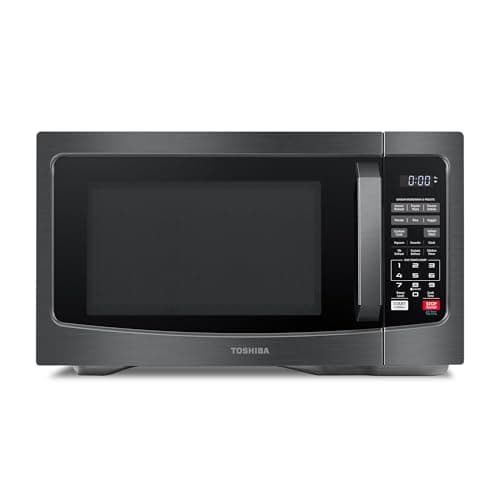
Toshiba Toshiba Countertop Microwave, 1.2 Cu Ft, 1000 W
Toshiba Countertop Microwave, 1.2 Cu Ft, 1000 W

The one most people should buy. At 1.2 cubic feet it is the smallest cavity that comfortably turns a full dinner plate — the specification that decides day-to-day happiness with a microwave — and 1,000 watts of rated output is the mainstream standard that every reheating instruction on a packet assumes.

Best overall
8.0
$133.97Amazon
02
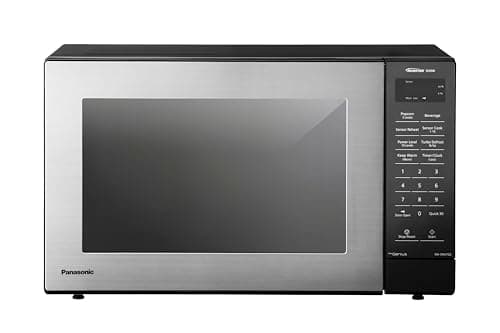
Panasonic Panasonic NN-SN67QS Inverter, 1.2 Cu Ft, 1250 W
Panasonic NN-SN67QS Inverter, 1.2 Cu Ft, 1250 W

The only genuine mechanism upgrade in the category, and the reason is checkable rather than marketing. Panasonic’s Inverter models deliver a continuous stream of reduced power instead of switching full power on and off — Panasonic’s own description is that it cooks “at 100% of the power selected, for 100% of the time required.” If you defrost, melt chocolate or reheat anything with a sauce, that is a real difference. It also costs multiples of the field.

Anyone who uses power levels below 100%
8.2
$295.57Amazon
03
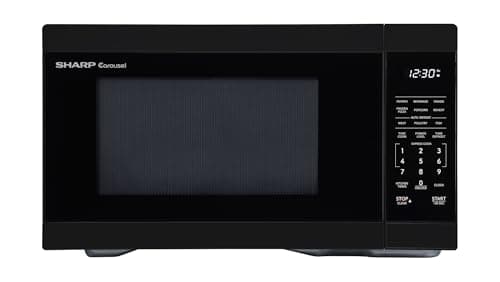
Sharp Sharp SMC1161KB Carousel, 1.1 Cu Ft, 1000 W
Sharp SMC1161KB Carousel, 1.1 Cu Ft, 1000 W

The plain, well-made middle option, and the one where the specification you actually care about is published: a 12.4-inch turntable. Cavity volume in cubic feet is a confusing proxy for what you want to know, which is whether your plate turns. Sharp tells you the diameter, which is the more useful number and one most brands leave out.

Anyone who wants the boring one that works
7.8
$119.99Amazon
04
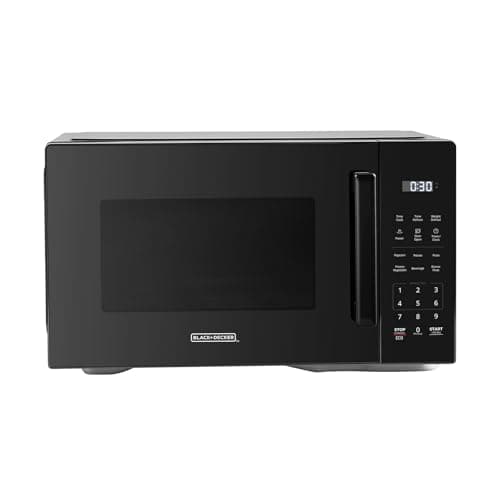
BLACK+DECKER BLACK+DECKER Countertop Microwave, 1.1 Cu Ft, 1000 W
BLACK+DECKER Countertop Microwave, 1.1 Cu Ft, 1000 W

The budget answer, and a genuinely sensible one because the thing you are giving up is fit and finish rather than function. Same 1,000 watts of output and the same cavity class as machines costing half again as much, plus a child safety lock. A microwave is a sealed box with a magnetron in it; past a point, more money buys a nicer door.

Best budget full-size
7.8
$89.98Amazon
05
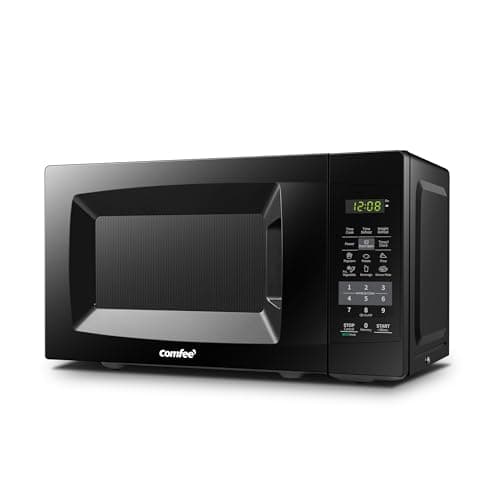
COMFEE’ COMFEE’ Countertop Microwave, 0.7 Cu Ft, 700 W
COMFEE’ Countertop Microwave, 0.7 Cu Ft, 700 W

The compact, for a dorm room, an office, an RV or a kitchen where the counter is genuinely full. Be clear about the trade: 700 watts is not 1,000 watts with a smaller box around it — everything takes about 40% longer, and every reheating instruction printed on a packet assumes the higher figure.

Small spaces, second machines, dorms and offices
6.4
$69.97Amazon

#ad · Live prices from the Amazon Product API, as of Aug 13, 2026. Where we have no verified live price, we show none — a gap beats a number that has rotted.

In detail

The picks, in full

01
Toshiba Toshiba Countertop Microwave, 1.2 Cu Ft, 1000 W

Best overall

Toshiba Countertop Microwave, 1.2 Cu Ft, 1000 W

1.2 cu ft cavity1,000 W rated outputTurntableCountertop
8.0/10

The one most people should buy. At 1.2 cubic feet it is the smallest cavity that comfortably turns a full dinner plate — the specification that decides day-to-day happiness with a microwave — and 1,000 watts of rated output is the mainstream standard that every reheating instruction on a packet assumes.

Usable cavity
9
Power control
6
Output power
8
Controls
8
Value
9

Pros

  • 1.2 cu ft turns a standard dinner plate without catching on the walls
  • 1,000 W output matches the times printed on frozen food packaging
  • Big, legible controls rather than a wall of tiny presets
  • Sits in the price band where microwaves stop getting meaningfully better

Cons

  • Reduced power levels are produced by cycling full power on and off
  • 1.2 cu ft externally is still a large object on a small counter
  • No inverter, so delicate reheating is less even than the Panasonic

Don't buy this if…

your counter genuinely cannot spare the width — the 0.7 cu ft compact below is half the machine, and honest about it.

$133.97View on Amazon

$148.9910% off

Price as of Aug 13, 2026. Prices change — Amazon's at checkout is the one that counts.

#ad · we may earn a commission from this link to Toshiba Countertop Microwave, 1.2 Cu Ft, 1000 W

02
Panasonic Panasonic NN-SN67QS Inverter, 1.2 Cu Ft, 1250 W

Anyone who uses power levels below 100%

Panasonic NN-SN67QS Inverter, 1.2 Cu Ft, 1250 W

1.2 cu ft cavity1,250 W rated outputInverter power controlGenius Sensor
8.2/10

The only genuine mechanism upgrade in the category, and the reason is checkable rather than marketing. Panasonic’s Inverter models deliver a continuous stream of reduced power instead of switching full power on and off — Panasonic’s own description is that it cooks “at 100% of the power selected, for 100% of the time required.” If you defrost, melt chocolate or reheat anything with a sauce, that is a real difference. It also costs multiples of the field.

Usable cavity
9
Power control
10
Output power
9
Controls
8
Value
5

Pros

  • Linear power control — 50% means half power, not full power flickering
  • Noticeably better at defrosting and at anything with dairy or sauce in it
  • 1,250 W output is above the mainstream, so full-power reheats are quicker
  • Panasonic publishes how the technology works instead of naming it and stopping

Cons

  • Costs two to three times what a capable 1,000 W machine costs
  • The advantage disappears entirely if you only ever press ‘start’ at full power
  • Sensor cooking is a humidity sensor, not intelligence — it guesses, well

Don't buy this if…

you use your microwave for reheating leftovers at full power and nothing else — you will never touch the feature you paid for.

This is the one pick on the page that rewards reading the mechanism. Every other microwave here makes “50% power” by running the magnetron at full output for a few seconds, then off for a few seconds, repeatedly — which is why the edges of a defrosting chicken breast start cooking while the middle is still frozen. An inverter varies the actual power delivered. Whether that is worth the price gap comes down to one question: do you ever press a power-level button? If the honest answer is no, buy the Toshiba.

$295.57View on Amazon

Price as of Aug 13, 2026. Prices change — Amazon's at checkout is the one that counts.

#ad · we may earn a commission from this link to Panasonic NN-SN67QS Inverter, 1.2 Cu Ft, 1250 W

03
Sharp Sharp SMC1161KB Carousel, 1.1 Cu Ft, 1000 W

Anyone who wants the boring one that works

Sharp SMC1161KB Carousel, 1.1 Cu Ft, 1000 W

1.1 cu ft cavity1,000 W rated output12.4 in turntableCarousel
7.8/10

The plain, well-made middle option, and the one where the specification you actually care about is published: a 12.4-inch turntable. Cavity volume in cubic feet is a confusing proxy for what you want to know, which is whether your plate turns. Sharp tells you the diameter, which is the more useful number and one most brands leave out.

Usable cavity
8
Power control
6
Output power
8
Controls
9
Value
8

Pros

  • Publishes the turntable diameter — 12.4 in — rather than only cubic feet
  • 1,000 W output, which is what packet instructions assume
  • Straightforward keypad without a screen full of presets
  • Dishwasher-safe glass turntable

Cons

  • Reduced power is duty-cycled like almost everything except the Panasonic
  • 1.1 cu ft is slightly tighter than the 1.2 machines for large plates
  • Nothing here that the cheaper BLACK+DECKER does not also do

Don't buy this if…

price is the deciding factor — the budget pick below has the same cavity class and the same output for meaningfully less.

$119.99View on Amazon

$149.9920% off

Price as of Aug 13, 2026. Prices change — Amazon's at checkout is the one that counts.

#ad · we may earn a commission from this link to Sharp SMC1161KB Carousel, 1.1 Cu Ft, 1000 W

04
BLACK+DECKER BLACK+DECKER Countertop Microwave, 1.1 Cu Ft, 1000 W

Best budget full-size

BLACK+DECKER Countertop Microwave, 1.1 Cu Ft, 1000 W

1.1 cu ft cavity1,000 W rated outputChild safety lockTurntable
7.8/10

The budget answer, and a genuinely sensible one because the thing you are giving up is fit and finish rather than function. Same 1,000 watts of output and the same cavity class as machines costing half again as much, plus a child safety lock. A microwave is a sealed box with a magnetron in it; past a point, more money buys a nicer door.

Usable cavity
8
Power control
6
Output power
8
Controls
7
Value
10

Pros

  • 1,000 W output at the price other brands charge for 700 W compacts
  • Child safety lock, which is not universal at this money
  • Full-size cavity, so it is not a compromise on the specification that matters
  • Cheap enough that its short repair life stops being an argument

Cons

  • Plastic control panel and door feel exactly like the price
  • Duty-cycled power levels, like the rest of the field
  • Least likely of these to still be running in eight years

Don't buy this if…

you want the machine to be a fixture — spend up to the Sharp or Toshiba, which feel built to be looked at daily.

$89.98View on Amazon

$109.9918% off

Price as of Aug 13, 2026. Prices change — Amazon's at checkout is the one that counts.

#ad · we may earn a commission from this link to BLACK+DECKER Countertop Microwave, 1.1 Cu Ft, 1000 W

05
COMFEE’ COMFEE’ Countertop Microwave, 0.7 Cu Ft, 700 W

Small spaces, second machines, dorms and offices

COMFEE’ Countertop Microwave, 0.7 Cu Ft, 700 W

0.7 cu ft cavity700 W rated outputEco modeCompact footprint
6.4/10

The compact, for a dorm room, an office, an RV or a kitchen where the counter is genuinely full. Be clear about the trade: 700 watts is not 1,000 watts with a smaller box around it — everything takes about 40% longer, and every reheating instruction printed on a packet assumes the higher figure.

Usable cavity
5
Power control
5
Output power
5
Controls
8
Value
9

Pros

  • Genuinely small — it fits where a full-size machine simply does not
  • Eco mode cuts the standby draw of a machine that is idle 23 hours a day
  • Cheapest way to have a microwave at all
  • Light enough to move, which matters in a rental or an RV

Cons

  • 700 W means roughly 40% longer than the times on food packaging
  • A 0.7 cu ft cavity will not turn a full-size dinner plate
  • Duty-cycled power levels, and at 700 W the cycling is more noticeable

Don't buy this if…

this is your only microwave and you reheat dinner plates — measure your plate against the turntable before you buy anything this size.

$69.97View on Amazon

$80.9914% off

Price as of Aug 13, 2026. Prices change — Amazon's at checkout is the one that counts.

#ad · we may earn a commission from this link to COMFEE’ Countertop Microwave, 0.7 Cu Ft, 700 W

Cubic feet is a proxy. Turntable diameter is the answer.

Cavity volume is what gets printed, and it is a poor guide, because a microwave’s interior is not a cube and the corners are useless to you. What you actually want to know is whether your dinner plate fits on the turntable and rotates without catching the walls — because a plate that cannot turn reheats in stripes. Sharp publishes 12.4 inches for its 1.1 cu ft Carousel machines; a 0.7 cu ft compact is typically around 10 inches. Measure your largest plate before you buy. If it is 11 inches across, a 0.7 cu ft machine is not a smaller version of what you want, it is the wrong machine.

The watts on the box are output, not draw

A microwave rated at 1,000 watts is describing the cooking power it delivers into food, not what it takes from the wall — the draw is higher, because converting mains electricity into microwave energy is not free. Two practical consequences. First, the reheating times on frozen food packaging are written for 1,000 W output, which is why a 700 W compact takes roughly 40% longer and why people think their small microwave is broken. Second, a microwave is a serious electrical load, so running one on the same kitchen circuit as an air fryer and a kettle is how breakers trip — which we work through in can you plug an air fryer into an extension cord.

How your microwave makes “50% power” (and why one brand is different)

A magnetron has two states: on and off. There is no dimmer. So when you select 50% power on almost any microwave, what happens is that the magnetron runs at full output for a few seconds, switches off for a few seconds, and repeats. Averaged over a minute, that is half power. Moment to moment it is not, which is exactly why defrosting cooks the edges of the meat while the middle is still solid, and why chocolate seizes.

Panasonic’s Inverter models are the exception, and it is a mechanical difference rather than a marketing one: the power supply varies the actual output continuously instead of switching it. In Panasonic’s own words, an Inverter oven cooks “at 100% of the power selected, for 100% of the time required,” where conventional machines “repeatedly turn power off and on in order to maintain the power level.” If you only ever press start at full power, this is worth nothing to you. If you defrost, soften butter, melt chocolate or reheat anything with a cream sauce, it is the single biggest quality difference available in the category.

Sensor cooking is a humidity sensor, not intelligence

“Sensor” presets work by detecting the steam coming off the food and stopping when the rate of change says it is hot. That is genuinely useful for reheating a covered plate of leftovers and useless for anything uncovered, anything dry, or anything in a sealed container — because the mechanism depends on steam escaping. It is a fine feature to have and a bad reason to choose a machine, in the same way that a recipe library is a bad reason to choose an air fryer, which we argue in the smart air fryer roundup.

Running cost: the cheapest way to reheat anything

The arithmetic is the one we use everywhere on this site — kilowatts times hours times your rate. A microwave pulling around 1.5 kW for three minutes uses roughly 0.075 kWh, which is about 1.3 cents at the U.S. average residential rate. Reheating the same plate in an air fryer takes eight to ten minutes at a similar draw, so call it three or four cents; in a full-size oven, with fifteen minutes of preheat, it is an order of magnitude worse. That is the honest hierarchy: the microwave wins on speed and cost for reheating, the air fryer wins whenever the texture matters, and the oven wins on volume. Our running-cost calculator takes your own utility rate if you want the exact number.

The one appliance with no “buy for parts” argument

Everywhere else on this site we rank on repairability — can you still get a bowl, a basket, a sealing ring in ten years. A microwave breaks that rule, and it is important to say why rather than quietly drop the criterion. The high-voltage section of a microwave includes a capacitor that can hold a dangerous charge long after the machine is unplugged, which is why every manufacturer, without exception, tells you not to remove the outer case. In practice that makes a countertop microwave a disposable appliance: when the magnetron or the high-voltage transformer goes, the machine goes. Buy accordingly — which is a real argument for not overspending, and the reason the budget pick above scores as well as it does.

What a microwave will never do

It will never brown, crisp or dry the surface of food, because microwave energy heats water and water caps out at boiling. That is not a flaw to be engineered around; it is the mechanism. Anything that needs a dry, browned surface — chips, wings, reheated pizza, anything battered — is an air fryer or an oven job, and the numbers behind that are in air fryer vs microwave. Most kitchens end up owning both for exactly this reason, and if you only have space for one, the answer depends entirely on whether you reheat more than you cook.

How we picked

We did not lab-test this gear

Everyone in this category says they tested twenty air fryers. We have not lab-tested any of these, and we say so. What we did instead: compiled the published specifications — wattage, capacity, materials — worked out what each machine actually costs to run at the national electricity rate, read the manuals and owner reviews, and scored each one against a published rubric. The scores are judgments from documented research — not measurements we took, because we do not have a lab and we will not pretend we do. Where a number came from someone else's work, we name them in Sources.

Questions

Frequently asked

What size microwave do I need?
Measure your largest dinner plate first. A 1.1 to 1.2 cubic foot machine has a turntable around 12 inches and will turn a standard plate; a 0.7 cubic foot compact is nearer 10 inches and will not. Cubic feet is the number brands print, but turntable diameter is the number that decides whether you are happy with it.
Is an inverter microwave worth it?
Only if you use power levels below 100%. An inverter delivers reduced power continuously instead of switching full power on and off, which makes defrosting, melting and reheating saucy food markedly more even. If you press start at full power and nothing else, you will never use what you paid for — buy a good 1,000 W conventional machine instead.
Why does my 700-watt microwave take so long?
Because the reheating times printed on food packaging assume a 1,000-watt machine. At 700 watts you should expect roughly 40% longer for the same result. It is not a fault, and adding time is the correct fix — turning the power level up does nothing, since it is already at maximum.
Do I need a microwave if I have an air fryer?
They do opposite things. A microwave heats water inside the food and steams it, which is unbeatable for speed and cost but can never brown anything. An air fryer dries and browns the surface, which is why reheated pizza and chips are so much better out of one, and it takes five to ten times longer for a plate of leftovers. Most kitchens want both — see air fryer vs microwave for the numbers.
How much does it cost to run a microwave?
About 1.3 cents for a three-minute reheat at the U.S. average residential rate, assuming roughly 1.5 kW of draw. It is the cheapest way to make food hot, by a wide margin — the savings come from not heating a cavity, which is the same reason an air fryer beats a full-size oven. Our running-cost calculator takes your own rate.
Can a microwave be repaired?
Realistically, no — and you should not open one. The high-voltage capacitor inside can hold a dangerous charge long after the machine is unplugged, which is why every manufacturer tells you never to remove the outer case. That makes a countertop microwave the one appliance on this site where we do not rank on parts availability, and a good argument for not overspending on one.

Keep reading

Receipts

Sources

We do not run a testing lab, and we do not pretend to. Where a measured number came from someone else's work, we name them and link them. Where we could not verify something, we say so on the page rather than quietly leaving it out. Read our full method.