Under a hundred dollars the machine is the cheap part — the oil is the real recurring cost, and the fill volume decides it. Three picks ranked on recovery and on what each one drinks.
We earn a commission when you buy through our Amazon links, at no extra cost to you. It never changes a verdict, and we say so when the cheaper product is the better buy. How this works.
Buy the Secura Stainless-Steel Triple-Basket 4 L. It is the only machine in this bracket that publishes its whole specification — 1,700 watts at 120 V, a 4-liter removable oil tank, a 250°F to 375°F range, a 60-minute timer and three dishwasher-safe baskets — and the removable tank is what makes used oil a pour rather than a bailing job. It suits a household that fries once or twice a month and wants to choose the temperature. The budget pick is the Presto FryDaddy: the cheapest machine here that genuinely does the job, and the one whose economics actually work if you fry three times a year, because it holds four cups of oil instead of four liters. The honest caveat is that it has no thermostat at all. If you fry for a table, the Hamilton Beach Professional-Style 4.5 L holds the most oil and three baskets — and publishes neither a wattage nor a temperature range.
The reason this bracket deserves its own page is an arithmetic one that the category never prints. A deep fryer is cheap to run and expensive to feed. Thirty minutes at 1,700 watts is 0.85 kilowatt-hours, which is about 14 cents at the US average rate — and then you pour in four liters of oil, which costs many times that, every time you change it. So the specification that decides the real cost of ownership is not the price on the box and not the wattage. It is the fill volume. The three machines here hold 4 liters, 4.5 liters and four cups, and the cheapest one is cheapest twice.
What we rank these on
Watts per liter of oil. Recovery — how fast the oil climbs back to temperature after a cold load goes in — is what separates crisp food from greasy food, and nobody publishes a recovery figure. Watts divided by liters is the closest honest proxy, and it is a division this category never does. The Secura is 1,700 W across 4 L, so about 425 W per liter. The FryDaddy is 1,200 W across four cups, which is roughly 1,270 W per liter — by a wide margin the fastest-recovering machine on this page. Hamilton Beach publishes no wattage at all, so its figure is not a low number, it is an absent one.
Oil per fill, treated as a recurring cost. Four and a half liters is nearly five times what the FryDaddy needs. We publish no dollar figure for cooking oil because the price moves weekly and we are not going to pretend to a number — but the ratio is published by the makers themselves, and it is the most consequential fact on the page.
Published temperature control. The USDA's own frying guidance sits in the 350°F to 375°F band, and this entire category stops at exactly 375°F. What varies is whether you can choose at all: the Secura publishes a 250°F floor and a dial, the Hamilton Beach publishes no range, and the FryDaddy has one fixed temperature that you cannot verify.
What the oil touches, where it is published. Presto publishes a PFAS-free ceramic nonstick surface, which is a specific material claim and the only one in this bracket. Secura states a removable tank in a stainless body but does not state what the tank itself is lined with; Hamilton Beach does not publish the tank material either, though the retail listing says stainless. We report each of those exactly as it stands.
None of these machines has been tested in a lab by us. Every figure below is the manufacturer's own published specification or an absence we name, which is what how we review commits to in those words. Prices come from the live price layer with the date they were checked, and availability was verified against the price pipeline before any machine was featured.
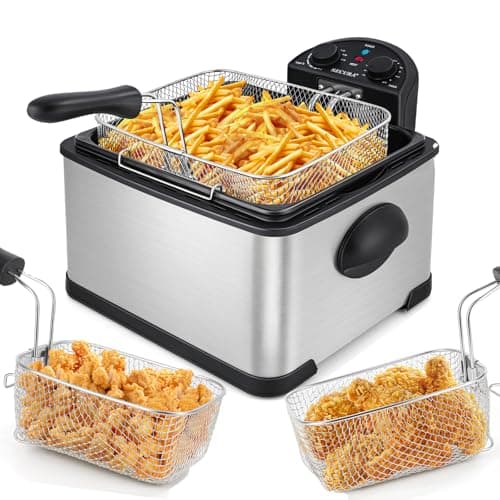
The best deep fryer under $100, and the only one here that publishes everything: 1,700 watts at 120 V, a 4-liter removable oil tank in a stainless body, a 250°F to 375°F range, a 60-minute timer and three dishwasher-safe baskets. The removable tank is the feature you feel — used oil comes out as a pour rather than a bailing job.
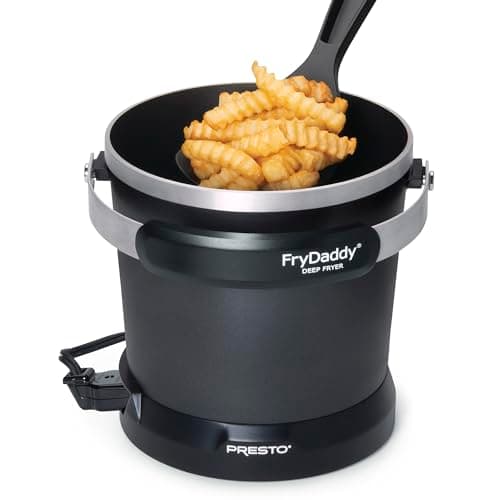
The budget pick — the cheapest machine here that genuinely does the job, and the only one whose economics work at low use. Presto publishes 1,200 watts, four cups of oil for four servings, a fixed automatic temperature, a PFAS-free ceramic nonstick surface and a snap-on lid that stores the oil in the pot. It recovers faster than anything else here and it cannot be told what temperature to use.
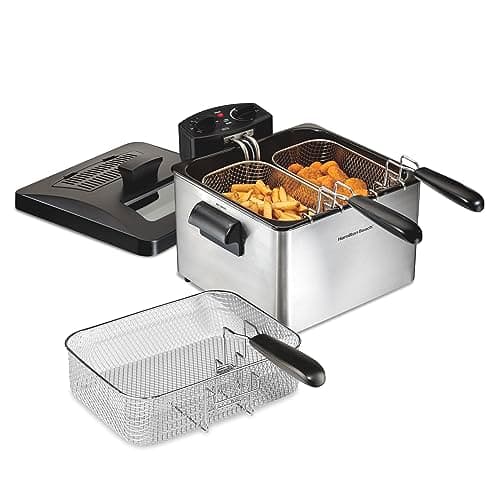
The batch machine, and the cheapest way to fry for a table rather than a plate. Hamilton Beach publishes 4.5 liters of oil — the largest fill in this bracket — a 12-cup food capacity, three baskets with two of them side by side, an immersed element, an adjustable timer and a magnetic breakaway cord. What it does not publish is a wattage or a temperature range.
#ad · Live prices from the Amazon Product API, as of November 23, 2026. Where we have no verified live price, we show none — a gap beats a number that has rotted.
In detail
The picks, in full
01
Best under $100 overall
Secura Stainless-Steel Triple-Basket Deep Fryer, 4 L (L-DF401B-T)
1,700 W / 120 V4 L / 17 cups oil250°–375°F3 dishwasher-safe baskets
7.6/10
The best deep fryer under $100, and the only one here that publishes everything: 1,700 watts at 120 V, a 4-liter removable oil tank in a stainless body, a 250°F to 375°F range, a 60-minute timer and three dishwasher-safe baskets. The removable tank is the feature you feel — used oil comes out as a pour rather than a bailing job.
Recovery (W/L)
8
Capacity
8
Control
9
Materials
7
Oil economy
6
Pros
+Publishes wattage, voltage, temperature range and dimensions — two bigger brands in this category do not
+Removable oil tank, so the pot comes out to clean and to pour
+Three baskets including a jumbo, at the lowest price of any multi-basket machine we track
+Magnetic breakaway cord and a splatter lid with a viewing window
+The smallest full-size footprint here at 15.5 by 14.5 by 9.5 inches, and nine pounds
Cons
−Secura is a far smaller brand than the rest of the category — parts in five years are a thinner proposition
−One-year limited warranty
−No filtration and no drain: the oil comes out the way it went in
−425 watts per liter is mid-pack recovery, not the fast end
−The tank is removable, but Secura does not state what the tank itself is lined with
Don't buy this if…
…you buy appliances expecting to find a replacement basket a decade from now. Brand longevity is the one argument this machine cannot win.
Ranked against the machines above this ceiling on the full deep fryer roundup, where the filtration and oil-storage machines live. On a price-ceiling page it is the clearest demonstration that the ceiling is not the constraint: the specification sheet here is more complete than the one on a machine costing three times as much.
The budget pick — the cheapest machine here that genuinely does the job, and the only one whose economics work at low use. Presto publishes 1,200 watts, four cups of oil for four servings, a fixed automatic temperature, a PFAS-free ceramic nonstick surface and a snap-on lid that stores the oil in the pot. It recovers faster than anything else here and it cannot be told what temperature to use.
Recovery (W/L)
10
Capacity
3
Control
2
Materials
8
Oil economy
10
Pros
+Four cups of oil per fill — roughly a quarter of the Secura's and a fifth of the Hamilton Beach's
+About 1,270 watts per liter, the best recovery figure on this page by a wide margin
+Presto publishes a PFAS-free ceramic nonstick surface; nothing else in this bracket makes a material claim
+The snap-on lid stores the oil in the fryer itself — no decanting, no separate container
+A scoop instead of a basket, which removes the greasiest thing to wash
Cons
−No thermostat and no display: you get one temperature and you trust it
−No timer and no thermometer, so there is no way to verify where the oil actually is
−Four servings is a genuine ceiling, and a second batch means waiting
−The surface is a coating, however benign, where the stainless machines have none
−One-year limited warranty, and Presto notes it cannot be shipped to Washington State addresses
Don't buy this if…
…you want to fry things that need different temperatures in one evening. A fixed-temperature fryer cannot be told what to do, and doughnuts and battered fish do not want the same number.
Also on the main deep fryer roundup. We name it the budget pick rather than the cheapest thing we could find for a specific reason: the cheapest fryer that still gets used beats a cheaper one that does not, and the reason deep fryers stop getting used is almost never the machine. It is the four liters of oil standing in the cupboard.
Hamilton Beach Professional-Style Deep Fryer, 4.5 L, 3 baskets (35034)
4.5 L / 19 cups oil12-cup food capacity3 baskets (1 jumbo, 2 side-by-side)Immersed element
5.8/10
The batch machine, and the cheapest way to fry for a table rather than a plate. Hamilton Beach publishes 4.5 liters of oil — the largest fill in this bracket — a 12-cup food capacity, three baskets with two of them side by side, an immersed element, an adjustable timer and a magnetic breakaway cord. What it does not publish is a wattage or a temperature range.
Recovery (W/L)
4
Capacity
10
Control
6
Materials
5
Oil economy
4
Pros
+The largest oil capacity in this bracket, and the only machine here with three baskets
+Side-by-side baskets fry two things at once without cross-loading one basket
+Immersed element plus a magnetic breakaway cord — the safety feature that matters on a full pot
+Adjustable timer with an audible tone, plus power and ready lights
+A known brand with real service depth, unlike the top pick
Cons
−Hamilton Beach publishes no wattage and no temperature range on its own product page, so recovery cannot be calculated at all
−The oil tank material is not published either; the retail listing says stainless
−4.5 liters is the most oil to buy, every single fill — the biggest recurring cost here
−Only the baskets are stated dishwasher safe, and nearly five liters is a lot of oil to pour by hand
−The biggest footprint of the three
Don't buy this if…
…you cook for one or two. Filling nearly five liters of oil to fry a single portion is the most expensive mistake in this category, and the FryDaddy above exists precisely for that kitchen.
Ranked with the whole category on the deep fryer roundup. Its position here is a direct consequence of the page's criteria rather than a judgment about the build: a machine that will not publish a wattage cannot be ranked on recovery, and the largest fill in the bracket is also the largest recurring cost.
Price as of November 23, 2026. Prices change — Amazon's at checkout is the one that counts.
#ad · we may earn a commission from this link to Hamilton Beach Professional-Style Deep Fryer, 4.5 L, 3 baskets (35034)
What the next hundred dollars buys
Three things, in order of how much they change the job. First, oil management: above this ceiling you get machines that filter the used oil and store it in a sealed container, which is the single most unpleasant part of owning a deep fryer. Second, a published 1,800-watt immersed element and a 175°F floor, which together mean faster recovery and the ability to hold oil warm between batches. Third, warranty length — three years rather than one. The full deep fryer roundup ranks those machines, and it is the page to read if the used oil is what has been putting you off.
What the next hundred dollars does not buy is better fried food. Oil at 350°F to 375°F cooks the same in a $66 stainless pot as in a $200 one, provided the oil gets back to temperature after the food goes in — which is why recovery, not price, is the column that matters.
The oil arithmetic, done properly
This is the part people discover after they buy. Oil is not a one-off purchase: it degrades with heat, with moisture from the food and with time, and the usual guidance is a handful of frying sessions per fill before it starts tasting of everything you have ever cooked. So the real cost of a deep fryer over a year is roughly the number of fills times the fill volume. Run the two extremes on this page: the Hamilton Beach needs 4.5 liters per fill and the FryDaddy needs about 0.95, so the big machine costs nearly five times as much to feed. On electricity, both are trivial — a half-hour session is well under 20 cents at the US average rate, and the running-cost calculator will do the arithmetic for any wattage you give it.
That inversion is the reason the budget pick here is not a compromise. If you fry a few times a year, the machine that holds four cups of oil will cost you less over five years than a machine someone gives you for free. It is the same shape of finding as the best electric kettles under $100, where the cheapest machine in the bracket is also the one that wins on the page's own criteria — in these categories the ceiling is rarely the thing constraining you.
Or: do not buy a deep fryer
Worth saying on a page like this one, because for most of the food people actually want, the honest answer is a different appliance. Air fryer versus deep fryer works through it in detail: an air fryer does fries, wings, nuggets and anything already breaded and frozen with no oil to buy, store or dispose of. A deep fryer wins on exactly one class of food — wet batter, which needs to be submerged to set — plus doughnuts and anything you want genuinely blistered. If beer-battered fish and tempura are not on your list, the money is better spent on an air fryer under $100.
Safety, in four lines
Fill to the line, not above it. Every machine here marks a maximum, and overfilling is how a pot boils over when wet food goes in.
Dry the food. Water in hot oil is the spitting and the boil-over, and frozen food should be shaken clear of loose ice first.
Use the breakaway cord properly. Both full-size machines here publish a magnetic breakaway; its whole purpose is that a snagged cord releases instead of pulling four liters of hot oil off the counter.
Never move a full pot. Let the oil cool to room temperature before carrying, pouring or storing it — which is the one place the FryDaddy's store-it-in-the-pot lid earns its keep.
How we picked
We did not lab-test this gear
Everyone in this category says they tested twenty air fryers. We have not lab-tested any of these, and we say so. What we did instead: compiled the published specifications — wattage, capacity, materials — worked out what each machine actually costs to run at the national electricity rate, read the manuals and owner reviews, and scored each one against a published rubric. The scores are judgments from documented research — not measurements we took, because we do not have a lab and we will not pretend we do. Where a number came from someone else's work, we name them in Sources.
Questions
Frequently asked
What is the best deep fryer under $100?+
The Secura Stainless-Steel Triple-Basket 4 L. It is the only machine in the bracket that publishes its full specification — 1,700 W, a 250°F to 375°F range, a 60-minute timer and a removable 4-liter oil tank — and the removable tank is what makes dealing with used oil tolerable.
Are cheap deep fryers any good?+
For frying, yes. Oil at 350°F to 375°F behaves the same in a cheap stainless pot as in an expensive one, as long as the oil recovers after the food goes in. What the money buys above this ceiling is oil filtration and storage, a published wattage and a longer warranty — not crisper food.
How much oil does a deep fryer need?+
In this bracket, between four cups and 4.5 liters depending on the machine — the Presto FryDaddy takes about a fifth of what the Hamilton Beach does. Oil is the real recurring cost of owning a deep fryer, so the fill volume matters more than the purchase price if you fry occasionally.
Is a deep fryer or an air fryer better?+
For wet batter, doughnuts and anything you want genuinely blistered, a deep fryer — batter has to be submerged to set. For fries, wings, nuggets and frozen breaded food, an air fryer does the job with no oil to buy or dispose of. Air fryer versus deep fryer settles it food by food.