Start with the uncomfortable part, because every honest espresso guide has to. If you buy a $500 machine and pair it with pre-ground supermarket coffee, you will make worse espresso than someone with a $150 machine and a decent burr grinder. Espresso is an extraction under pressure, and extraction is controlled by grind size far more than by the machine forcing water through it.
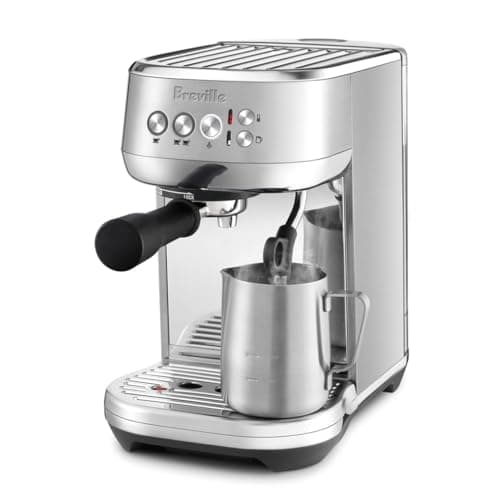
With that said, machines differ in ways that matter, and three specifications do most of the work. Temperature stability: espresso wants water in a narrow band, and machines achieve it with a thermoblock, a thermocoil with PID control or a boiler. Portafilter size: 54 mm on Breville’s home line and 58 mm on Gaggia’s commercial-style Classic, which is the size the professional accessory world is built around. And pressure behavior: 15-bar pumps are ubiquitous, but 9 bar at the puck is what actually produces good espresso, which is why the better machines advertise a 9-bar extraction rather than a 15-bar pump.
The fourth question is how much of the process you want to do. A manual machine means grinding, dosing, tamping and steaming yourself; a super-automatic grinds, doses, tamps, brews and froths at a button. Both are legitimate. Neither is a compromise if you are honest about which one you will use on a Tuesday morning.
Buy the grinder. We mean it.
Espresso extraction is controlled by how finely and how evenly the coffee is ground, because that determines how the water moves through the puck. A blade grinder produces a mix of dust and boulders and cannot make espresso. Pre-ground coffee is ground for drip and is too coarse. A burr grinder with fine, repeatable adjustment near the espresso range is not an accessory — it is half the machine.
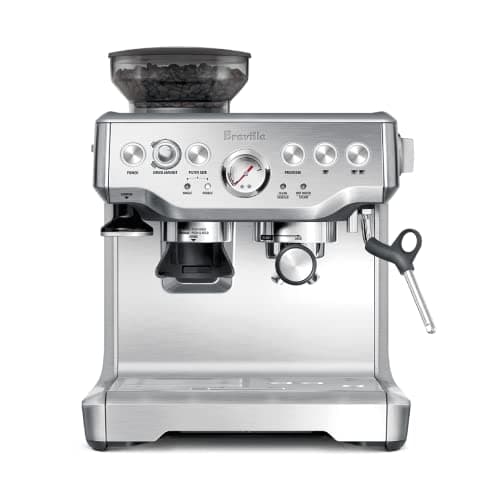
This is why the Barista Express is recommended so relentlessly: the grinder is in the box, with 16 grind settings and dose control, which removes the decision entirely. If you buy any machine without a grinder, budget for one at the same time rather than “later,” because later is when people conclude espresso machines are disappointing.
15 bar, 9 bar, and the number that matters
Almost every listing shouts 15 bar, because pumps are rated at 15. Good espresso is extracted at around 9 bar at the puck, which is why Breville describes both — a 15-bar Italian pump with a 9-bar extraction — on both machines here, and why Gaggia’s Classic line is built around 9-bar brew pressure. A machine that only advertises 15 bar and says nothing about what reaches the coffee is telling you which number it wants you to look at.
Temperature stability, and how each machine gets it
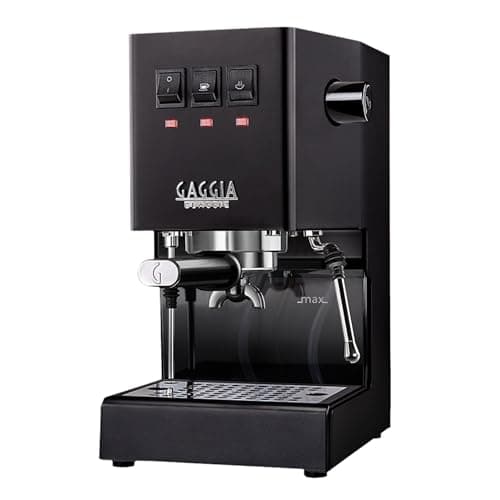
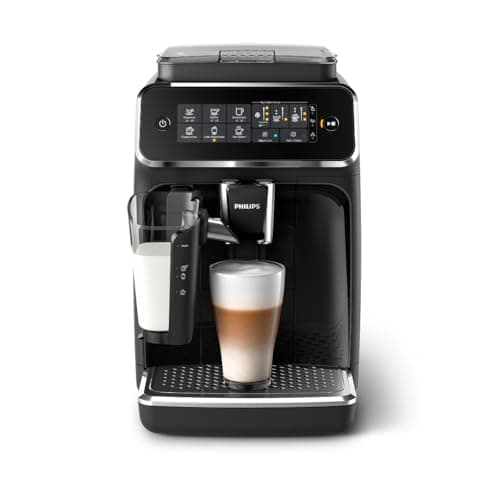
Espresso is sensitive to brew temperature. Breville’s ThermoJet gets the Bambino Plus to temperature in three seconds; its thermocoil with PID control on the Barista Express delivers water at exactly 200°F. Philips holds 194 to 208°F on its automatic. Gaggia uses a traditional single boiler, which is stable once warm and is the reason enthusiasts talk about warm-up routines. Cheaper machines use a simple thermostat, which is the real reason a $120 machine has a lower ceiling than a $500 one — not the pump.
54 mm or 58 mm
Breville’s home machines use a 54 mm portafilter; Gaggia’s Classic uses the 58 mm commercial standard. Both make excellent espresso. The difference is the ecosystem: 58 mm is what cafes use, so precision baskets, bottomless portafilters, tampers and distribution tools are abundant and cheap. If you expect to go deep, 58 mm saves you money later. If you want a good flat white and nothing more, it is irrelevant.
Manual, semi-automatic or super-automatic
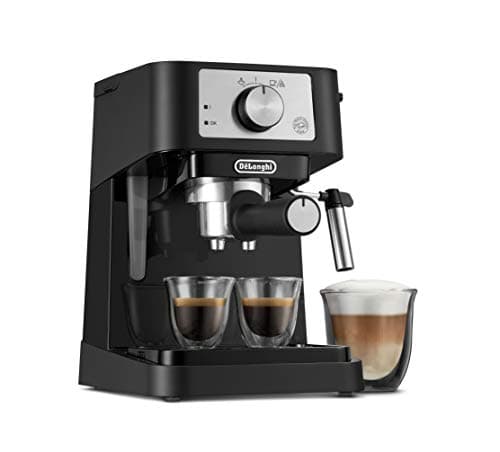
Manual/semi-automatic — Gaggia, Breville, De’Longhi here — means you grind, dose, tamp, pull and steam. Highest ceiling, most involvement, and a real learning curve.
Super-automatic — the Philips — grinds, doses, tamps, brews and froths at a button, using a ceramic grinder rated for at least 20,000 cups. Lower ceiling, vastly lower effort, and the right answer for a household where several people want a coffee and nobody wants a technique.
There is no correct answer, only an honest one about your mornings. If drip coffee is closer to what you actually drink, the machines for that are in best coffee makers, and a gooseneck kettle for pour-over is in best electric kettles.
Maintenance is the hidden running cost
Every espresso machine needs descaling, and how often depends on your water hardness. Philips defers it with an AquaClean filter — up to 5,000 cups between descales — which is a genuine convenience feature rather than a marketing one. Manual machines need backflushing with a blind basket and a cleaning detergent, plus regular group-head and portafilter cleaning. A machine that is not cleaned makes bitter coffee long before it breaks, which is the failure mode most people misdiagnose as the machine getting worse.