If you have arrived at this page from our air fryer coverage, here is the short version of why it exists. The plastic question people ask about air fryer baskets — where the food-contact parts are metal — is genuinely worth asking about kettles, where the appliance holds hot water against its own interior for minutes at a time. This is the appliance where an all-metal interior actually changes your exposure, as we set out in BPA-free air fryers.
Beyond that, kettles divide on two axes. Temperature control, which matters if you drink green or white tea or make pour-over coffee, because boiling water scalds delicate leaves and over-extracts coffee. And pour geometry: a gooseneck spout gives you a slow, controlled stream for saturating a coffee bed evenly, and a normal spout does not. Everything else — LED colors, keep-warm timers, app connectivity — is decoration.
Boil speed we deliberately do not rank on. Every kettle here is between 1,200 and 1,500 watts, and the difference across the group is well under a minute for a mug of water. If a manufacturer leads with boil time, it is because there was nothing more interesting to lead with.
What the water actually touches
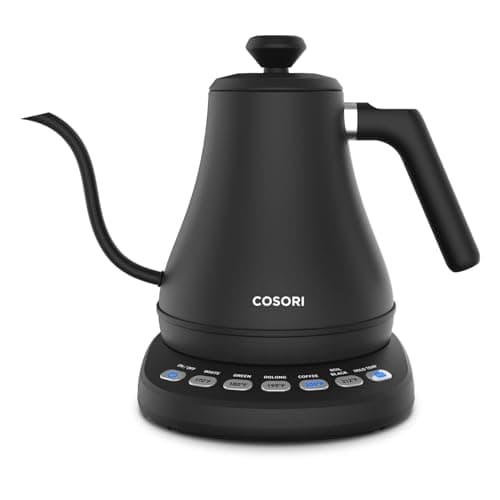
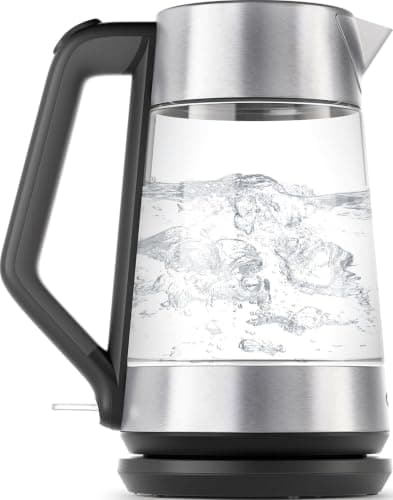
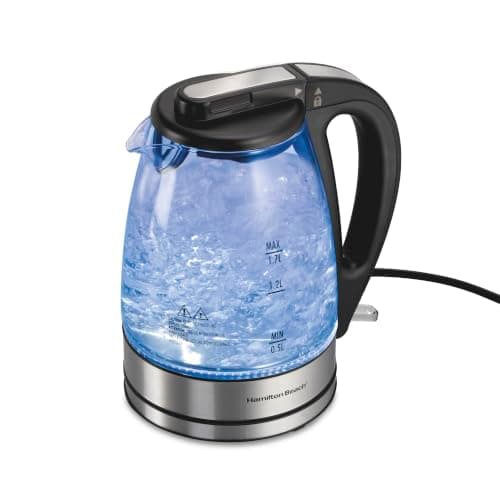
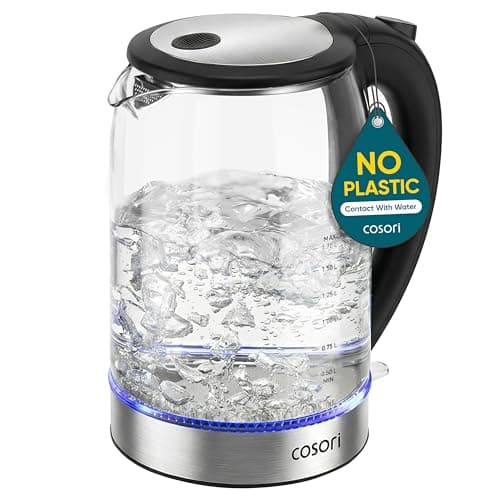
This is the specification we rank first, and almost nobody publishes it clearly. A great many kettles have a stainless exterior and a plastic interior, or a stainless body with a plastic spout, inner lid and filter — all of which sit in the water path. Cosori is unusually explicit about its all-stainless model: the spout, inner lid and filter are all 304 stainless, so no plastic part comes into contact with the water. Glass is the other answer, and OXO’s glass body delivers it at family capacity.
Is boiling water in a plastic-lined kettle dangerous? There is no regulatory finding that says so, and the FDA’s current position on BPA specifically is that it is safe at the levels that occur in food. We treat this as a preference worth honoring rather than a hazard to escape — which is exactly the line we take on coatings in are air fryers toxic. The difference is that here the swap costs almost nothing.
Temperature control: who actually needs it
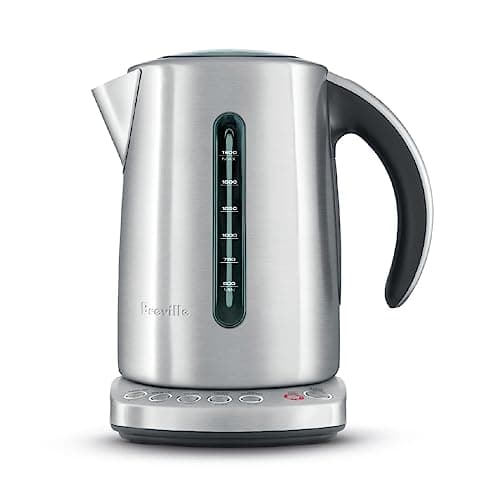
Black tea and boiling water are made for each other. Green and white teas are not — boiling water strips them and makes them bitter, which is why Breville’s presets separate black, green, white and oolong. Coffee is the other case: brewing wants water below boiling, and pour-over in particular depends on hitting a consistent temperature every time. If you drink one kind of tea and it is black, you do not need this feature and should not pay for it.
Gooseneck or ordinary spout
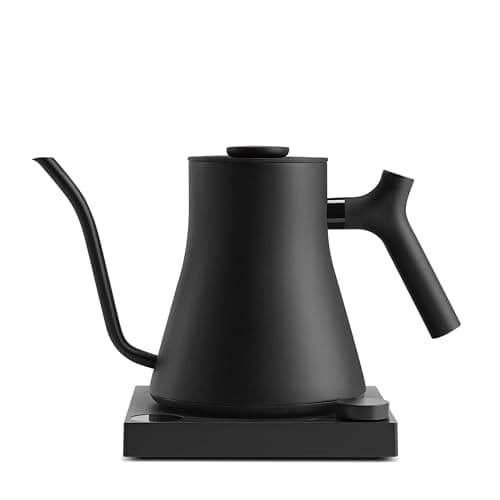
A gooseneck exists for one job: pouring a thin, slow, aimable stream over a coffee bed so the grounds saturate evenly. Fellow describes the Stagg’s precision pour spout as supporting a slow, controlled flow for even saturation, which is precisely the point. For tea, a gooseneck is slower to fill and slower to pour, and offers nothing. Buy one only if pour-over is part of your routine — and if it is, the coffee-maker side of the same decision is in best coffee makers.
Capacity, honestly
Gooseneck kettles are small on purpose — 0.8 to 0.9 liters — because you are pouring one or two brews at a time and a full liter of water is heavy to control. General-purpose kettles run 1.7 to 1.8 liters, which is a table of tea. If you want one kettle for both jobs, you are choosing which one to compromise, and our recommendation is to compromise the coffee: a fast, boring 1.7-liter kettle plus a $30 pour-over kit will beat a gooseneck used badly for tea.
Running cost and descaling
A 1,500-watt kettle boiling a full 1.7 liters for about four minutes uses roughly 0.1 kWh — under two cents at the US average residential rate. Nobody should choose a kettle on running cost. What does cost you is scale: in hard-water areas, limescale insulates the element and slowly makes the kettle less efficient and noisier. Descale it with plain white vinegar or a citric-acid product on a schedule that suits your water, and prefer a kettle whose interior you can see or reach. The arithmetic for any appliance is on what an air fryer costs to run.